Sign in. It’s quick, free and it’s up to you.
An account is an optional way to support the work we do. Find out more.
Sign in. It’s quick, free and it’s up to you.
An account is an optional way to support the work we do. Find out more.
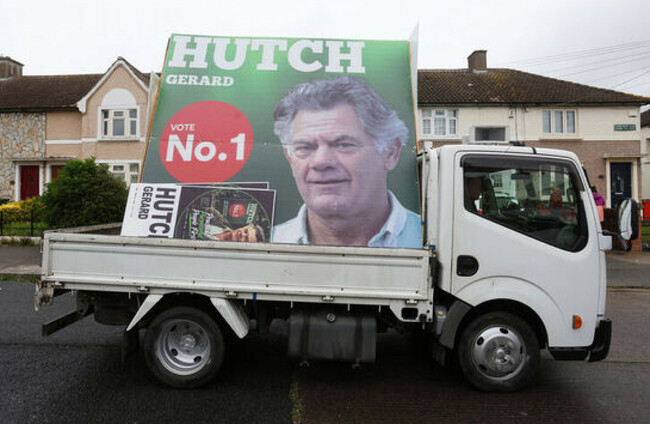

CORRECTION: An earlier version of this article today contained an incorrect interpretation of tallies around Gerry Hutch’s share of the vote in Drumcondra South A in Dublin Central. While the raw tally data was exported correctly, the formulas used to find the aggregate votes for each electoral district contained discrepancies which gave incorrect vote totals (and therefore percentages). We apologise for this error and have corrected the below article accordingly.
ONE CRITICISM AMONG other candidates in the RDS over the weekend was that the media had become so fixated on the pseudo-celebrity candidacy of Gerard Hutch – all clamouring to join him on the canvass in his working-class heartlands – that the rest were deprived of the oxygen they crave.
It’s a fair critique, and I don’t intend to spend too long here discussing him, his past or his platform. But suffice to say, I suspect even Hutch himself would be surprised to see how well he did in what are notionally some of Dublin Central’s better-off areas.
The first thing to say about the figure in the headline is that the stat only tells half the story. The same electoral district that includes the IFSC also includes some of Ireland’s most underprivileged areas, including Sheriff Street. ‘North Dock C’, as the area is wonkishly labelled by State cartographers, is very much a tale of two Irelands: the affluent one driven by professional services, and the one left behind when the revenues don’t always flow into the streets nearby.
If you crunch the numbers from the constituency as a whole from the unofficial (yet comprehensive) tallies of individual ballot boxes, the performance of Hutch – and of Malachy Steenson, whose candidacy was more overtly critical of national policy on immigration – in that specific area jumps out.
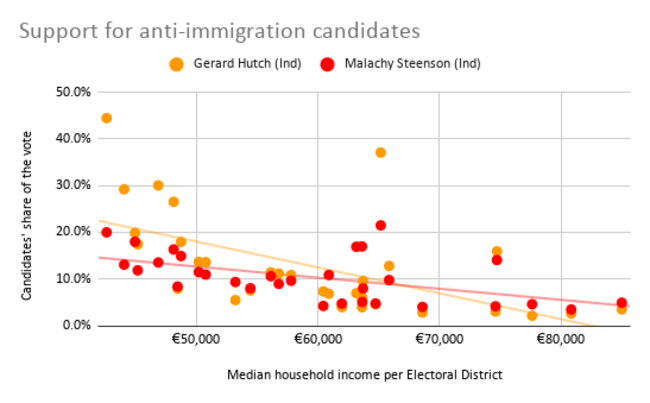
Here’s how the votes of those two men look if you place them on a chart, and organise the various districts of the constituency by ‘median household income’ – in other words, how much cash the middle-of-the-road house brings in:
The yellow dot at the left of the chart is ‘Mountjoy A’, the capital’s poorest district: the area south of Summerhill around Seán MacDermott Street Lower. The average household there has about 30% less income than the average across the constituency, and indeed across the country.
Given how immigration is often characterised as a working class concern, this high vote for Hutch (and for Steenson) fits with the orthodoxy. Especially in the midst of a cost-of-living crisis, those who need the State’s help to get by will see immigrants as competing for the same resources. That perhaps isn’t so pressing a concern for middle class voters who can largely fend for themselves – and the chart bears that out. In broad and crude terms, areas with more money seem less exercised by immigration, and are less likely to vote for a candidate who makes it a central theme of their platform.
The unusually high yellow and red dots in the middle of the graph tell a story of their own, however. It’s not that there are middle class voters in comfortable high-end apartments who are suddenly leaning in an unexpected political direction, it’s that those professionals are living in a different world to those whose homes they can see from a high-rise office window.
A deep dive into the tallies also illustrates the remarkable performance that led Daniel Ennis to such an emphatic win last Friday – and the impressive double act that the Social Democrats seem to be pulling off.
Comparing the votes earned by Ennis, and by his nearest rival Janice Boylan of Sinn Féin, suggests that actually Sinn Féin did not do quite so badly as the post-match analysis would make out. Yes, Sinn Féin may have been labelled as underperforming in this election, and McDonald objectively would have hoped her own voters would remain loyal to an alternative SF candidate – but the Sinn Féin vote still held up well enough in the working class areas.
Crucially, however, so too did the Social Democrat vote: Daniel Ennis evidently mopped up a very healthy vote in those working class districts, proving to be enough of a crucial dampener on the Sinn Féin vote in those areas. In short, the Soc Dems scored consistently well in the areas where cash is harder to come by.
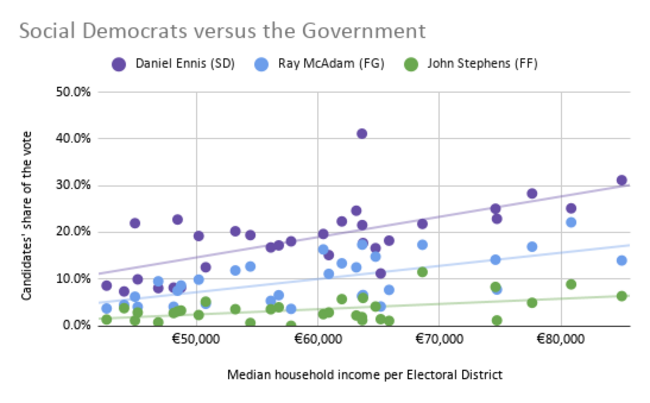
But here’s the same comparison, of Ennis’s votes versus those of the two government parties:
Seeing a spread like this is striking for a couple of reasons – firstly, it only serves to emphasise just how weak the Fianna Fáil vote was. Granted, Fianna Fáil has struggled in this constituency for a generation, without an electoral win since Bertie Ahern in 2007, but just look at the Stephens vote. His best performing area (at just 11.5%) is the southern part of Glasnevin, the area that includes the cemetery. Readers may draw their own demographic gags.
But more pertinently; it shows how the Social Democrats cleaned up in middle-class areas too. In urban areas, Fine Gael and Fianna Fáíl – increasingly to their own mutual detriment – are fishing in the same pool. Fianna Fáil’s old working class base has been ceded to the parties of the left, and now its voters are in the professional classes, the same ones that Fine Gael had cornered for years. But now, the Social Democrats are winning those areas too.
Suffice to say, a party that can beat Sinn Féin among the working classes, and comfortably outpoll the centrist/centre-right parties in the better off areas, is one building a huge movement for itself.
Going into the count, the consensus was that Daniel Ennis would be significantly more transfer friendly than Janice Boylan, and the Sinn Féin candidate would need a healthy lead on first preferences in order to withstand the charge that the Social Democrat would make as others on the centre-left were eliminated. Once it became obvious that Ennis would top the poll in his own right, it was safe to call the race (I did so after two hours, once the Cabra boxes had been reviewed).
But given how many lower preferences Ennis won too, merely leading on first preferences would never be enough. As it turns out, Boylan would have needed a 15-point lead over Ennis to withstand the purple tsunami coming her way.
In Dublin Central, at least, the SocDems have built an incredible vote-winning machine. Replicating this across the country would leave the party in tremendous shape when seats are being filled in the next Dáil. The challenge for them now is to maintain the support of both income groups, when their status as would-be governors attracts tougher scrutiny.
For the party of the former League of Ireland footballer, the senior hurling starts now.
Gavan Reilly is the Political Correspondent for Virgin Media News and the host of Monday with Gavan Reilly, which airs every Monday at 10pm on Virgin Media Play and Virgin Media One.
To embed this post, copy the code below on your site
















have your say