Sign in. It’s quick, free and it’s up to you.
An account is an optional way to support the work we do. Find out more.
Sign in. It’s quick, free and it’s up to you.
An account is an optional way to support the work we do. Find out more.
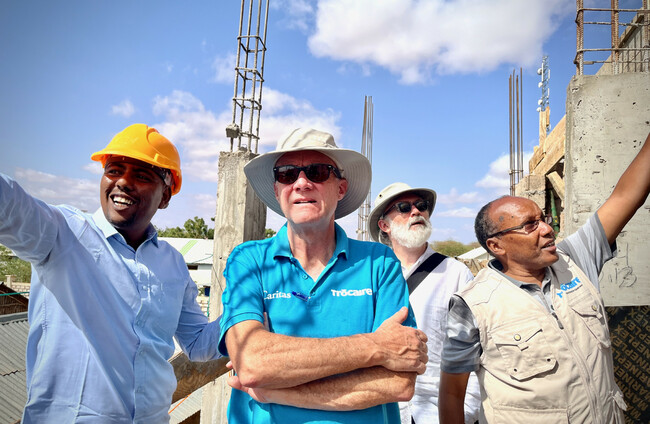

Today, World Humanitarian Day, comes at a critical moment for the humanitarian community. The system is underfunded, overstretched and under attack. Last year was the deadliest on record for humanitarian workers, with more than 380 killed. 2025 is already on track to be worse.
Paul Healy, originally from Dublin, has worked in the humanitarian sector for 28 years, the last 17 with Trócaire. Since leaving Ireland in 1997, he has served in Kenya, Afghanistan, Pakistan, India and Somalia. Due to retire at the end of this year, Paul reflects on his journey and the people who shaped it…
IN 1997, WHILE studying in Berkeley, I met Inez, an Irish nurse taking a break from her volunteer work in Kenya. At the time, I was considering taking a break from teaching to volunteer myself. Inez encouraged me to visit a home care programme for people living with HIV and AIDS in Kenya. I decided to go. And I stayed!
I was struck by the women and men in that programme — the way they managed their lives with dignity despite having no effective treatment or adequate facilities. At the time, many African communities saw HIV/AIDS as a curse upon the whole community, and countless people were left to die alone.
Irish missionaries and volunteers refused to accept that. Working with the Diocese of Kitui, they developed a groundbreaking home care programme. It gave people hope, helped them manage the terminal nature of HIV/AIDS, care for their health, avoid illness and take responsibility for themselves and their families.
One woman from that period has stayed with me. Mwende, who sold bananas in Kitui Town, was living with HIV and suffered recurring illnesses such as TB and pneumonia. Yet she displayed remarkable courage and took meticulous care of herself with the support of the programme. She is still alive today — a woman of great strength and character.
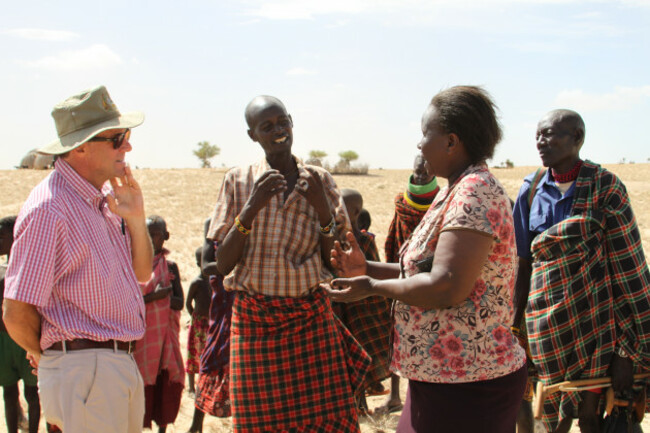
Those missionaries and volunteers shaped my early understanding of humanitarian work and of the importance of linking it to community resilience. They focused on local power, ownership and capacity — values that have shaped everything I have done since, and which are at the very heart of the way Trócaire works.
During that time, in the early naughties, Kenya was hit by severe droughts, particularly in the east of the country. Children suffered acute malnutrition and families struggled to survive. I was again inspired by how Irish missionaries – both lay and religious – helped communities find solutions. One of the most important was setting up local committees to identify the most vulnerable households in the face of a humanitarian disaster. That way, when external aid did arrive, communities already knew who needed help most. For me, that’s the essence of localisation: supporting local decision-making rather than imposing outside solutions.
I joined Trócaire in 2008, beginning work in Pakistan, India and Afghanistan. In 2010, Pakistan suffered catastrophic floods, displacing five million people. Entire communities were surrounded by water, with outbreaks of cholera and other diseases. I still wonder today how people survived — but they did.
We supported the Pakistan Fisherfolk Forum, a small group of local fishermen whose knowledge and networks proved vital in reaching isolated communities and bringing families and communities to recovery and new hope.
In eastern India, after a devastating cyclone in 1999, communities were able to imagine a future beyond the wreckage. With Trócaire’s support, they adopted a system of rice intensification (SRI), planting in a way that respected the soil, conserved water and reduced reliance on costly agricultural inputs. This approach maximised yields while protecting the environment. It remains one of the most inspiring initiatives I have seen.
In 2013, I returned to Kenya with Trócaire, working with extraordinary people in Nairobi’s informal settlements and in rural areas of Pokot, Kitui, Meru and Turkana. Communities adopted agroecology and other climate-resilient growing methods. They grew their own food, aggregating and coordinating sales at markets and added value to their produce. Our role was to allow ideas to emerge and support communities as they developed their own solutions. Women were central to this work, even in deeply patriarchal settings — a principle that continues across all our programmes today. With Trócaire, it has never been about leaving after a crisis, but about staying on, helping communities imagine and shape their own futures.
Now, since 2018, I work on our Somalia programme, where Trócaire has been present for over 30 years. We run a hugely successful health and nutrition programme that integrates water and sanitation and addresses the root causes of malnutrition. It is led by local elders and women from various clans. In one of the world’s most insecure regions, this community-led approach allows us to reach places no one else can. In often very dangerous environments, that has always been our greatest protection — working with and being accepted by local communities.
One of my most difficult recent memories is from the 2022–2024 famine. A mother arrived at our facility after a long journey with her baby. Within an hour, the baby girl had died. If we had had even one more day, we might have saved that life. It was devastating for me and for the team. But there are also moments of joy, like the severely malnourished child who, six weeks after treatment, left our hospital a smiling and healthy little boy. Knowing we made that possible is deeply rewarding.
I have been extremely fortunate to work alongside courageous, honest and determined people who refuse to see others downtrodden and who stand for the truth. My God! The talent, the commitment, and the empathy could only inspire others. It certainly inspired me to be the best that I could be. None of this work, of course, would have been possible without the generosity of the Irish public and the support of Irish Aid — support that has saved millions of lives.
As I prepare to retire, I know there are immense challenges ahead for the humanitarian sector. But I also know there are countless compassionate, committed and amazing people who will continue to care for and support their fellow human beings.
Paul Healy has worked in the humanitarian sector for 28 years, the last 17 with Trócaire. Since leaving Ireland in 1997, he has served in Kenya, Afghanistan, Pakistan, India and Somalia. Due to retire at the end of this year.
To embed this post, copy the code below on your site













have your say