Sign in. It’s quick, free and it’s up to you.
An account is an optional way to support the work we do. Find out more.
Sign in. It’s quick, free and it’s up to you.
An account is an optional way to support the work we do. Find out more.
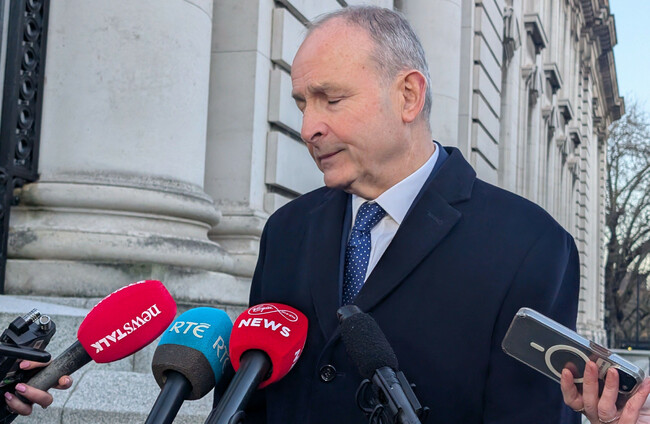

AS CHRISTMAS RAPIDLY approaches, it appears that An Taoiseach Micheál Martin will live to fight plenty more days.
He definitely has ardent critics within his parliamentary party who want him gone. They had to be hoping that the long awaited report into the process pursuant to which Jim Gavin became the Fianna Fáil standard bearer in October’s presidential election might contain a “smoking gun” or its equivalent.
Notwithstanding that the report does raise some serious questions with respect to how Gavin was chosen and precisely when the Taoiseach and his inner circle were made aware that there was an issue of a debt allegedly owed a one-time tenant by the former Dublin GAA boss, there wasn’t enough “there, there” – to use a dreadful Americanism (which the report is evidently replete with).
That said, Martin has undeniably been damaged.
While claims that his days are numbered and that he is on thin ice may be slightly overwrought, talk in the surrounds of Leinster House has turned to who will succeed him and when.
The anti-Martin forces may be frustrated that the individual labelled by virtually everyone as the next leader of Fianna Fáil – Minister for Justice Jim O’Callaghan – doesn’t seem, publicly at least, to be all that interested. Indeed, he has expressed pretty unflinching approval of the Taoiseach’s performance. There aren’t signs of “fire in the belly.” Of course, this may be all part of a grand, longer-term strategy. We shall see.
It may be an aside, yet it is an important point that this intraparty tumult that has consumed the political chattering classes for many weeks now isn’t to the fore in the minds of the broader citizenry. Micheál Martin’s personal popularity actually improved by three percentage points in a 7 December Sunday Independent/Ireland Thinks poll.
The Irish people will undoubtedly be more aggrieved by an Irish Times’ item suggesting that the current Fianna Fáil-Fine Gael Government “is one of the least productive in recent memory, measured by legislation passed in a first year,” than by a botched job of picking a nominee for a largely symbolic office.
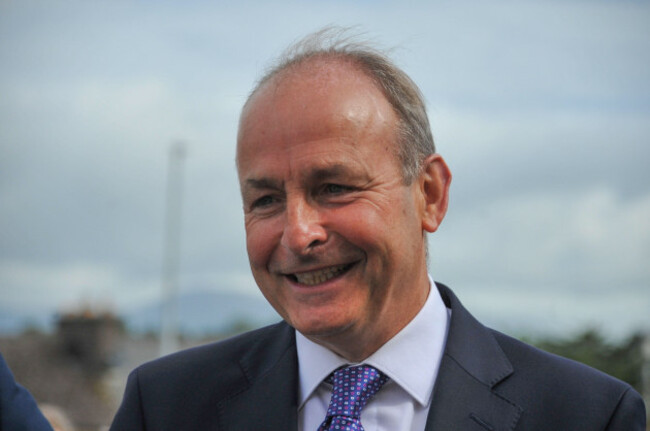
The Tánaiste and Fine Gael leader Simon Harris hasn’t had much to smile about either as of late. At one stage, the focus was on a “Harris hop,” but Fine Gael is at its lowest support level in a decade – 17% – according to the aforementioned opinion survey. Although polling conducted at such a remove from the next real test of strength should carry a health warning, it is a cause for concern.
A commission for renewal will communicate its findings and recommendations as to how to ameliorate the party’s standing in early 2026. In this milieu, it is a wise decision for Harris to take over for his departed colleague Paschal Donohoe as Minister for Finance. This ensures that he will be here, rather than traversing the planet as Minister for Foreign Affairs. With the hugely capable and widely respected Donohoe having exited national politics for a coveted position in the World Bank, the other Fine Gael ministers must step up to the plate to help fill the gap.
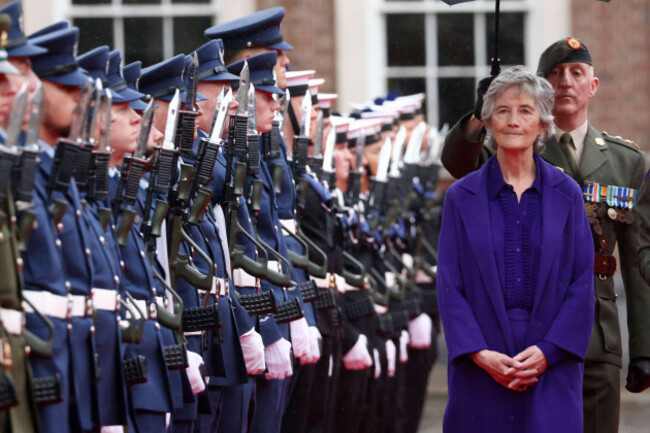
If 2025 was challenging for the centrist parties, it was promising for the left. Catherine Connolly – buoyed by the enthusiastic endorsement of progressive parties, groupings and independents, then propelled by the imprimatur of Mary Lou McDonald – comfortably prevailed in the race for the Áras. It is crucial to note that she had luck and timing with her: keepy uppies, anyone? She also benefitted from a relatively weak field of aspirants. Nonetheless, the scale of Connolly’s triumph is remarkable.
But does it portend a disruption in Irish politics in the form of greater unity on the left?
There are ample grounds for scepticism. First, it is foolhardy to extrapolate excessively from a presidential contest, especially given the unique dynamics of the campaign just concluded. Second, a recent nasty exchange between Sinn Féin and Labour in the Dáil serves to highlight the not insignificant divides both in policy and in emphasis that remain.
Third, because politics is a game of addition and Sinn Féin has the numbers, they are the lynchpin in any ad hoc or more durable coalition. Sinn Féin, owing equally to the facts that it is a political party and that it is a political party unlike most others, will do what’s best for Sinn Féin. Fourth, its putative allies are cognisant of this reality and will proceed warily. They have intertwined hesitations related to ideological purity and derived from the history of what is regarded as having used to be the IRA’s political wing.
Still, it will be fascinating to see how well the left coheres in the upcoming by-elections in Dublin Central and Galway West, which should be straight uphill battles for Fianna Fáil and Fine Gael.
Leaving aside the cut and thrust of raw politics for a minute and getting to the vexed conundrums confronting this country, those we elect in the belief that they will improve things have a lot on their agenda in the twelve months ahead.
Will there, at last, be genuine progress on the housing crisis? Are there measures, possibly in tandem with developments globally that lie beyond our control, which can be implemented to rein in the incessantly increasing cost of living? How exactly will the Government “grasp the nettle” on the complex topic of immigration?
None of these has a straightforward answer. Pessimism abounds across the spectrum as to whether they are amenable to satisfactory resolution in the near or even distant future. And all of the foregoing is without reference to the perhaps unprecedented pressure, and downright hostility in some cases, Ireland is facing from Europe and the United States for myriad reasons.
2026 is not going to be an easy year for the Government. Regardless, it can be said with a degree of certainty that Micheál Martin and Simon Harris will be glad to see the back of 2025.
Merry Christmas to all!
Larry Donnelly is a Boston attorney, a Law Lecturer at the University of Galway and a political columnist with The Journal.
To embed this post, copy the code below on your site











have your say