Sign in. It’s quick, free and it’s up to you.
An account is an optional way to support the work we do. Find out more.
Sign in. It’s quick, free and it’s up to you.
An account is an optional way to support the work we do. Find out more.

In Politics by Numbers, broadcaster, author and spreadsheet stan Gavan Reilly takes a data deep dive into a political point of the week.
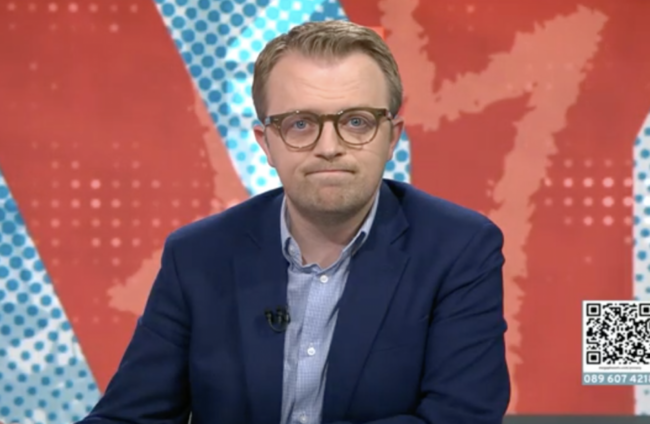
EARLIER THIS WEEK I went semi-viral on Instagram for silently making the above face on the telly.
On Monday with Gavan Reilly we’d been discussing the proposed changes to the law on attaining citizenship – whether they were fair to immigrants already here who had hoped to apply sooner; whether there was any need to replicate the average EU procedure given our dependence on migrants in the labour market; whether a civil and language competency test were reasonable impositions on someone hoping to become a legal equal.
Most sentiments were that the language requirements were reasonable: if we want Irish citizens to be full and empowered participants in society, we’d expect them to have a command of one or other of the national languages. As Aontú’s response said: if you can’t communicate, you can’t assimilate.
In closing the chat, I observed that if we’re to put this much emphasis on a citizen’s ability to communicate, I would stare awkwardly at the camera for a few seconds, as the dad of a pre-verbal seven-year-old who has never received any speech and language therapy from the public health system.
Anyone who follows the news in Ireland will see regular stories about the number of children whose wait for an Assessment of Need (AON) has exceeded the legal limit. By law, any child referred for one is supposed to have completed it within six months. As of the end of June, over 23,000 children were waiting longer than that legally stipulated time.
The government has simultaneously tried to remove the AON as a barrier for services – declaring that it’s no longer necessary to access special educational supports (though the exact new criteria are still to be clarified) – while also chipping away at the waiting list by paying €20 million this year for private assessments.
Yet the workload remains, and both the system and the law remain conclusively broken: a further 7,100 applications were made in the first half of the year, and just over 3,000 were completed. As of the end of June, the national average time to complete an AON was 24.3 months. Again, a reminder: the law stipulates that this process should be finished within six months.
There is sometimes an uncharitable view – and I use that word reluctantly, given how disability services are often carried out on the HSE’s behalf by actual charities – that parents apply for an AON because they’re looking for some secret leg up, or an educational advantage, or a quick payoff through using a diagnosis to apply for the Domiciliary Care Allowance. Surely a 24-month waiting period illustrates that this can’t really be the case: if it takes two years to get an assessment done, the child referred for it might well have started school already by the time it comes.
So why are people applying then? Most likely – as was the case in our household – because the parents are concerned that their child is missing developmental milestones and that they might have some degree of intellectual disability. In that case, they’re applying because they believe the child needs extra supports, whether educational or therapeutic, and think the AON is the best way to achieve them.
The AON is not strictly necessary to access some supports from a Children’s Disability Network Team (CDNT). But given how swamped those teams are, it’s hardly any wonder that people would rather have a diagnosis that points to the child’s legitimate needs.
This brings us to the other part of the process that rarely gets headlines: what’s supposed to happen after your child’s AON, and what actually happens in practice.
The ideal expectation of many parents is that an AON will trigger the delivery of services to address your child’s difficulties and equip them to tackle the world as best they can. This is the ideal, but rarely the outcome.
The same law that stipulates you should have an AON completed within six months of referral, also says that within three further months, the State should have outlined exactly what therapies the child would benefit from, and when (and how) these will be delivered. This is called the ‘service statement’ and is, in many ways, more important than the AON itself: the diagnosis is supposed to be the signpost for the journey, not the destination itself.
As you might have gathered, this law is rarely met too. In fact, compliance might even be worse: in the first three months of this year, while 1,528 AONs were completed, only 476 service statements were issued. In ten counties, literally not a single child received a service statement in that time. By the end of March, 18,933 statements were more than three months overdue (i.e. awaited for more than six months).
It’s a shame – though cynically understandable – that there aren’t any published figures for just how long some of those kids are waiting. My daughter’s almost three years waiting for hers. I suspect she’s not the only one, nor that her wait is anywhere close to being the longest. The staff in the CDNT in our area have effectively told us that the backlog of services has become a self-sustaining logjam: there’s such a waiting list to access the finite therapies available, that the queue will simply never meaningfully budge. (The team in our area also has the disadvantage of being run by one of the aforementioned charities; they don’t have pay parity with the HSE, so are on the back foot when it comes to hiring more therapists.)
Issuing a service statement for them has become a folly: they can’t provide the services, and it would be facetious to claim otherwise. Even though the law creates an entitlement for children, at least one team is so profoundly incapable of delivering services at any volume, it has simply even through the motions of issuing timetables for services.
The focus on AONs as the metric for a broken children’s disability sector has diverted attention from the bit that most parents are desperate for: the services they think will follow, which simply aren’t there. What good is a diagnosis, and what is the value of the State now going out of its way to pay for them privately, when there’s nothing next?
I wonder whether, in years to come, we’ll hear about immigrants whose bids for citizenship hit a brick wall because of communicative competency. Perhaps a child who came here alongside a parent on a working visa, who would become an adult and entitled to claim Irish citizenship, will find they can’t do so – not because they cannot demonstrate capacity to converse in English, but because they’re literally incapable of doing so.
If you really do need to communicate in order to assimilate, what’s the message for those already in our society who simply can’t – and who can’t even realistically hope of help?
Gavan Reilly is the Political Correspondent for Virgin Media News and the host of Monday with Gavan Reilly, which airs every Monday at 10pm on Virgin Media Play and Virgin Media One.
To embed this post, copy the code below on your site















have your say