Sign in. It’s quick, free and it’s up to you.
An account is an optional way to support the work we do. Find out more.
Sign in. It’s quick, free and it’s up to you.
An account is an optional way to support the work we do. Find out more.
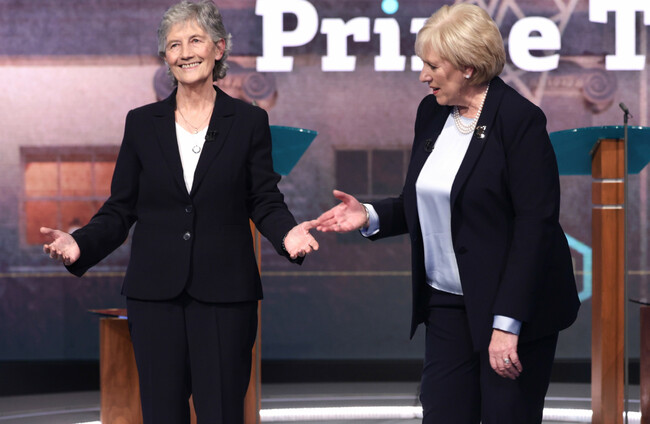
ONE BATTLE AFTER another.
By this journalist’s count, this was the seventh debate between the candidates and you may be glad to hear that it’s also the final one.
There have been plenty of other solo broadcast interviews of various lengths and formats thrown in there too but in terms of actual debates last night’s was the last one.
It’s often thought of as The Big One too.
The final debate before any election always has extra significance but, ever since The Frontline fiasco of 2011, the final RTÉ debate in a presidential election will always have some extra juice.
By that measure, the Prime Time debate between Independent Catherine Connolly and Fine Gael’s Heather Humphreys was, in all honesty, a huge disappointment from start to finish.
It was only in the final question after 70 minutes did we get to hear some semblance of difference to what we’ve heard multiple times before.
Asked if they had any regrets from their time in public life, Humphreys said that hospital restrictions for the terminally ill during Covid were too severe, depriving people of a chance to say goodbye.
“I think we could have found some way around that, and I regret that genuinely,” she said.
Connolly failed to come up with her own answer to that one, merely stating that she agreed with Humphreys and that she also regretted going along with “the government policy” of the time.
“Can I just come in to say that we followed the medical advice, but I just feel that we could have found a way to do it,” Humphreys added.
Groundhog day
Aside from that two minutes of novelty, the rest of the debate touched on the same issues that have been asked and either answered or not answered multiple times before.
Connolly’s work as a barrister, Connolly’s past comments on Europe, Humphreys’ lack of criticism of anything vaguely connected to the government, Connolly’s hiring of a gun convict, Humphreys defence of “rural pursuits” like fox hunting despite never being to a hunt.
If you’ve heard any of those issues discussed by the candidates over the past few weeks then you didn’t really miss anything from last night’s debate.
There’s a point at which a doggedness to pursue certain issues starts to look like a lack of imagination and that certainly came through here, if it hadn’t already happened during the campaign.
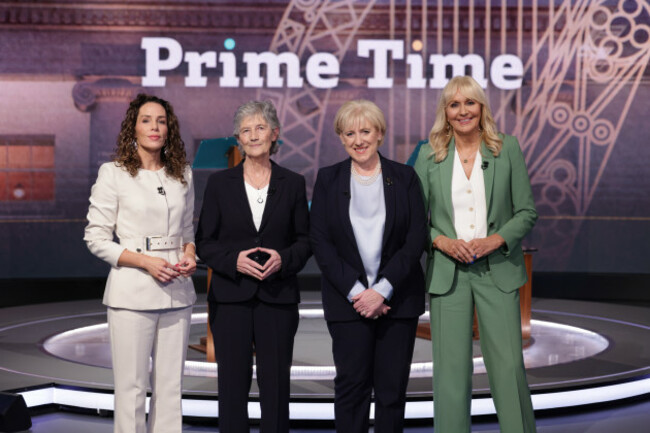
If you’re into podiums, there were four of them at least as it was the first stand-up TV debate of the campaign.
There were four women too thanks to the presence of presenters Miriam O’Callaghan and Sarah McInerney, a “historic” first said Connolly, and one that “should be recognised”.
Connolly said this just before she got into her answer to the question of “why would she be a better president?”
The most unexpected part of this answer was that she did it while speaking as if she had already been elected.
“I look forward to serving as president of this country,” Connolly said, before adding:
It will be an absolute privilege to do that.And I say to the people who are listening and watching that, I will do so with humility and with pride, and I will serve the people of Ireland to the best of my ability.
Sure, Connolly may perhaps have been just structuring her answer in a certain way, but given she is way ahead in the polls and some bookies have already paid out on her election, it sounded like a confident flex that is unusual for Irish politics.
Whether Humphreys noticed or not, she was busy gearing up to ask Connolly about whether the former barrister had worked for banks in repossession cases whilst also giving out about banks on Galway City Council.
The merry-go-round on this question turned for a while as Connolly defended the separation of powers before McInerney stepped in to bluntly ask whether she could just agree that she had..
“Yes, I represented credit institutions,” Connolly said, to which Humphreys responded: “That’s fair enough.”
Much of the debate thereafter proceeded along predictable lines, with few noteworthy moments.
When asked about whether the US was complicit in genocide in Gaza, Humphreys studiously avoided the g-word and instead pivoted to talking about the US peace efforts, shaky as they may be.
Connolly on the other hand made that connection, saying that genocide in Gaza has been “enabled and resourced by American money”.
Later in the debate, Connolly was pushed on whether as president she would use this language in a meeting with US President Donald Trump. She was less clear in that case.
“It’s a speculative question and so it will absolutely depend on what’s on the agenda for speaking. If it’s just a meet and greet, then I will meet and greet. If the if the discussion is genocide, that’s a completely different thing. But I doubt if that would be the discussion.”
Unlike the famous Frontline debate, there were no major mistakes for either candidate.
Missteps perhaps, such as when Humphreys commented on there being “a lot of foxes around” when asked about fox hunting.
“Cruelty to animals, in my book, is somewhat different to fox hunting,” she said, “there’s a lot of foxes around, as we know, and people go hunting the foxes.”.
Even then though, Humphreys position on fox hunting has come up several times before.
So where do things stand after the debate? “As you were” is probably the long and the short of it. Nobody won or nobody lost on the night.
Going by the polls, Humphreys needs a turnaround that would eclipse even Michael D’s of 14 years ago. The Fine Gael candidate may have been hoping her rival had something akin to a Seán Gallagher moment – but that failed to transpire.
There are two more days of campaigning and no moratorium anymore, so you’ll be hearing from the two of them up until Friday. At least there are no more debates.

To embed this post, copy the code below on your site










have your say