Sign in. It’s quick, free and it’s up to you.
An account is an optional way to support the work we do. Find out more.
Sign in. It’s quick, free and it’s up to you.
An account is an optional way to support the work we do. Find out more.
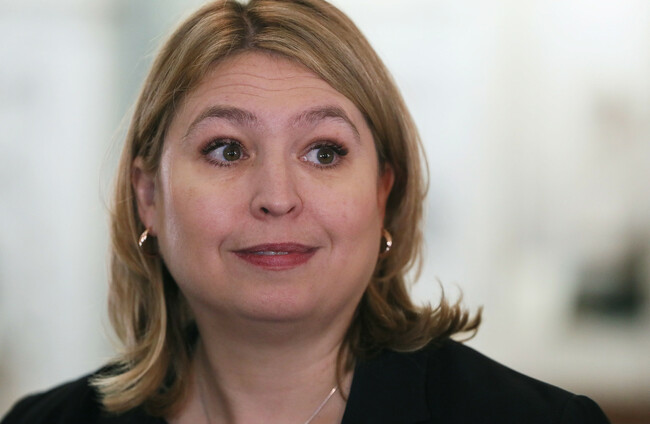
SINN FÉIN HAS issued a statement strongly criticising Northern Ireland Secretary of State Karen Bradley, after her response to a parliamentary question suggested that Irish citizens living in Northern Ireland wouldn’t be able to vote in any future referendum on a united Ireland.
Deputy leader Michelle O’Neill accused Bradley of a “staggering ignorance of the Good Friday Agreement” and said her comments are “patently ridiculous”.
Bradley had been asked by Armagh-born Labour MP for St Helens North Conor McGinn why reciprocal voting rights for Irish citizens don’t cover referendums, and what implications that would have for Irish citizens in Northern Ireland in relation to a future border poll.
“The voting rights which will continue to be enjoyed by British and Irish citizens are reciprocal,” she said.
British citizens may vote in local and parliamentary elections in Ireland but not Presidential elections or referendums. This reciprocal right is reflected in the voting rights of Irish citizens living in the United Kingdom.
However, with the Good Friday Agreement allowing people within Northern Ireland to identify themselves as Irish and be an Irish citizen, Bradley’s answer has been criticised for appearing to suggest that such citizens could not vote in a future referendum.
This is despite Irish citizens living in the North and the rest of the UK voting in the 2016 EU referendum, as well as the Good Friday Agreement referendum in 1998.
The Good Friday Agreement also contains the provision for the people on the island of Ireland alone to decide whether to bring about a united Ireland in the future.
Sinn Féin’s O’Neill said: “For Karen Bradley to suggest that Irish citizens would not be entitled to vote in a unity referendum is patently ridiculous.
It also completely ignores the fact that thousands of Irish citizens voted in the European referendum in 2016. Is she now saying that they did so illegally?
Bradley’s comments have caused a backlash from rights campaigners in Northern Ireland, but a spokesperson for the British government has said that the rules surrounding each referendum are set in legislation around that specific vote.
The spokesperson also said it’s “completely wrong” to suggest Irish citizens wouldn’t be able to vote in future UK referendums.
“In every recent referendum in the UK, Irish citizens have been able to vote,” the spokesperson added.
O’Neill, however, has said that the response by Bradley is indicative of a “wider disdain within her government for the Good Friday Agreement”.
“At every stage of the Brexit process, they have sought to undermine the Good Friday Agreement and have recently declared their intention to treat everyone in the North as British citizens,” she said.
That is entirely unacceptable. The British Government cannot and will not be allowed to redefine Irish citizenship or rewrite the Good Friday Agreement.

To embed this post, copy the code below on your site
















have your say