Sign in. It’s quick, free and it’s up to you.
An account is an optional way to support the work we do. Find out more.
Sign in. It’s quick, free and it’s up to you.
An account is an optional way to support the work we do. Find out more.
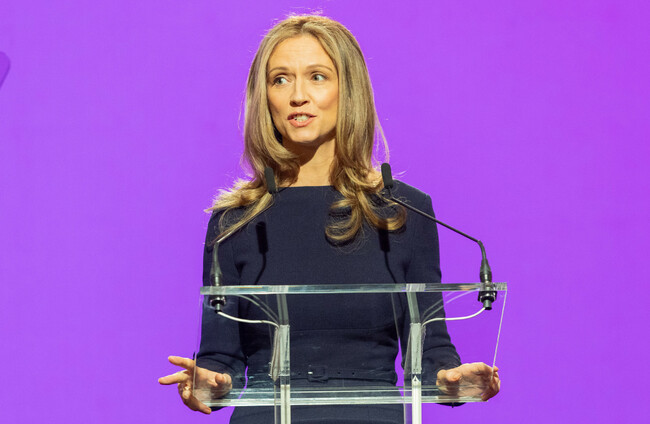
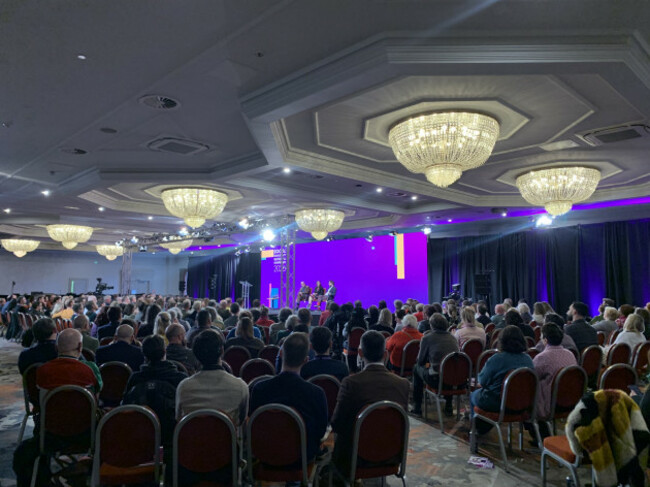
A MID-AFTERNOON SATURDAY session at the Social Democrats national conference attracted one of the largest crowds over the two-day event.
The subject matter: Irish unity.
Hosted by the party’s TD Sinead Gibney, The Irish Times’ Fintan O’Toole and The Belfast Telegraph’s Sam McBride laid it all out for the audience — the pros and cons, the economic realities, as well as what it could mean if the process of uniting the island is a botched job by governments.
Party leader Holly Cairns mentioned a united Ireland in her closing speech this weekend:
We believe a United Ireland is fast approaching, and we’re ready to work together with communities in the North to make that a reality.
Similarly, last year, Labour leader Ivana Bacik made similar comments closing out her party conference by calling out the government to set a clear timeline towards a referendum on Irish unity.
For some years now, the calls have been getting louder from the majority of opposition parties for the government to actively plan for any such eventuality.
However, the topic would always have been a big talking point at any Sinn Féin Ard Fheis. What is notable is that the issue is becoming a much bigger topic for debate at other political party events, such as the Social Democrats national conference this weekend.
Such changes are perhaps explainable due to recent polls showing that the majority of those in the Republic would support reunification, while support for Irish unity in Northern Ireland has also been on the rise.
But for the Social Democrats, with such a young demographic within the party, it is research showing that younger voters are more supportive of a united Ireland than their older counterparts which could be heeded the most.
With the Social Democrats seeing a two point boost in the latest Irish Times poll, bringing them to 7%, there’s a school of thought that the party could be eating into the Sinn Féin vote.
While Sinn Féin remains the most popular party in the country at 24% (in the same poll), it has dropped three points, leading some political thinkers speculating that perhaps the SocDems are being seen by left-leaning voters as a viable alternative to Sinn Féin.
While that is the train of thought among some, others speculate that Cairns’ party could also be eating into Fine Gael’s middle class vote.
So, perhaps the SocDems is nibbling at everyone’s lunch.
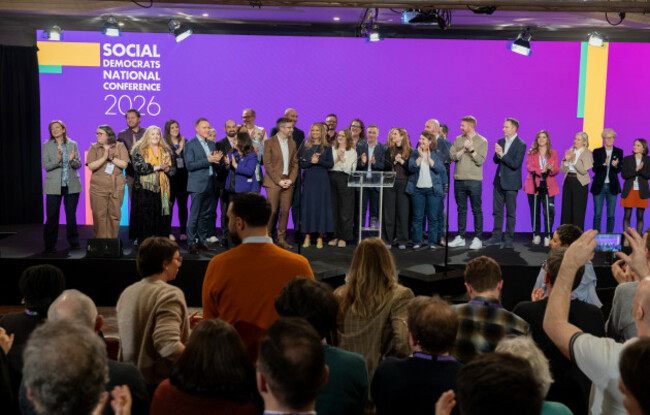
Having attended party conferences for more than ten years, what is notable about the party conference in Cork this weekend is the age of attendees.
It is by far one of the youngest crowds of any political gathering.
Sinn Féin would also attract a young crowd at its events, and while the Soc Dems might not command the same numbers as Sinn Féin, the gathering over the weekend was notable in size for a party that is just ten years old.
The founders of the party, former TDs Catherine Murphy and Róisín Shortall were in attendance this weekend (no, the other founder, former Fianna Fáiler Stephen Donnelly was not in attendance).
Ten years ago, when starting up the party, the two women could hardly have guessed that it would have a three-point lead over their nearest neighbours, the Labour Party.
Ten years ago, they also couldn’t have guessed they would have 11 TDs in the Dáil and one senator elected.
Speaking to The Journal, the party’s housing spokesperson, Rory Hearne said some of Ireland’s political parties have been around for over 100 years, while the Social Democrats are just ten years old and are doing well with 11 TDs and hitting 10% in some opinion polls of late.
“I think it’s very significant for a new party to be growing like that. And even when you look across Europe, there’s not many new parties that would have emerged kind of post austerity. Because, you know, when you look at the roots of the Social Democrats, it was kind of that sense of opposing austerity.
“We’re a movement as well as a party. And you feel that kind of energy that’s there, you look at the age profile, there’s a good mix, but there’s a lot of young people,” said Hearne.
But it hasn’t all been smooth sailing for this party, particular in the last year or so.
Two weeks after the party’s TD Eoin Hayes won his seat in the Dáil, he was dramatically suspended from the parliamentary party after he gave incorrect information to the media about when he sold shares in Israeli Defence Forces-linked company Palantir Technologies.
The suspension was lifted, but Hayes continued to keep a low profile.
Then, another controversy, when Hayes apologised after the Irish Daily Mail published photographs of him in blackface at a party in 2009. The party has also lost some members along the way.
On her first day back in front of the media after maternity leave, Cairns was forced to confront the Hayes controversy. The ordeals were an embarrassment to the party and did some damage, party insiders admitted.
Hayes has since been welcomed back into the fold, and perhaps drawing a line under those incidences, was in attendance at the conference this weekend, sitting front row with his party colleagues.
In an attempt to learn from its mistakes, the party voted on a motion this weekend to improve the party’s candidate vetting procedure. It calls on the party’s executive to “show show due regard to the party’s policies and values when selecting election candidates”.
The motion specifically mentions that a ‘risk register’ should be established and should take into account if a possible candidate “have held shares in, been employed by or served in a senior advisory or board role within any company or corporation… whose activities are demonstrably in conflict with the core values, polices and principles of the party”.
Asked about those changes and learnings for the party, Hearne said there’s no doubt the party has learned a lot of lessons in the last two years, “in terms of our experience around elections”.
“You are literally building a new political party, a political movement, from scratch. That’s what Róisín Shortall and Catherine Murphy and others have been doing. And as you grow and grow, you need to learn things that other parties have been doing, as I said, for decades and decades.
“So of course, you’re going to make mistakes, and of course, there’s going to be lessons to be learned, and that’s what we’re doing and we’re working together. I think we are really setting out and becoming professional, becoming serious, and we are serious,” he said.
Hearne said they are a party that is open about the fact that politics is difficult and politics is challenging.
“We want to encourage people to get involved in politics. We want people to believe the change is possible, and we’re all human beings at the end of the day. I think often that’s kind of missed in politics. People don’t see the people who are behind the politicians and their families and lives and I think there needs to be a recognition of that, you know, most people are just trying to do their best, and politics isn’t perfect.”

To embed this post, copy the code below on your site















have your say