Sign in. It’s quick, free and it’s up to you.
An account is an optional way to support the work we do. Find out more.
Sign in. It’s quick, free and it’s up to you.
An account is an optional way to support the work we do. Find out more.
(Seo alt ónár bhfoireann Gaeltachta. Is féidir an bunleagan as Gaeilge a léamh anseo)
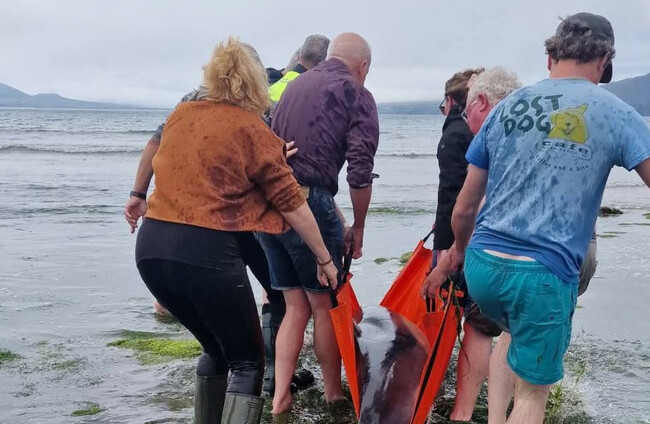
VOLUNTEERS CAME TO the rescue of dolphins stranded on a Gaeltacht beach in West Kerry on Wednesday, an official with the Irish Whale and Dolphin Group (IWDG) has confirmed.
Stephen Comerford, the IWDG’s offshore renewable energy officer, responded after the group received a call on its emergency line indicating that dolphins had been left stranded on Trá na Feothanaí in west Kerry’s Corca Dhuibhne.
The stranded animals were of the common dolphin species and are a different species to bottlenose dolphin. The common dolphin feeds in deep ocean waters while the bottlenose swims closer to shore in search of food.
“Usually I work at a desk but I give whatever help I can and, as I live in Dún Chaoin, when the call came that dolphins had come ashore at Trá na Feothanach, I rushed along with others from the group to the beach which is not far from my home,” he said.
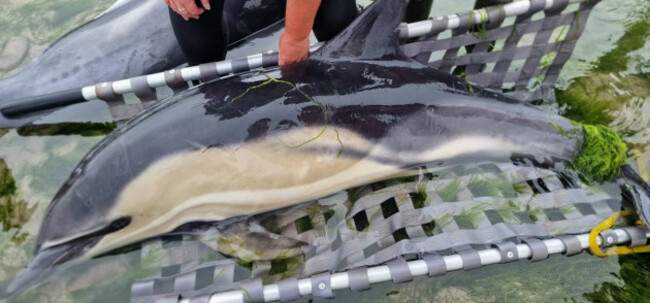
“When we arrived at the beach, there were twelve animals there, and there were five calves as well – but all the young dolphins were already dead by that point and four adult dolphins were dead, so there were eight remaining with a chance of survival.”
Comerford explained that many people were making their way to the beach by that stage – people with specific experience and equipment to help get the dolphins back out to sea.
“The most important thing in these cases is that everything remains calm and that there is no panic or shouting that would put stress on the dolphins.
“There was a lot of help, a lot of responders, some people from the community, tourists and a couple of Gardaí as well.
“Anyway, with stretchers and with effort, and a lot of strong people, we managed to get the animals – eight of them at any rate – back into the water afloat. They responded well and began swimming in the right direction out to sea.
“That doesn’t always happen – sometimes they come back around in a circle to the beach.”
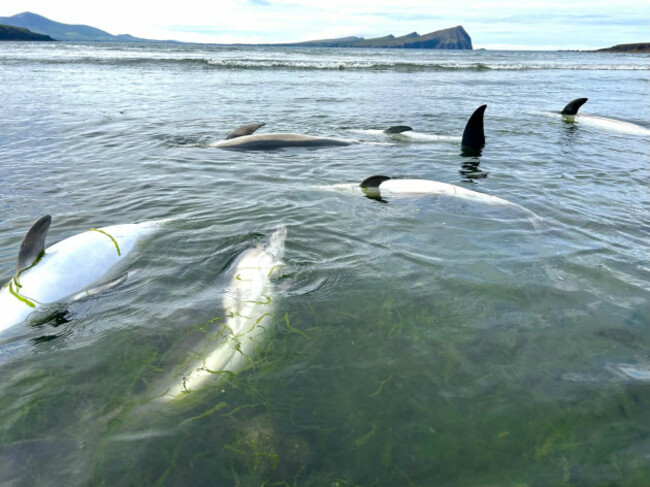
He said a number of dolphins, one adult and three calves, had already been put to sea by local man, Kevin Flannery, a marine biologist who heads up the Dingle Aquarium, who originally raised the alarm. So all told twelve dolphins were rescued.
He said people had been keeping watch on the beach since then in case they came back again, but they had not been seen since.
“These stranding events are increasing and the reason for that is that these dolphins are an oceanic species – a species that lives in the deep waters of the open sea – but for whatever reason, and we are almost certain it relates to a lack of food and climate change, they are spending more time closer to the shore.
“It is unfortunately the case, however, that they are not well adapted to swimming like this close to the coast, and what happens is that they come in looking for fish in shallow water and they are feeding away, everything is fine, and then the tide starts going out and they are trapped, caught behind a sandbank and unable to escape.
“That would never happen to a bottlenose dolphin that spends its time closer to the coast.”
Comerford praised and thanked all the people who came to help on this occasion. “This is a huge voluntary effort and people give their time in conditions that are physically difficult and, in many ways, emotionally difficult, to help these animals and they deserve all the credit.”
He gave advice to people on what should be done if they come across stranded dolphins or whales on a beach.
“Stay calm, don’t be shouting or roaring or doing anything to put additional stress on them – they are under stress as it is. Don’t let dogs near them, keep them cool and wet and keep them upright – if they lie on their side, that puts pressure on their lungs.”
He also advised against pulling them by the tail or the fin as that can dislocate bones.
He said the first thing to do if someone comes across a stranding like this on a beach is to call the group’s emergency line, 097 28118, which is always manned.
He also said the IWDG runs courses to train people in the best way to help in stranding situations.
The Journal’s Gaeltacht initiative is supported by the Local Democracy Reporting Scheme.
This article was originally written in the reporter’s native Irish and has been translated to English here. AI was used as part of the translation process before final edits.

To embed this post, copy the code below on your site















have your say