Sign in. It’s quick, free and it’s up to you.
An account is an optional way to support the work we do. Find out more.
Sign in. It’s quick, free and it’s up to you.
An account is an optional way to support the work we do. Find out more.
PHARMACEUTICAL AND CAR EXPORTS from the European Union to the United States will be subjected to a 15% tariff rate, according to a joint US-EU statement detailing the new trade deal today.
EU Commission president Ursula von der Leyen said the ceiling of 15% would provide “predictability” for companies and consumers, following months of Donald Trump’s on-and-off-again tariffs, which included threats that the tax could rise as high as 250% at one point.
EU trade commissioner Maros Sefcovic described it as a “serious, strategic deal” which affects a wide range of sectors, including strategic industries such as, pharmaceuticals, cars semiconductors and lumber.
Taoiseach Micheál Martin said he welcomed the “greater clarity and certainty” on what EU-US trade would look like.
“I welcome today’s publication of the Joint Statement on trade between the European Commission and US,” Martin said.
“It brings greater clarity and certainty to what the agreement between the EU and the US will mean in practice. This is especially important for enterprises that either import from or export to the US.”
However, Martin added that that further talks are needed to secure a “potential carve-out” for goods such as med-tech products and spirits, which will also be subject to a 15% tariff.
“Given the significance of the airline sector to Ireland, He noted that there are “specific” zero-for-zero tariffs in place for aircraft and aircraft parts, something that the Taoiseach welcomed given the “significance of the airline sector” to Ireland.
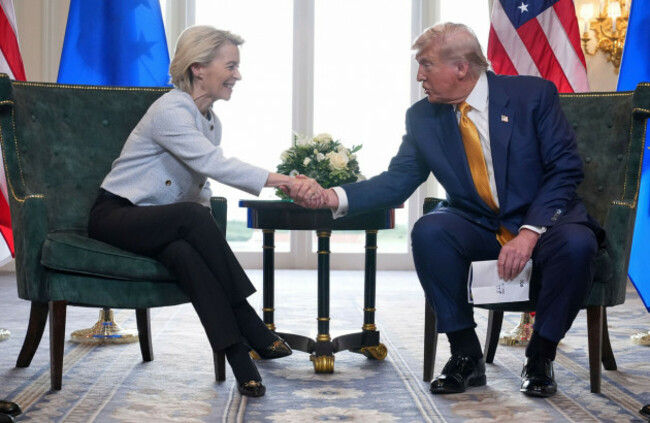
Following an agreement last month with von der Leyen at Trump’s Turnberry golf course in Scotland, a baseline US tariff of 15% was set on imports from the EU. However, this left out some sectors, including pharmaceuticals.
One of Ireland’s most lucrative sectors, it faced further uncertainty when the White House initiated investigations into the imports of pharmaceuticals under Section 232 of the Trade Expansion Act.
The purpose of a Section 232 investigation is to determine whether certain imports “threaten to impair” US national security.
Today’s agreement addresses any potential for further threats against the pharma industry will not be impacted by a Section 232 investigation, as it intends to ensure that the tariff rate “does not exceed” 15%. This also applies to semiconductors and lumber.
On this, the Taoiseach welcomed the guarantees provided in today’s agreement.
“Given the scale of the pharmaceutical and semiconductor sectors in Ireland, it is important that the Joint Statement confirms that 15% is a ceiling that will apply to EU exports in these areas in all circumstances, including when the current US Section 232 investigations are concluded,” the Fianna Fáil leader said.
Von der Leyen faced criticism from many quarters of the EU bloc after last month’s agreement, with anger expressed over how the EU had responded to Trump’s tactics.
In his own statement today, the Taoiseach credited the EU negotiating team for the latest deal. “While I have been clear all along that I do not support tariffs, this is a significant win for the EU,” Martin said.
“As I have consistently said, tariffs are bad, bad for business and bad for consumers. There is no doubt that the tariffs now imposed by the US on EU products will have a negative impact on many businesses and on consumers both in the EU and the US,” Martin added.
“But the publication of the Joint Statement does provide a degree of certainty and predictability that is so important for business and investment decisions.”
Tánaiste Simon Harris described the 15% rate as a “ceiling” for the levies and welcomed the announcement as assurance for exporters.
“This provides an important shield to Irish exporters that could have been subject to much larger tariffs pending the outcomes of Section 232 US investigations into these sectors,” he said.

To embed this post, copy the code below on your site















have your say