Sign in. It’s quick, free and it’s up to you.
An account is an optional way to support the work we do. Find out more.
Sign in. It’s quick, free and it’s up to you.
An account is an optional way to support the work we do. Find out more.
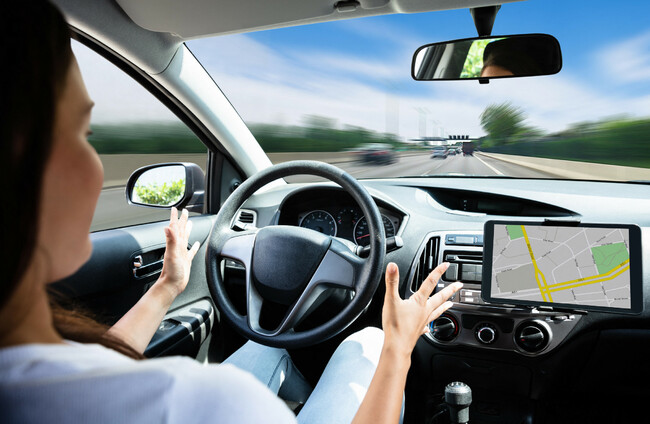
A SELF-DRIVING CARS national strategy is currently being developed by the government to allow the vehicles to be used on Irish roads.
According to Transport Minister Darragh O’Brien, the strategy is being worked on in close collaboration with multiple key stakeholders including representatives of local authorities, the Road Safety Authority, Transport Infrastructure Ireland, and the gardaí.
It was recently reported that the government is in talks with Tesla about allowing self-driving cars on Irish roads.
It’s part of the company’s efforts to roll out its high-tech vehicles to the European market.
While Level 2 systems are already used in some EU countries, Tesla’s Full Self-Driving (Supervised) car has Level 2+ software, which means the driver can remove their hands from the wheel while on the road.
In response to a parliamentary question by Fianna Fáil’s Malcolm Byrne, the minister said that in March of this year, changes to the Road Traffic and Roads Act 2023 were commenced which formally legalises the use of Level 2 vehicles on Irish public roads.
Vehicles with this software can control both steering and acceleration/braking simultaneously, but the driver is asked to continually supervise the driving.
Sean Canney, a minister of state at the Department of Transport, has supported the legislation, arguing that Ireland’s laws should “keep pace” with technological developments.
O’Brien also said his department is currently transposing an EU directive to help create an infrastructural and data sharing framework which will further facilitate the safe rollout of connected and automated vehicles.
Russell Vickers, CEO of Future Mobility Ireland, told The Journal that such technology would have to be introduced on a phased basis due to infrastructural limits.
The driver assistance software lacks the ‘intuition’ that is sometimes required on country roads. It uses sensors to find the centre line and the roadside.
“At the moment, the technology is dependent on good road conditions,” Vickers said.
“It can handle the motorway network … but then if you go down a bohereen and there’s a grass patch in the middle of the road, the vehicle might struggle to understand.”
Future Mobility Ireland creates, tests and promotes new technologies in transport.
Vickers explained that a Level 2+ vehicle is not fully autonomous.
“You can take your hands off the steering wheel and feet off the pedals, but you must keep your eyes on the road, and you must be able to take over at any time,” he explained.
It differs from Level 4 vehicles, where the driver is virtually a passenger, not having to control anything. Such software has been used by taxi companies in San Francisco, where people can pay for driverless rides. It’s geofenced, meaning it only works in some areas, where infrastructure allows.
One company, Waymo, has begun testing driverless taxis in London.
What Ireland is considering is “quite different in terms of capabilities”, Vickers says.
He explained that Level 2+ relies on the driver paying attention and being ready to jump in instantly if prompted by the vehicle.
For example, if it’s raining heavily, “it will say ‘I can’t see the way you can, so I’m going to hand it over to you’”.
It would be an adjustment for drivers, says Vickers.
“The act of having your hands on the steering wheel makes you more attentive.
“When you’re just mentally engaged, that can be more difficult.”
Vickers said that while an automated car may be convenient, safety must be the priority.
“When people buy a car today from a dealership, they don’t really get any training,” Vickers said, adding that more education is needed to ensure autonomous cars are driven responsibly.
When it comes to technological malfunctions, Vickers says in the eyes of the law, they’d be treated like any manufacturing issue.
In Level 2+ cars, drivers are filmed the whole time. There’s also a “black box” which records all actions. The information can be viewed in the event of a crash.
The Netherlands was the first EU country to approve the driver assistance software for public roads, saying it makes a “positive contribution” to road safety when used correctly.
To embed this post, copy the code below on your site














have your say