Sign in. It’s quick, free and it’s up to you.
An account is an optional way to support the work we do. Find out more.
Sign in. It’s quick, free and it’s up to you.
An account is an optional way to support the work we do. Find out more.


The Housing Essay is a weekly deep dive from a rotating variety of voices into issues impacting the property crisis in Ireland. Are there potential solutions that may be currently overlooked or traditionally ignored by policymakers?
WHY DO WE ask that? Well, we’ve seen people with physical disabilities, in need of a wheelchair, being forced to sleep on our streets. This has us wondering if this is the new normal.
The reality is, being disabled and homeless has long been normalised in Ireland; it’s just hidden from us most of the time. When a society doesn’t care about where and how its vulnerable citizens live, many end up living in horrendous conditions.
Back in 2022 the census found that 36% of the people in emergency accommodation reported a disability (although the figure could be higher due to a very low response rate). Combining this percentage, and the latest figures of 17,885 people suggests there are well over 6,000 people with a disability in emergency accommodation. A disgustingly shocking statistic in a country with €9.2 billion in tax surpluses this year.
This ‘crisis within a crisis’ is not new; it was identified way back in 2017, with calls for action again in 2019 and every year since. The fact that the government do not track the additional needs of people in emergency accommodation, on housing lists, in family refuge or direct provision reveals a systematic lack of care. This is combined with the complete lack of data on everyone in hidden homelessness, let alone those with disabilities in hidden homelessness.
Once again, the government is refusing to manage by not measuring.
A tactic that has very damaging consequences.
Simon Harris’s recent proclamation that this year’s Budget will support people “who get up early every morning and go to work” is particularly telling. What about the people for whom this is not possible? Are the Government simply saying the quiet part out loud, the only people that matter are those who financially contribute to revenue? And those who can’t do that are ruthlessly cast aside?
This is the worrying sentiment for over 1.1 million people with a disability in Ireland; that’s 22% of the population. In a country as interconnected as Ireland, this means we will all know people with a disability or we may even have a disability ourselves.
Of course, people with disabilities can have very successful and well-paying careers, but the reality is many find full or part-time work too difficult or even impossible. You only need to look at the eye-opening statistics presented on the Disability Federation of Ireland website. People with disabilities are less likely to have completed education and less likely to be employed compared to the rest of the population.
It is well documented how the housing crisis is affecting many workers. Even earning double the national average wage doesn’t guarantee that you can afford to buy or rent a home. So, how do we expect those without the ability to work to afford a home? This is especially pertinent given that so many will have significant additional costs associated with having a disability, just to survive. The ‘Eat or Heat’ campaign is a damning testament to these existential struggles faced by so many. But do we as a society even care?
In this essay series we’ve previously raised concerns that as a nation we don’t believe that everyone should have a home. Maybe this belief extends to people who struggle to complete third-level education, who struggle to hold down a job and who struggle with a disability?
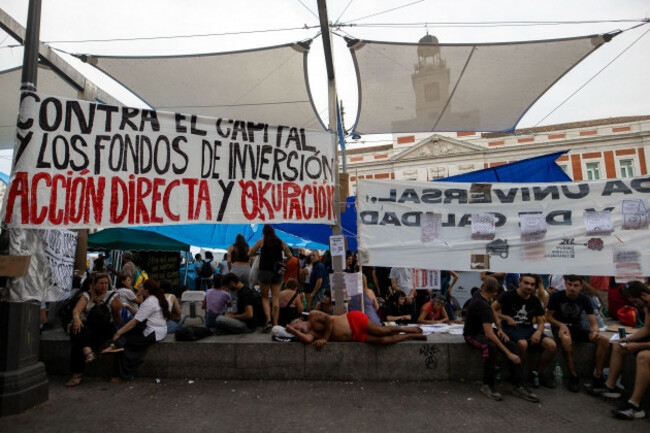
Just this weekend in Spain, 30,000 people marched through Madrid and hundreds set up tents on the city’s Puerta del Sol square, to protest the forceful eviction of an 87-year-old woman. Where were the Irish protests in June when a double amputee man and his wife in Wicklow were being evicted from their home of 20 years and were refused placement on the council housing list, despite both being pensioners.
In our recent past, institutions hid those with disabilities away from society, out of sight, out of mind. This led to a plethora of problems, many of which are still being revealed. Then, when we closed the doors to the institutions we simply left our people in need in the lurch, expecting their families, neighbours and friends to step up, with the State left off the hook.
The trauma from the mass institutionalisation of people with disabilities has not fully ended in Ireland. These rigidly controlled congregated living arrangements were meant to be phased out by 2018, but eight years later there are still 1,335 people living in locations isolated from family and friends.
A report in June found that a quarter of disabled children in State care live more than 50km away from their families (and half of these children live over 100km away). But again, this is likely to be undercounted due to failures in HSE records. Meanwhile, in 2025 it was found there were another 1,209 people under 65 living in nursing homes because they can’t get adequate home care.
With all of this, you may wonder if people with disabilities have any housing rights.
The Irish government seemed to think so, when they signed us up to the UN’s Convention on the Rights of Persons with Disabilities, which was fully adopted in 2018. This acknowledged that disabled people have a right to live independently and be included in the community.
Inexcusably, implementation of this convention is yet to materialise here, so the suffering continues.
In fact, it has taken another eight years for councils just to set housing delivery targets for people with disabilities.
The government may not have got their care referendum passed but through their inaction they have certainly got their unofficial policy of putting the responsibility of care back onto families. Whether this is on purpose or not, the consequences of substandard support services are stark.
As far back as 2019, the Independent Living Movement Ireland (ILMI), an advocacy group for the full and independent participation of people with disabilities in Irish life, stated that disabled people were facing a housing crisis for years due to “severely limited” accommodation options.
As recently as Monday, the Before We Die campaigners accused the government of being heartless with their housing policies. Heartless seems to be the right word when you consider what parents of children with disabilities have to go through. They are given no choice but to look after their child every day, every week, every month, 100% of the time on duty.
The Before We Die campaign has really brought home the realities of parents caring for children with an intellectual disability. There are thousands of parents over 70 still looking after their adult children with little to no help, all the while living in fear that when they die their children will have no care and no home. Yet shockingly only 2% have a formal state-supported housing plan in place for their children’s future.
In a society that has normalised working long hours, with a government whose priority is those “who get up early every morning and go to work”, you begin to understand the position families with disabilities are being put in, and the daily burdens they face, juggling family life around these unrealistic expectations, caring, going to work while also supporting the community.
It’s truly scandalous that the most vulnerable and their families and friends are required to protest for basic human rights. Why should they have to share their personal trauma, to become a national face of a campaign, experiencing even further suffering and trauma, just so they can get basic essential care? Otherwise, nothing changes. No doubt many people will also be afraid to speak up in case it impacts the little support they receive. You only need to consider the trauma the parents of Harvey Morrison Sherratt have been put through, constantly fighting for their child’s medical care throughout his short life and now forced to fight for answers on the State’s disgusting medical failures.
Progress to date was hard-fought for and won by disability campaigners.
It makes you wonder how protest has become a perverse way of competing for services, where protestors with disabilities are seriously disadvantaged. Take the recent fuel protestors with their massive machinery to block the roads and disrupt the economy, who can afford to buy expensive tables at political party fundraisers.
They didn’t have to protest for years unheard. In fact, they were very quickly financially rewarded for their confrontational behaviour. What hope, then, have protesters for disability rights, who only have their voices, and sometimes not even that privilege.
And lest we forget, there are alternatives to institutionalisation and to families struggling for the rest of their lives, fighting for adequate care, for adequate State support, for adequate housing.
In February there were calls for the Capital Assistance Scheme (CAS) to include funding to buy and convert existing buildings into suitable homes for people with disabilities as well as more dedicated respite housing. Which, considering the amount of empty buildings in town and city centres, combined with the billions in tax surplus, seems like a no-brainer to ensure people can stay living within their community.
Just last week Micheál Martin hinted that he would like to introduce a test on Irish values for those moving to Ireland. This reminded us of the famous saying “the true measure of any society can be found in how it treats its most vulnerable members”.
Will Micheál include the abandonment of people with disabilities as a core Irish value?
As always, we live with Dóchas that someday soon the needs of the most vulnerable people in Irish society will be prioritised through creating long-term structural changes, with readily available high-quality state support and services, all the while contributing to creating a fairer and more equitable society where everyone is welcome.
Jude Sherry and Dr Frank O’Connor are founders of anois.org, ffud.art and #DerelictIreland. They are part of a series of writers, academics and economists penning a weekly essay delving into the housing crisis and potential solutions.
To embed this post, copy the code below on your site











have your say