Sign in. It’s quick, free and it’s up to you.
An account is an optional way to support the work we do. Find out more.
Sign in. It’s quick, free and it’s up to you.
An account is an optional way to support the work we do. Find out more.
LAST UPDATE | 12 Feb 2023
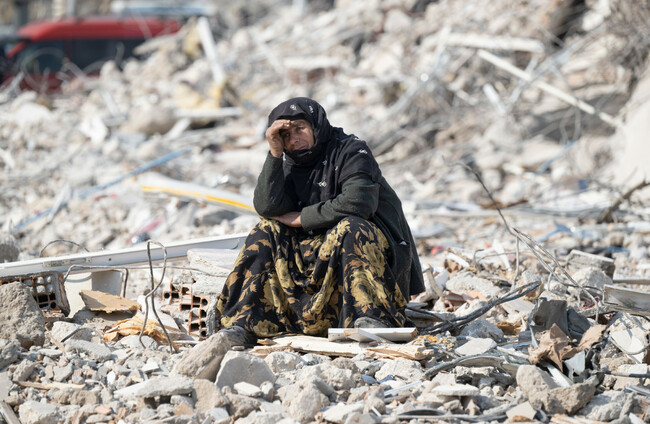
THE UN DENOUNCED today as a failure to get desperately needed aid to war-torn regions of Syria, while warning that the death toll of over 33,000 from an earthquake that also devastated Turkey could double.
A UN convoy with supplies for northwest Syria arrived via Turkey, but the agency’s relief chief Martin Griffiths said much more was needed for millions whose homes were destroyed.
“We have so far failed the people in northwest Syria. They rightly feel abandoned. Looking for international help that hasn’t arrived,” Griffiths said on Twitter.
Supplies have been slow to arrive in Syria, where years of conflict have ravaged the healthcare system, and parts of the country remain under the control of rebels battling the government of President Bashar al-Assad, which is under Western sanctions.
Derek O’Rourke, Regional Security Advisor for GOAL, told Newstalk’s On The Record that even before the earthquake, getting aid into Syria was a challenge but it is much harder now.
“So before the earthquake, getting aid into northwest Syria was always a challenge. It’s always been a challenge over the years, a challenge that we’ve become very good at managing through experience, through expertise,” O’Rourke said.
“We’ve only a couple crossings that we can use and then getting stuff across can be slow. When you factor in damages to roads, a massive breakup of supply chain infrastructure in Turkey.
“All of our fuel for northwest Syria, all of our flour for our bakeries in northwest Syria, a lot of the food we buy for communities in northwest Syria, you know, we source it in Turkey and bring it across the border.
“What was always a challenge over the last 10 years or so has become even more so now and we’re trying to get a grip of that.”
The UN convoy of ten trucks crossed into northwest Syria via the Bab al-Hawa border crossing, according to an AFP correspondent, carrying shelter kits including plastic sheeting, ropes and screws and nails, as well as blankets, mattresses and carpets.
Bab al-Hawa is the only point for international aid to reach people in rebel-held areas of Syria after nearly 12 years of civil war, after other crossings were closed under pressure from China and Russia.
Assad today thanked the United Arab Emirates for providing “huge relief and humanitarian aid” with pledges of tens of millions of dollars in aid as well.
But security concerns prompted the suspension of some rescue operations, and dozens of people have been arrested for looting or trying to defraud victims in the aftermath of the quake in Turkey, according to state media.
An Israeli emergency relief organisation said Sunday it had suspended its earthquake rescue operation in Turkey and returned home because of a “significant” security threat to its staff.
Miraculous tales of survival still emerged, though experts caution that hopes for finding people alive in the devastation dim with each passing day.
A seven-month-old baby named Hamza was rescued today in southern Hatay province more than 140 hours after the quake, while Esma Sultan, 13, was also saved in Gaziantep, state media reported.
The United Nations has warned that at least 870,000 people urgently need hot meals across Turkey and Syria. In Syria alone, up to 5.3 million people may have been made homeless.
Almost 26 million people have been affected by the earthquake, the World Health Organization (WHO) said as it appealed Saturday for $42.8 million to cope with immediate health needs after dozens of hospitals were damaged.
Turkey’s disaster agency said more than 32,000 people from Turkish organisations are working on search-and-rescue efforts, along with 8,294 international rescuers.
But, in many areas, rescue teams said they lacked sensors and other advanced search equipment, meaning they were often reduced to carefully digging through destroyed buildings with shovels or only their hands.
“If we had this kind of equipment, we would have saved hundreds of lives, if not more,” said Alaa Moubarak, head of civil defence in Jableh, northwest Syria.
Syria’s transport ministry said 62 aid planes had landed in Syria this week with more on the way in coming days, in particular from Saudi Arabia.
UN Secretary-General Antonio Guterres has urged the Security Council to authorise the opening of new cross-border aid points between Turkey and Syria, with a meeting to discuss Syria possible in the coming days.
After days of grief and anguish, anger in Turkey has been growing over the poor quality of buildings as well as the government’s response to the country’s worst disaster in nearly a century.
Officials say 12,141 buildings were either destroyed or seriously damaged in the earthquake.
Turkish police reportedly detained 12 people yesterday, including contractors, over collapsed buildings in the southeastern provinces of Gaziantep and Sanliurfa.
Officials and medics said 29,605 people had died in Turkey and 3,574 in Syria from last Monday’s 7.8-magnitude quake, bringing the confirmed total to 33,179.
Additional reporting by Tadgh McNally

To embed this post, copy the code below on your site










have your say