Sign in. It’s quick, free and it’s up to you.
An account is an optional way to support the work we do. Find out more.
Sign in. It’s quick, free and it’s up to you.
An account is an optional way to support the work we do. Find out more.
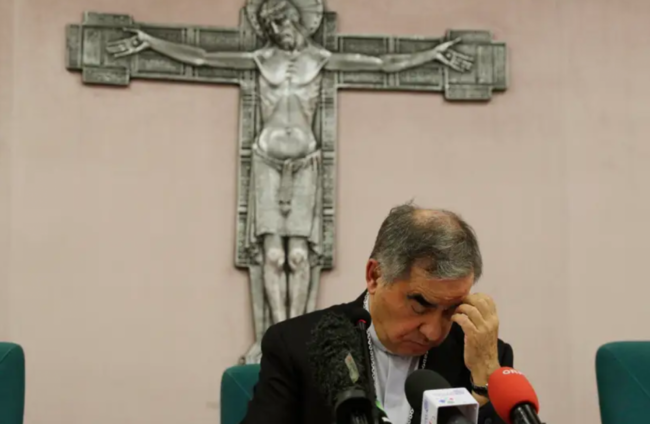
A VATICAN TRIBUNAL has convicted a cardinal of embezzlement and sentenced him to five-and-a-half years in prison.
Cardinal Angelo Becciu, the first cardinal prosecuted by the Vatican criminal court, was absolved of several other charges.
Nine other defendants received a combination of guilty verdicts and acquittals among the nearly 50 charges brought against them during a two-and-a-half-year trial.
Becciu’s lawyer, Fabio Viglione, said he respected the sentence but would appeal against it.
Prosecutor Alessandro Diddi said the outcome “showed we were correct”.
The trial focused on the Vatican secretariat of state’s €350 million investment in developing a former Harrods warehouse into luxury flats.
Prosecutors alleged Vatican monsignors and brokers fleeced the Holy See of tens of millions of euros in fees and commissions and then extorted the Holy See for €15 million euros to cede control of the building.
Becciu was accused of embezzlement-related charges in two tangents of the London deal and faced up to seven years in prison.
In the end, he was convicted of embezzlement stemming from the original investment of €200 million in a fund that bought into the London property, as well as for his €125,000 donation of Vatican money to a charity run by his brother in Sardinia.
He was also convicted of using Vatican money to pay an intelligence analyst who in turn was convicted of using the money for herself.
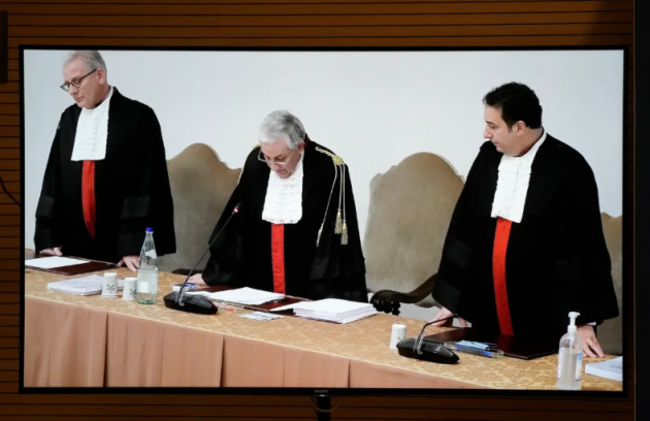
The trial had raised questions about the rule of law in the city state and Pope Francis’s power as absolute monarch, given that he wields supreme legislative, executive and judicial authority and had exercised it in ways the defence says jeopardised a fair trial.
The defence lawyers praised Judge Giuseppe Pignatone’s even-handedness and said they were able to present their arguments fully. But they lamented the Vatican’s outdated procedural norms, gave prosecutors enormous leeway to withhold evidence and otherwise pursue their investigation nearly unimpeded.
Prosecutors had sought prison terms from three to 13 years and damages of over €400 million to try to recover the estimated €200 million they say the Holy See lost in the bad deals.
In the end, the tribunal acquitted many of the suspects of many of the charges but ordered the confiscation of €166 million from them and payment of civil damages to Vatican offices of €200 million. One defendant, Becciu’s former secretary Monsignor Mauro Carlino, was acquitted entirely.
Financial reforms
The trial was initially seen as a sign of Francis’s financial reforms and willingness to crack down on alleged financial misdeeds in the Vatican. But it had something of a reputational boomerang for the Holy See, with revelations of vendettas, espionage and even ransom payments to Islamic militants.
The secretariat of state, for example, sought damages to fund a marketing campaign to try to repair the reputational harm it says it incurred. Even the Vatican communications department said the trial itself had been a “stress test” for the legal system.
Much of the London case rested on the passage of the property from one London broker to another in late 2018. Prosecutors allege the second broker, Gianluigi Torzi, hoodwinked the Vatican by manoeuvring to secure full control of the building that he relinquished only when the Vatican paid him off with €15 million.
For Vatican prosecutors, that amounted to extortion. For the defence — and a British judge who rejected Vatican requests to seize Torzi’s assets — it was a negotiated exit from a legally binding contract.
In the end, the tribunal convicted Torzi of several charges, including extortion, and sentenced him to six years in prison.
It was not clear where the suspects would serve their time. The Vatican has a jail, but Torzi’s whereabouts were not immediately known.
The original London investigation spawned two other tangents that involved the star defendant, Becciu, once one of Francis’s top advisers and himself considered a papal contender.
Prosecutors accused Becciu of embezzlement for sending €125,000 in Vatican money to a Sardinian charity run by his brother. Becciu argued that the local bishop requested the money to build a bakery to employ at-risk youths and that the money remained in the diocesan coffers.
The tribunal acknowledged the charitable ends of the donation but convicted him of embezzlement, given his brother’s role.
Becciu was also accused of paying a Sardinian woman, Cecilia Marogna, for her intelligence services. Prosecutors traced some €575,000 in wire transfers from the Vatican to a Slovenian front company owned by Marogna and said she used the money to buy luxury goods and fund vacations.
Becciu said he thought the money was going to pay a British security firm to negotiate the release of Gloria Narvaez, a Colombian nun taken hostage by Islamic militants in Mali in 2017.
He said Francis authorised up to €1 million to liberate the nun, an astonishing claim that the Vatican was willing to make ransom payment to al Qaeda-linked militants.
The tribunal found both Becciu and Marogna guilty and sentenced Marogna to three years and nine months in prison.

To embed this post, copy the code below on your site












have your say