Sign in. It’s quick, free and it’s up to you.
An account is an optional way to support the work we do. Find out more.
Sign in. It’s quick, free and it’s up to you.
An account is an optional way to support the work we do. Find out more.
A FORMER PRESIDENT of the British Archeological Association has criticised Wexford County Council for its handling of a historic part of the county town.
The comments were made after the local authority and the State planning authority gave approval for a developer to demolish houses dating to the mid 1800s in an area known as The Faythe.
Located close to Wexford Harbour near the south-east coast, The Faythe is in a historic part of Wexford town where its narrow streets crisscross eras of the last several hundred years of Irish history.
Dr Richard Gem told The Journal that it was important to see The Fayth granted special conservation status so that the area could be developed in line with the historic nature of the area.
He said it was a matter of “some surprise and concern” that the area is not included among the Architectural Conservation Areas (ACAs) designated in Wexford’s County Development Plan.
However, Gem said it was “even more extraordinary” that the nearest designated area “terminates precisely at the point where The Faythe commences – as if to suggest, quite misleadingly, that there is nothing there in the townscape or architecture worth conserving”.
“It is not difficult to see that with increasing pressures nationally to meet current housing needs by developing land behind houses, the historical and archaeological interest of The Faythe is especially vulnerable,” Gem said.
Residents fighting against the development in Wexford have criticised the decision to give approval, pointing to a planning report that warned the development would be “crammed” into the old area.
They say that the case raises legitimate questions over how older towns are developed amid the backdrop of the housing crisis.
They are now seeking to acquire protected and conservation status for the area known as The Faythe.
Two years ago, Co Wexford-based developer Bawn Developments applied for planning permission to knock three houses for a block of apartments and 11 houses, and take green space as part of the grounds for the development.
In late 2023, Wexford County Council initially granted permission despite 90 objections, but the proposals eventually ended up before An Bord Pleanála.
The approval came despite an An Bord Pleanála inspector warning it would make for a “crammed development”, while an established architecture and heritage expert has said he finds it “extraordinary” that the area is not designated with conservation status.
The council has defended the plans as much needed for the area and to address the housing crisis in the county, where over 1,500 households are on the social housing list awaiting new accommodation.

The three homes earmarked for destruction sit on the corner of the street and are approximately 150 years old. One house was previously a thatched cottage and dates back to the early 1700s.
Then, in March, Bawn was given the greenlight to go ahead and knock the homes to prepare for development.
This came after An Coimisiún Pleanála, formerly known as An Bord Pleanála, overruled its own inspector who had supported many of the community’s concerns.
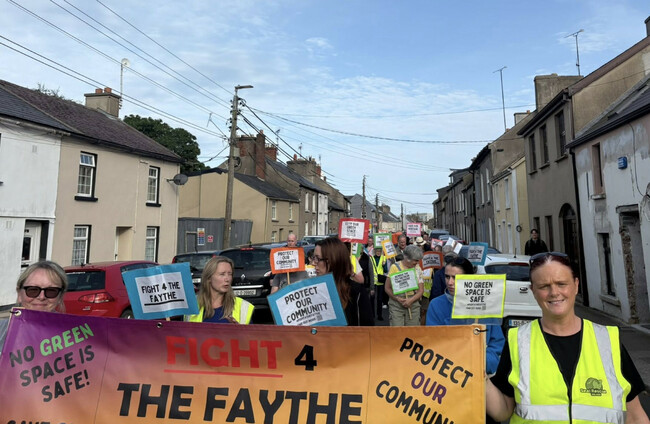
A local community group, called Fight 4 The Faythe, has been established and has been holding weekly protests and marches against the development every week since.
They have pointed to planning authorities description of the homes as habitable prior to being sold.
When speaking to The Journal, Fight 4 The Faythe founder Sue Rea said that they would continue to oppose the development and hold peaceful protests over the months to come.
“We are in a housing crisis and this has to be acknowledged,” Rea said. “However, surely town planners and those making planning decisions should be considerate of existing residents and provision of amenities.”
In her report, inspector Angela Brereton warned that the site would make for a “crammed form of development” if approved.
“It would not provide for a replacement building of exceptional quality that would have a positive impact on the visual quality and character of the area,” Brereton said in the report last November.
She added that scrapping the existing houses and replacing them with the apartments and other housing would run contrary to objectives ranging from built heritage to sustainable development.
Despite Brereton’s issues with the proposals, the planning board overruled her findings in a 2-1 vote.
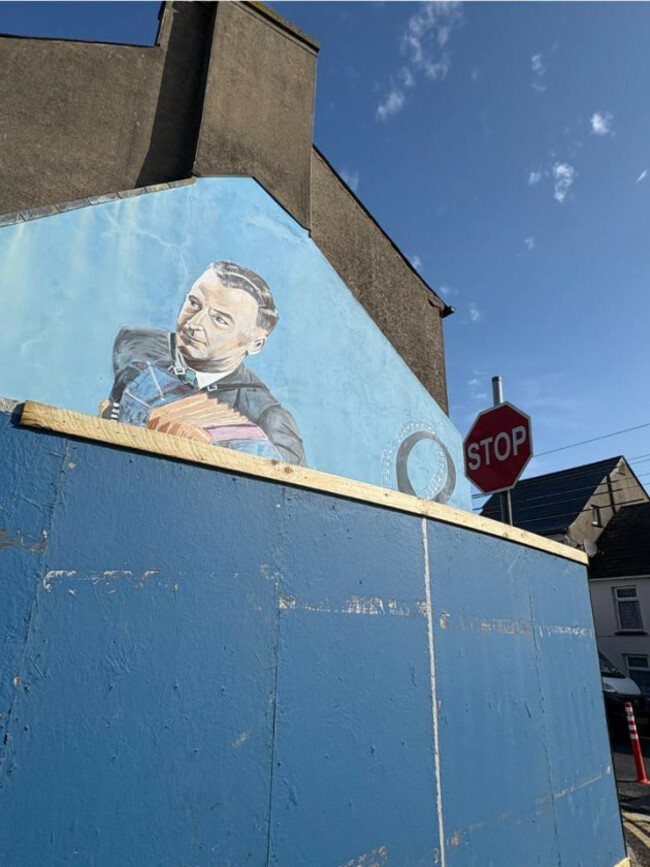
For the past seven years, the corner had been marked with a mural of a former Fleadh winner and accordion player, George Ross, who hailed from The Faythe.
That has been removed in recent weeks as the development got underway.
In its response to concerns raised, Wexford County Council said that the homes were not Protected Structures and that the mural does not have planning permission.
It added that the “contribution the mural makes to the historic streetscape is entirely subjective” for onlookers.
Wexford County Council and Bawn Developments were both contacted for comment and did not respond.

To embed this post, copy the code below on your site











have your say