We need your help now

Support from readers like you keeps The Journal open.

You are visiting us because we have something you value. Independent, unbiased news that tells the truth. Advertising revenue goes some way to support our mission, but this year it has not been enough.

If you've seen value in our reporting, please contribute what you can, so we can continue to produce accurate and meaningful journalism. For everyone who needs it.

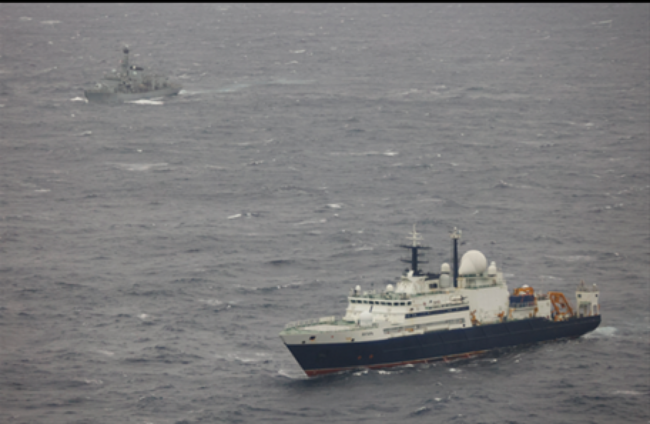
A British Ministry of Defence issued image of the Yantar as a naval ship monitors it close by. UK MOD

Why are the British and others making threats about Russian ship the Yantar?

The ship, built for subsurface work, is suspected of involvement in espionage that could pose a risk to undersea cables.

IN RECENT WEEKS Irish security services have been monitoring the movements of the Russian ship Yantar as she appeared in waters close to the massive Irish Exclusive Economic Zone (EEZ) in the North Atlantic.

The ship is specifically built for subsurface work and is suspected by Irish authorities, European and NATO analysts to be involved in espionage and is a risk to undersea cables. Russia on the other hand will say it is a research vessel.

The Yantar left her base in Kaliningrad, Russia in recent weeks and has been operating in the North Atlantic particularly. Her location on publicly available ship tracking apps is said to be purposefully wrong. 

Last November the Irish Naval Service ship LÉ James Joyce escorted the Russian vessel out of the Irish Sea after she was spotted off Dublin above critical undersea infrastructure internet cables and a pipeline bringing gas from Scotland.

Yesterday British Defence Secretary John Healey issued a stark warning to Russia and made a threat of potential military action should the vessel travel south and closer to Britain. Sources said any such action would involve a special forces boarding of the Yantar but that this would not occur. 

Sources here and abroad have said their concerns are that the capabilities of Yantar are such that she could be used to sabotage undersea cables or pipelines. 

Healey accused the Yantar of being “part of a Russian fleet designed to put and hold our undersea infrastructure and those of our allies at risk”.

It is understood that in recent weeks she was operating to the north west of Ireland, outside the Irish EEZ. An Irish Air Corps aircraft did not spot her within the EEZ but NATO forces, particularly British aircraft based in Scotland and in Iceland have been observing her. 

HMS Somerset

The recent rescue operation off the Mayo coast for a lost British Navy sailor involved several Royal Navy assets. One of those was the HMS Somerset which diverted from her operations which are understood to have involved the Yantar.

There was an incident in which a Royal Air Force P8 Poseidon maritime surveillance aircraft had a laser directed from the ship to the eyes of the pilots of the aircraft.  

The Irish navy were operating a ship in the Irish Sea at that time and was not involved in direct operations around the Yantar, it is understood. 

Sources have said that this is not the first time the Yantar or Russian ships have used lasers in incidents. It is understood that a similar incident happened off Spain and near Gibraltar involving a Russian vessel. 

The Journal has learned that reports that the vessel was making her way towards Ireland were erroneous – the ship was north of the British islands off the Scottish coast several hundreds of kilometres from the Irish EEZ.

It is understood, from security sources abroad, that the ship was closer to the Norwegian coast and after the warning from John Healey the vessel headed north towards the arctic circle.

an-image-of-the-russian-spy-ship-yantar-which-is-operating-off-the-northern-coast-of-scotland-is-shown-on-a-screen-during-defence-secretary-john-healeys-speech-on-how-the-uks-defence-industry-is-de An image of the Russian spy ship Yantar which is operating off the northern coast of Scotland. Alamy Stock Photo Alamy Stock Photo

Robust reaction

The reason why the ship is causing such a robust reaction, sources here and abroad have said, is that there is developed intelligence shared between NATO and European Union aligned forces that the Yantar is part of a broader hybrid warfare activity by Russia. 

There have been a series of incidents of sabotage and arson across Europe with governments blaming it on Russia as part of so-called Grey Zone activities. In recent days the Polish Government blamed Russia for a number of explosions on rail lines.

Grey Zone is a hybrid form of warfare which occurs when there is peacetime posturing between States – some definitions state it is often a prelude to war. It uses sabotage, cyber activities and espionage. 

There is also a series of incidents of drone swarms being detected across Europe causing issues above airbases and airports. Governments have also said that investigations are ongoing but that they suspect Russia. It is believed that some of those drones were launched from so-called Shadow Fleet cargo ships. 

The Yantar’s capabilities are such that she can use remote controlled submersibles to target deep sea infrastructure. This has been assessed because a study of the ship’s structures show that the vessel has an enclosed hanger for submersibles, deck facilities for heavy subsurface work and also has largescale communication systems and radars. 

NATO set up a dedicated maritime security centre in Northwood in Britain and this is monitoring activities by Russia and other states. Information from there is being shared across the alliance. 

Sources have said that one military analysis considered plausible is that the Putin regime is using the Yantar as a public relations piece. Much like a show of force by other navies. 

It should be understood that the Russians are not the only navy with spy ships near Irish waters. Some are engaged in direct espionage while others are monitoring sea temperatures and even salination of the water which is critical information for the work of submarines. 

These include a British spy ship which was operating in the Irish Sea in the last two weeks and The Journal recently reported on a US Navy contracted vessel in Cork Harbour involved in maintaining subsea listening posts.  

A spokesperson for Minister for Foreign Affairs Helen McEntee said the Minister was briefed today by officials from the Department of Defence as well the Chief of Staff of the Defence Forces, Lieutenant General Rossa Mulcahy.

“It is not appropriate to comment on operational decisions which may be taken around the deployment of military capabilities,” she said.

“However, the Naval Service and the Air Corps routinely carry out Maritime Defence and Security Operations in Ireland’s territorial seas and exclusive economic zone (EEZ). In addition, the Naval operations command centre in Haulbowline carries out remote monitoring 24 hours a day, seven days a week.”

Readers like you are keeping these stories free for everyone...
Our Explainer articles bring context and explanations in plain language to help make sense of complex issues. We're asking readers like you to support us so we can continue to provide helpful context to everyone, regardless of their ability to pay.

Close
JournalTv
News in 60 seconds