Sign in. It’s quick, free and it’s up to you.
An account is an optional way to support the work we do. Find out more.
Sign in. It’s quick, free and it’s up to you.
An account is an optional way to support the work we do. Find out more.
IN THIS SERIES, making a comeback for the bank holiday weekend, TheJournal.ie takes a look at an urban myth, old wives’ tale, or something that your mammy told you years ago to see if there’s any truth in it.
KEEPING BREAD IN the fridge is a controversial practice in Irish society.
While most people would stick to the traditional bread bin system, others conscious of ensuring the bread doesn’t go moldy would try the fridge.
We put the question to our readers last year, revealing that only a tiny minority engage in the latter.
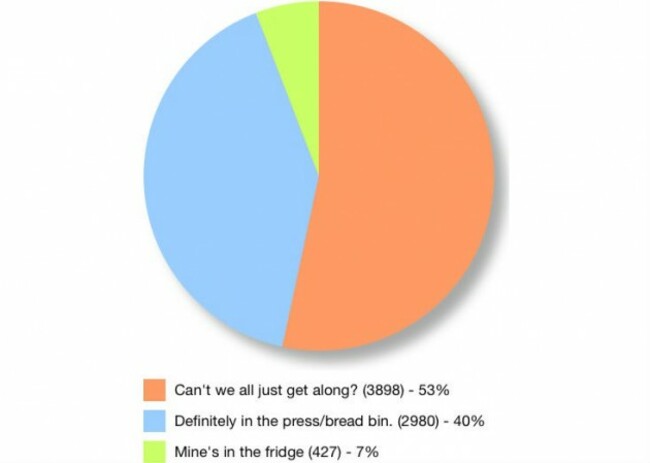
The result was striking, 7 per cent said they kept it in the fridge, although were somewhat skewed by 53 per cent of voters calling for peace between the two camps.
Bread is the single most wasted item in Irish households, so should the majority of us reconsider our bread habits to cut down on this, or will it be at the expense of taste?
We set up a highly complex, strictly-controlled experiment in which two slices of bread were placed, unwrapped, in the fridge, and same in a darkened cupboard.
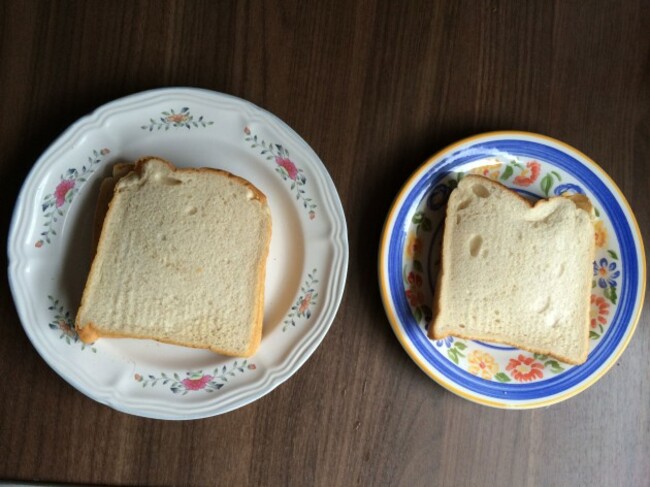
Both pairs of slices managed to survive for two weeks, and emerged virtually identical.
While both were stiff and inedible, the one in the press kept slightly better, being less difficult to snap.
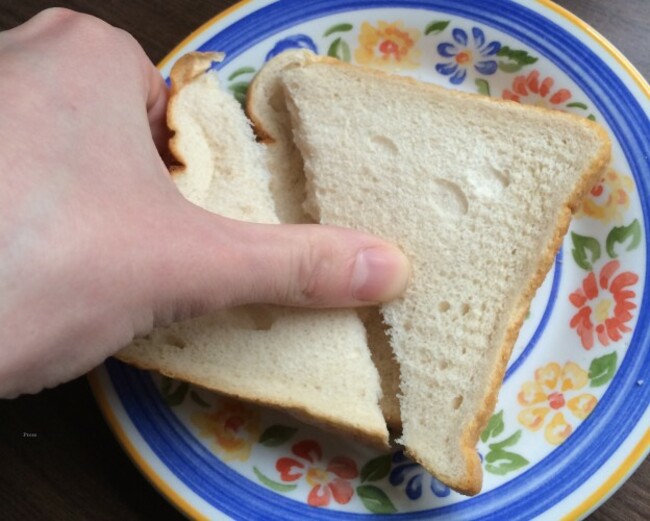
The results were inconclusive, so what’s the science behind it?
Dr Linda Gordon with Safefood explained that mould, the appearance of which generally mean the bread will be chucked in the bin, appears on foods like bread that have a low moisture content when they are exposed to a damp environment.
This is likely to occur in the plastic bag that bread is kept it, but would occur at a slower rate due to the reduced temperature in the fridge.
However, she noted that keeping bread in the fridge will make it go stale quicker than if it is kept in a bread bin.
This is due to the crystalline structure of starch changing at low temperatures.
“Storing in a bread bin is fine,” she told TheJournal.ie, “as long as it is not damp , and it’s probably best to store it in paper rather than plastic.”
However, Gordon suggested the best thing to do with bread is to freeze it, and to take out as much as you need each day, meaning that the bread is kept fresh but also that waste is minimised.
She noted that if you are unfortunate enough to have a slice of bread go mouldy, scraping it off won’t help – it’s best to just throw it out.
“The types of mould usually found on bread do not usually cause illness, although some people are allergic to mould, so it is a food quality rather than a food safety issue,” she said.
The evidence looks to be pointing towards how much bread your household eats. A lot, and the bread bin will suffice, but Gordon’s suggestion of freezing the bread is probably more suitable for reducing waste.
Is there a myth you’d like debunked? Email nicky@thejournal.ie

To embed this post, copy the code below on your site













have your say