TheJournal.ie uses cookies. By continuing to browse this site you are agreeing to our use of cookies. Click here to find out more »
Dublin: 11 °C Saturday 18 May, 2013

Census 2011: 1.77m say they are able to speak Irish

In the latest census, people were asked if they were able to speak Irish and, if so, how frequently they did.

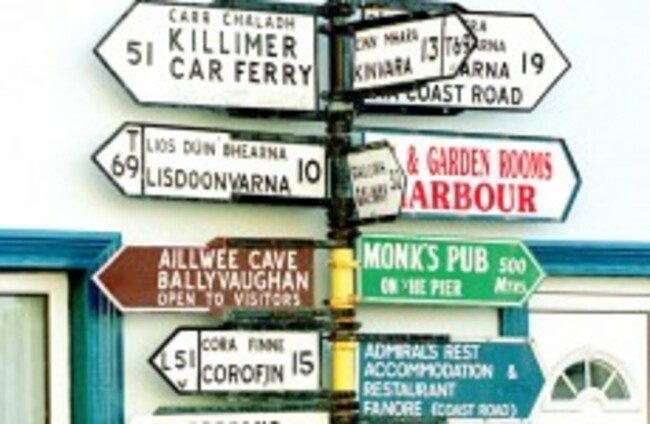
A cyclist studies his map at a junction in Ballyvaughn Co. Clare, Ireland in this May 22, 2002 file photo
Image: JOHN COGILL/AP/Press Association Images

THE NUMBER OF people who say they are able to speak the Irish language has fallen to 1.77 million, according to the results of Ireland’s most recent census.

This figures represents 41.1 per cent of respondents – a slight decrease from 41.9 in 2006.

The question was broken down into two parts: individuals were asked if they were able to speak the language and, if so, the frequency with which they did so. Almost one in three (30.8 per cent) of 10 to 19 year olds said were not able to speak Irish.

More women than men identified themselves as being able to speak Irish, with 44.9 per cent of females saying they were able to speak the language compared with just 37.9 per cent of men. These result are identical to those from 2006.

Of the 1.77 million people who said they were able to speak the language:

  • 77,185 said they speak it  daily outside the education system
  • 110,642 said they spoke it weekly
  • 613,236 said they spoke it less often than weekly
  • One in four said they never spoke Irish

The number of people speaking Irish on a daily basis, who are not in school, increased  by 5,037 persons since 2006 from 72,148 to 77,185, according to the data.

There was an increase of 7,781 people who said they speak the language on a weekly basis, while those who spoke Irish less frequently showed the largest increase of 27,139 people.

Gaeltacht areas

Of the 77,185 daily Irish speakers who were not in the education system, just over one in three lived in Gaeltacht areas.

The population of all Gaeltacht areas as of April 2011 had increased by 5.2 per cent since 2006, rising from  91,862 to 96,628. Of these, 68.5 per cent said they could speak Irish (66,238).

(NOTE: Two figures regarding the percentage of daily Irish speakers outside the education system were published in the census data: 24 per cent and 35 per cent. We are currently trying to establish which is the correct figure.)

The breakdown of daily Irish speakers between the years 2006 and 2011 in specific Gaeltachts are as follows:

Cork County: 867 daily speakers to 982 daily speakers (+115)

Donegal County: 6,956 to 7,047 (+91)

Galway County: 9,654 to 10,085 (+431)

Galway City: 571 to 636 (+65)

Kerry County: 2,394 to 2,501 (+107)

Mayo County: 1,281 to 1,172 (-109)

Meath County: 336 to 31 (-22)

Waterford County: 456 to 438 (-18)

Here are the highlights of Census 2011>

Read next:

Comments (53 Comments)

  • John 29/03/12 #

    They should have asked the question in Irish that would have given more accurate results.

    Reply
  • Here we go with the negative comments and remarks. The whole country didn’t suddenly decide to lie for one question. For people who are saying it’s not accurate- it’s the most accurate document in the country- what could possibly be more accurate

    If you think it’s bullsh*t get out of your box and go explore different parts of the country. Whenever i’m in a shop/café /restaurant I will always say “Dia Duit” or “Go raibh maith Agat” and you’d be surprised by the amount of people who can speak it.

    There’s around 6,700 spoken languages in the world. It may surprise you to learn that Irish is in the top 300 languages used in the world. It’s in the top 100 languages used online.

    Labhar í agus bí bródúil as- beidh ionadh ort

    Reply
    • Dermot D 29/03/12 #

      Ok, so let’s presume what you’re saying is true and this is “the most accurate document in the country”. So about 1.77m people can speak Irish and of those 77,185 of them speak it on a daily basis and 110,642 on a weekly basis. So roughly 6% of those who can speak the language actually bother to speak it on a weekly basis (outside of the education system). That doesn’t say much for the language does it?

      The truth is that the 77,185 people who speak the language represent a far larger percentage of Irish speakers than 6%. Because 1.77m can’t speak the language. The true figure is nowhere near that high! If you said “Dia Duit” to me I’d know how to respond, but pretty quickly it would become very evident that I can’t hold a conversation in Irish. That is the case for the majority of the 1.77m who say they can speak Irish. If the census was to ask questions about fluency in the language, we would have a far better idea of how many Irish speakers there actually are in the country.

      People didn’t necessarily “lie” when responding to the question but a lot of them would have considered the question about Irish in a different context to other languages. For example, there are plenty of people (like myself) who after finishing school had far better French than Irish. Despite this, many of them will claim to be able to speak Irish on the form but not French. It all comes down to a sense of national pride about a national language. But the truth is 1.77m people can’t speak the language.

      Reply
  • Glad to see numbers of people using it daily increasing, even if they are a small number of people. I came to Ireland in 2009 and have studied Irish for a few years now, and now I have the cúpla focal and I am delighted I can have a simple conversation or understand when people use their cúpla focal and dont feel like a dumb blow in!

    I think Irish is a great language, I wish more people embraced it here and used what they had, Bród Clubs a great idea. Irish peoples general apathy towards their native language stunned me when I first came, you’d rarely see a Welsh person rejecting their own language.

    I dont know will I go on to to become fluent, I am happy with what I have and id say ive done well for a ‘new arrival’ and it often shocks Irish people when I have more Irish than them (even though after their mental block they end up speaking loads to me).

    I think more should be done to make the language useful after school, theres a big drop in users after school age. But thats largely up to the people to use it, or lose it!

    Reply
  • Fair play to Limofax. Pity the education system still holds on firmly to the failed reading and writing methods of learning languages. 12 weeks of verbal would surely beat the 12 years of the current system. Same goes for French and German.

    Reply
  • They should have asked more detailed questions about levels of fluency, I think this figure of 1.77m represents the ‘cúpla focal’ speakers mostly.

    Reply
    • Definitely…. I don’t even know four people that are fluent in it.

      Reply
    • As usual, whenever this type of statistic comes up, there is never a shortage of people saying ‘ah sure, they’re just making it up’.

      I hear this a lot, but when I ask the person saying it ‘who specifically do YOU know who exaggerated their ability on the census’, they never have an answer.

      Undoubtedly, some people will lie on the census, but to say that most people are lying, is a wild exaggeration.

      Most reasonable people (and people are mostly reasonable) would consider the ability to hold a conversation as Gaeilge as meaning that they can speak Irish.

      They may not be expounding on the finer points of the poetry of Cathal Buí, but they will at least be able to talk about themselves and others, and understand Irish language TV and radio.

      Start speaking Irish (I recommend Gael Linn), and you’ll find there are a lot more people with good Irish than you think. We co-exist in an English speaking environment, so if you only use English that’s all you’ll hear. Understandable then that you think nobody speaks it or that they exaggerate their ability.

      But I agree, some measure of fluency would be welcome on the census, to avoid this misconception. But then would we still have people saying ‘sure, they’re just making it up’…?

      Reply
    • SeanS 29/03/12 #

      1.77 million people is what? A third of the population? There is no way one third of the country has a reasonably competent understanding of the Irish language, sure they may be able to speak a few words and pick out a few snippets of conversation from the radio/tv but there is not a hope in hell they would be able to come to the gaeltacht and hold a decent conversation. Heck, I’m from the gaeltacht myself and the particular part of it that I live in, I’d be surprised if as many as a quarter of them had what I would consider competent Gaelic.

      Reply
    • limofax 29/03/12 #

      I started adult classes in Irish two years ago.While I’m not fluent,I use Irish on a daily basis where I can and according to others I am improving.I feel more confident using the language and I am trying to introduce a few words to my pre-schooler son when playing with him. I had little or no Irish on leaving school,I failed pass Irish in the leaving and hated it at the time. I only sat the exam at the time because I had to. The adult classes are all based around using the language in conversation which is a lot different to how it was taught in school. I’m really enjoying it and it’s given me a whole new appreciation of the language.A lot of friends have expressed an interest (time permitting) in taking adult classes as well.

      Reply
    • @floodzie: nobody said that people were lying. The point being made was that the questions could have been thought through better

      Reply
    • Every irish person should be able to cos i have never met a german,italian,spanish,polish or any other citizen that dont speak their own language.

      Reply
  • As a new Irish citizen (2002) I was surprised at how hard it is to learn Irish. Now, I speak well Spanish and Portuguese;and get along in German and French and Italian. I have yet to find any comprehensive audio books or library classes in Irish. I’m sure I’m wrong; but my impression is that Irish is a secret or code language — similar to Navaho in the western USA . The pronunciation bears no resemblance to the spelling. I love trad music. I wish I could understand the lyrics!

    Reply
    • RG Cuan 29/03/12 #

      James, fáilte isteach.

      Irish is quite uniform and once you know the how it works the pronunciation isn’t that difficult. There are loads of learning resources out there, if you live in Baile Átha Cliath just call into Conradh na Gaeilge on Harcourt St, or Gaelchultúr in Temple Bar and they’ll help you out.

      Ádh mór!

      Reply
    • It does bear relation to the spelling, Irish phonetics are just different from Germanic or Romance languages. But as Celtic languages are very rare in the grand scheme of things theres not really another language you can have that will give you an in into Irish like french/spanish/italian or german/english. If that makes sense? Irish is a hard language to learn but once youve studied for a while you get the feel of how things should be pronounced by seeing the spelling, it becomes 2nd nature

      Reply
    • EM 29/03/12 #

      James there’s a ton of irish language courses you can buy, books cds etc plus online courses. Your best bet though is doing an adult class, there are many such courses around the country.

      Reply
  • I think the figure we should be looking at is the people who use it regularly outside of the education system. Anyone who uses it on a weekly basis, outside of school should be the accurate figure of ‘Irish Speakers’. I speak Irish daily.

    I’m curious, as I can’t find the data on the Census website itself – Is the weekly figure inclusive of the daily speakers, or exclusive? 110k speakers, to 190k speakers.. Can you provide me with the data-set please? As the Census website doesn’t display them.

    Reply
  • I think when we speak about speaking Irish, we speak out of both sides of our mouth. We have a film script that won the Pitch Award at The Galway Film Fleadh in 2010. The Script is in Irish and English. Scandinavian countries, Germany and the US get it. No takers here. We appear to want to sell the idea to the outside world that we speak it when we do not. We wanted to bring the language and it’s beauty to the world using film as a visual means, in a bi-lingual way. Our fight goes on.

    Reply
  • Those Galway figures look wrong.

    Reply
  • Well those now in their 20s and 30s and 40s have more or less lost out on Irish due to poor teaching at national school level and relaxed curriculum and testing. Unless you study your ass off, independently, to get fluent in Irish (I am proud to say I did this) most of that generation won’t ever have much of the language. It’s those kids now in the gaelscoileanna who will actually have fluency. Not many else.

    Reply
  • EM 29/03/12 #

    I agree with the point about how the questions are asked. I use some irish rairly regularly but do not consider myself an irish speaker as I’m far from fluent, I was unsure how best to answer the question.

    Reply
  • Hrm – the numbers on the PDF don’t match your figures: http://www.cso.ie/en/media/csoie/census/documents/census2011pdr/Tables%20D.pdf

    Could you tell me where you sourced them pleased? I’m trying to round-up all the figures here at the moment.

    Reply
  • Reg 29/03/12 #

    Complete bollix!

    Reply
    • Toisc muna bhfuil tú in ann Gaeilge a labhairt, ní ciallaíonn sé sin go bhfuil ceart agat ceap magaidh a dhéanamh dúinnse. Is cuma liom faoi do chuid “thuairimí” – foscail dó shuile agus tchífidh thú an méid Gaeilge atá labhartha achán lá. Lig dó scíth babez!

      Reply
  • Ah right, that 1.77 million people speaking irish has nothing to do with being fluent. As long as you say some cúpla focal you are part of the 1.77million elite. Cupla focal- thats me now apart of the people speaking irish. Aren’t statistics great.

    Reply
  • whats ‘lol’ as gaeilge ?

    Reply
  • Imagine Irish people actually just stopped speaking their own native language over time, is Ireland the only country in the world to have literally done this? A poor reflection on their intellect and patriotism?

    Reply
    • Nope, we’re not the only ones. There’s the Scots, the Welsh, the Manx, the Bretons, the Cornish, the Walloons (Belgium), the Jews (abandoning Hebrew before Christ’s birth), the vast majority of native Americans, the Occitans, the Belarusians…. It’s part and parcel of the homogenization of the human race. 50% of the world’s spoken languages will be extinct wwithin the next 90 years. Even English itself is undergoing a massive process of simplification.

      Reply
    • Stupid comment. Language has nothing to do with intellect. You’ve just proved it

      Reply
    • @paul It has. it shows how little value the Irish has in its own culture. Stick your condescending attitude where the sun don’t shine!

      Reply
    • Paul C, no it hasn’t. The possession or non-possession of a language has nothing to do with intellect. Don’t get me wrong, I’m a staunch supporter of the language, but whether or not Irish people place value in the Irish language has nothing to do with intellect. It’s just a reflection on what their priorities are and how they view Irish culture. You may agree with them or disagree with them; they are neither right nor wrong in their viewpoint. But it most certainly is not a reflection of their intellect. To be honest, it’s these types of comments from supporters of Irish that drives many Anglophones even further from the language. Who wants to be part of a minority community which is perceived as attacking the intelligence of another, simply because they don’t speak the language of that minority community?

      Reply
    • Brian, I am not calling into question the intellect of people who cannot speak or learn the language. I am however questioning the intellect of people through condescension abandoned Irish in favour of English as the language of choice. These attitudes are still very pervasive and inhibit many people from using Irish today, a relic of colonisation I’m afraid that still exists!

      Reply
    • skeolawn 30/03/12 #

      Ireland has a slave culture and mentality still. That’s the seed of the current crisis.

      Reply
  • Ta a lan scamall as speir.

    Reply
  • Cearc

    Reply
  • Jeff 29/03/12 #

    L.O.L, Sure!!…

    Reply
  • So circa 75% of people in the Gaeltacht do not speak Irish on a daily basis? Shows you how unsuccessful the elite have been at encouraging Irish speaking. But then sure it’s primarily a method of ensuring only a certain class of Irish can be guards teachers civil servants etc.

    Reply
    • No you need a good level of Irish in order to teach the subject, its not about class, you wouldn’t let someone who was illiterate in maths teach maths would you? Also, you don’t need Irish to be a Garda, that was abolished.

      Reply
  • This statistic sits along side the 81% of men who claim to be better than average at driving and the 89% who claim to be better than average in the sack!

    Reply
  • Irish people can hardly speak English and literacy levels are dropping. Let’s get our priorities right – if we don’t have a decent vocabulary it makes it impossible to master another language.
    Our children for generations will be leaving to work in all corners of the world and as English is a better language when traveling that’s where the rescourses should be spent.

    Reply
    • Agree that English is important Frank, but it’s not an either/or situation.

      Look at the Dutch, Danes etc. They speak their own language, and usually better English than the English!

      That’s what we should aim for; but the school teaching of it is crap and a terrible waste of time and money.

      Until the teachers can speak Irish themselves, what hope is there for them to be able to teach it?

      Reply
  • Is léir nach bhfuil cumas ard ag 1.77 milliún ach léiríonn seo toil agus spéis ghinearálta an phobail inti. Is cóir tacú leis sin ach thairis sin caithfear an dream a roghnaíonn an phríomhtheanga náisiúnta a spreagadh agus a chosaint. Tá ag teip ar an rialtas sa mhéid sin.

    Reply
  • It’s a great language but it is a luxury when people are out of work, hungry and need money to support their families.

    Reply

Add New Comment