Sign in. It’s quick, free and it’s up to you.
An account is an optional way to support the work we do. Find out more.
Sign in. It’s quick, free and it’s up to you.
An account is an optional way to support the work we do. Find out more.
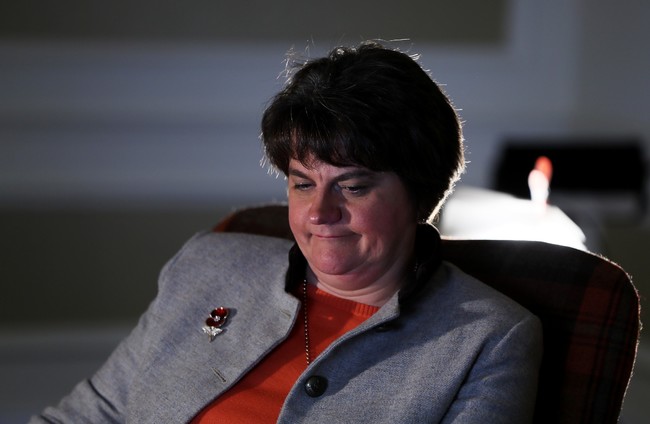
THE GAGS GAVE it away at the Democratic Unionist Party conference today.
Brexit Secretary Stephen Barclay had been declined a speaking spot at the conference because of his “inability to recall what he actually negotiated”, riffed deputy leader Nigel Dodds.
“Rather than have Boris with us today we have had to send him to the naughty step,” joked leader Arlene Foster.
The frosty relations with the government have dominated headlines about the DUP in the past week. From compromise on ‘blood red lines’ to being sidelined by Johnson in his deal with the EU, the DUP has gone from power to parody in the space of only a few day.
A day feels like a long time in politics, Foster told delegates.
But the jokes at Johnson and his government’s expense reveal the struggle going on at the heart of the DUP. The alliance with the government has brought the DUP power, money and a list of UK government-funded projects that will look good on a manifesto.
Yet the confidence-and-supply agreement has also brought the party to the brink of disaster. Johnson’s bid to push his deal through parliament – with all the provisions on customs and Stormont that the party finds so objectionable – has backed the party into a difficult corner.
It’s a reality that could leave the DUP uniquely vulnerable in the face of voters, who might easily conclude that the stinging defeats of recent weeks – from same-sex marriage to abortion and a regulatory border in the Irish Sea – have made the party a poor man’s choice at the ballot box.
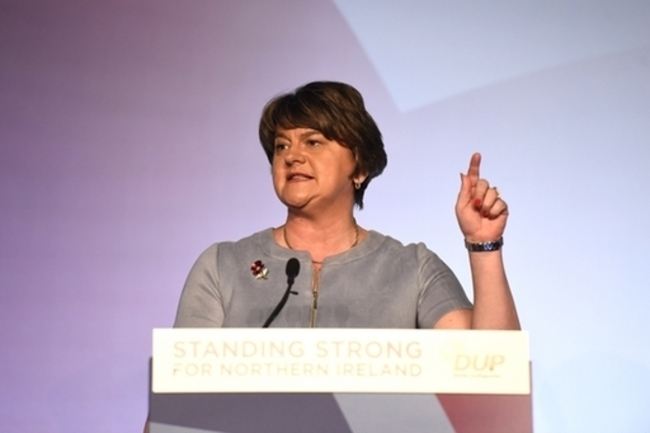
It was an idea that the party tried to dispel early this morning. Sir Jeffrey Donaldson made his speech a pre-election list of the gifts the confidence-and-supply agreement has brought Northern Ireland.
The agreement negotiated with Theresa May – which may or may not still have legs into the future – has left critics claiming that the party has had its mouth ‘stuffed with gold’.
But to Donaldson, it was a gift that instead could keep on giving – for everyone in Northern Ireland. From education to mental health and broader infrastructure projects, he said that “we know exactly where this money is being used”.
Election
It still remains to be seen whether the DUP will back an election on Monday. Today, Foster said the party was “ready” and wiling to face voters.
“We have a strong record to put to the people and now more than ever we will seek a mandate to ensure Northern Ireland has the strongest team fighting for it,” she said.
Yet for all pre-election messaging, the phantom polling day that overshadowed this conference didn’t seem to channel excitement into attendees.
With relatively few young faces and a crowd of older members, there seemed little appetite to go knocking on doors in the dark evenings of December.
Even Foster’s speech attracted a smaller crowd than last year.
Challenges
Perhaps it was this the reason Foster and her fellow party leaders tried to project a message of the DUP as a broad church committed to a modern Northern Ireland.
It’s not an entirely new message, but today it was accompanied by a self-reflection that doesn’t always come naturally to the party.
Early this morning, Emma Little-Pengelly, who pulled off a surprise victory in Belfast South at the 2017 election, said: “Our opponents attempt to demonize us – part of the challenge will be to ensure that we do not make it easy for them.”
“Perhaps, too often, we play into our enemies hands,” she said. “I know that we are not a party of hate, or bigotry, or backwardness. I know we are a party of passion and compassion.”
She told TheJournal.ie afterwards that unionism is broader than the DUP – she pointed out how Labour, the Liberal Democrats and the Conservatives all contain different shades of the same commitment to the UK.
The DUP, she said, needs to do more to explain itself – especially to younger voters.
“There is so much more to the party. The fact that people do perceive some of what we say or some of what we do as motivated by hate, when I know it isn’t, grieves me, so I think we can do more to try and explain that and try and reach out to people,” she said.
The challenges faced by unionism, she said, might have distracted the party from projecting a more positive image.
“Maybe too few people see that we’re also very compassionate, that we’re passionate about a range of issues,” she added.
Whether or not we do get an election in the coming weeks, expect this message to be at the forefront of the party’s campaign for a long time to come.
Dominic McGrath was reporting from Belfast

To embed this post, copy the code below on your site












have your say