Sign in. It’s quick, free and it’s up to you.
An account is an optional way to support the work we do. Find out more.
Sign in. It’s quick, free and it’s up to you.
An account is an optional way to support the work we do. Find out more.
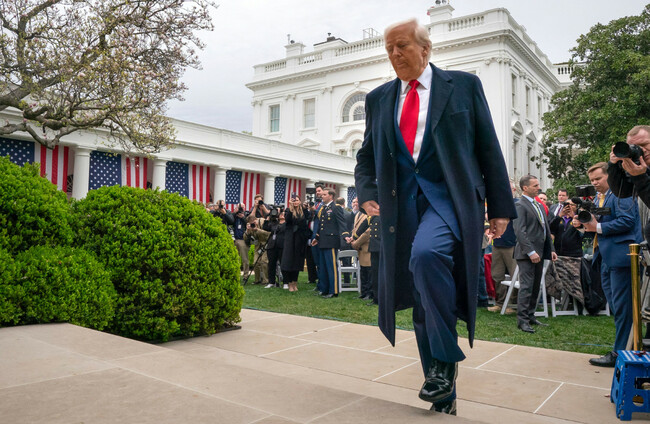
COULD THE EU’s response to Donald Trump’s tariffs be just as damaging to Ireland?
That is the Irish government’s concern amid the fallout to the White House’s Liberation Day announcement, with a number of major European states eyeing up the US tech sector – so much of which is headquartered here – as their route for payback.
German Economy Minister Robert Habeck said today that the “big tech companies have an incredible dominance in Europe and are largely exempt from European taxes”, as did a French government spokeswoman who highlighted the sector as an option for the EU’s retaliatory tariffs.
But any move by the EU against US tech firms operating here would undoubtedly have an impact on Ireland, given the prevalence of US tech companies here.
According to Dr Paul Egan of the Economic and Social Research Institute (ESRI), any moves by the EU or the US that “specifically target” sectors such as tech or pharmaceuticals would have a “significant” impact on the Irish economy.
Taoiseach Micheál Martin has stated today that the Irish government does not want to see the EU seek to pressure Trump by deploying a tax on Big Tech, as has been floated by some in Brussels.
Speaking on the RTÉ Six One News, the Taoiseach said “there’s no point making things worse,” which is why he doesn’t favour a digital services tax.
He told reporters earlier: “This has to be a considered response, a measured response – one that is clearly calculated and calibrated not to bring more damage on the European economy and European citizens.”
Martin stressed the need for a “collective response” from the EU but added that, while “solidarity” was important, the government would make the case for Ireland’s own interests.
“There has to be solidarity, but we have made our views known to the EU at a Commission level,” added Martin.
“Ireland will not be shy in terms of our interests, but also our strategy”.
Micheal Martin says Ireland is not in favour of a digital services tax being imposed.
— Christina Finn (@christinafinn8) April 3, 2025
McGrath says if the trade relationship between US and EU fails there will be multifaceted problems not just for big business. pic.twitter.com/FYpoxeUxFD
Opposition parties from Sinn Féin to Labour, Social Democrats and People Before Profit have all urged the government to avoid a trade war with Ireland caught between the EU and the US.
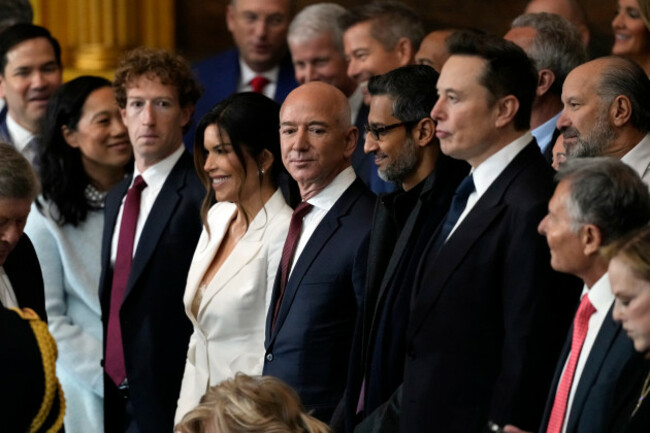
Trump’s second term in the White House has been marked by the closeness of the owners of the some of the world’s largest tech companies around him, from X owner Elon Musk, Meta’s Mark Zuckerberg and Oracle founder Larry Ellison.
All have significant operations in Ireland with Dublin as their European headquarters.
One senior MEP has said this relationship between Trump and Big Tech could be a way of ensuring the EU gains “leverage” over the White House and to force talks.
Germany’s Anna Cavazzini – who chairs the European Parliament’s internal market and consumer protection committee – said it was “really important to cause economic pain to the US” and this in order to make Trump change course.
Cavazzini told Channel 4 News last night that the EU should target “Trump’s voter bases or companies that are supporting Trump and make it very costly” for him to continue with the tariffs.
Dr Paul Hand from the Economic and Social Research Institute (ESRI) said there is a real risk to Ireland depending on the EU response, with a “tit-for-tat” between the US and the EU having the potential to be especially damaging here.
“Our results clearly showed that the tit-for-tat scenario would have a more negative impact,” Hand told The Journal today, adding that while the consequences may not be as severe as Trump’s initial tariffs, they would “definitely exacerbate” the problems for Ireland’s economy.
In a paper published last week and co-authored by Egan, the ESRI projected that “protectionist shocks” arising from a trade war could hit finances across the economy.
Its worse case scenario had Ireland set to miss out on up to 80,000 jobs over the coming years due to investment being hampered. A more conservative estimate reckoned that 50,000 jobs may not be created.
But those figures come with caveats, Egan explained. The study highlights that the concentrated nature of corporation tax revenue in Ireland across a small number of companies makes it difficult to accurately forecast the potential fallout.
The danger therefore also lies in any tariffs that target specific sectors which are critical to the Irish economy. Egan pointed to pharma and US tech companies, both of which have now been flagged by Trump and the EU as potential targets for further tariffs.
While there was an initial relief when the pharma sector was not named in last night’s tariffs, Tánaiste Simon Harris acknowledged today that it was likely that pharma will be impacted eventually.
He told RTÉ’s Claire Byrne that US Treasury Secretary had told him there would be a “lag time” in when more sector specific levies would be announced.
If so, Egan said would also mean a “disproportionate negative impact” on Irish tax receipts – from personal taxes to indirect and corporation tax – and less money for the government to spend in the coming years.
“Any policies that were to specifically target high tech sectors – meaning pharmaceutical and ICT – would be an additional risk to the Irish economy and the public finances outside of what we include in our modeling framework,” Egan said. “It’s something we’ll have to keep an eye out for as these things progress.”
With reporting by Christina Finn.

To embed this post, copy the code below on your site















have your say