Sign in. It’s quick, free and it’s up to you.
An account is an optional way to support the work we do. Find out more.
Sign in. It’s quick, free and it’s up to you.
An account is an optional way to support the work we do. Find out more.
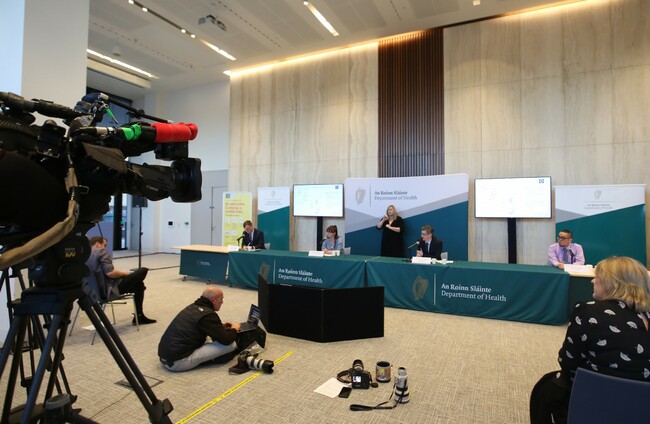
YESTERDAY’S NEWS THAT NPHET has recommended that the government move the entire country to Level 5 for four weeks has taken everyone by surprise.
People are debating whether this roadmap-leapfrog is warranted, as counties have been in either Level 2 or Level 3 up until now (Dublin has been under Level 3 restrictions for over two weeks, while Donegal has been under these restrictions for just over a week).
Here is a data trawl, some insight from a member of NPHET, and some context to give more insight into what led up to this recommendation.
NPHET has said that the “trigger points” for moving into Level 5 are as follows:
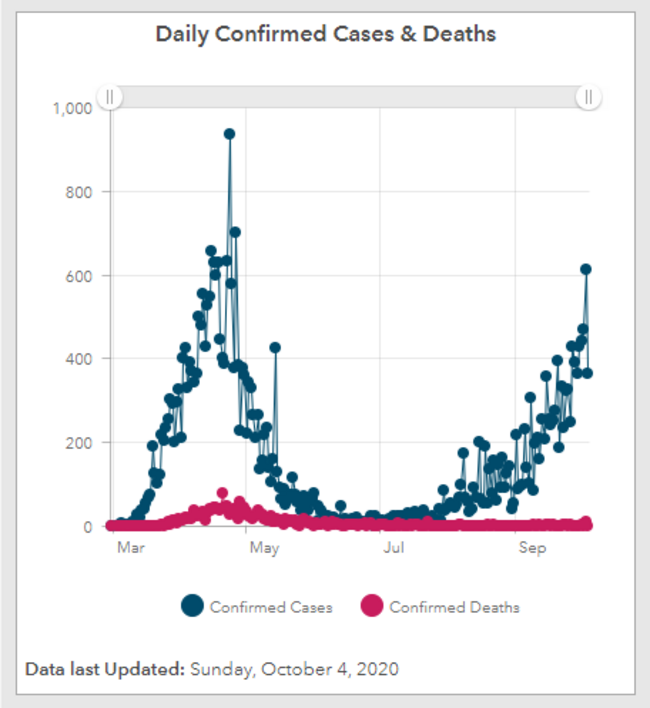
The number of new daily confirmed cases has been increasing over the past few weeks, with over 1,000 new cases confirmed over the weekend. On Saturday, there were 613 new cases confirmed, 470 cases on Friday, and 442 on Thursday.
According to the latest data from the HPSC, the national incidence rate is 107 cases per 100,000 of the population on a 14-day rolling average.
Initially, the government thought that localised restrictions would prevent the spread of the disease, as they did in Kildare, Laois and Offaly. But the restrictions haven’t worked as effectively in Dublin and Donegal, and there are now “lots of embers” across the country, as Acting Chief Medical Officer Dr Ronan Glynn said in the last briefing at the Department of Health.
Currently there are 265 cases per 100,000 of the population in Donegal, and 162 cases per 100,000 in Dublin, according to the latest HPSC data.
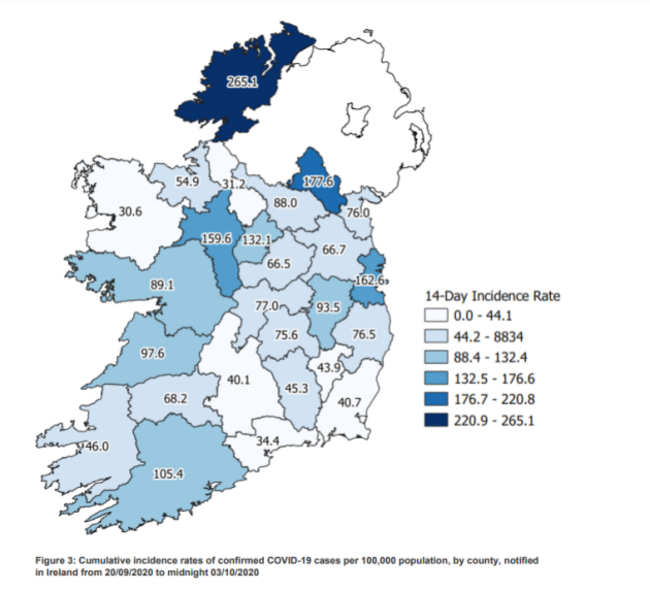
A more detailed breakdown of each county on the Covid-19 Data Hub shows that the incidence rate goes up to 602 per 100,000 in one eastern part of Donegal, and around 200 cases per 100,000 in parts of Dublin – the rest of the country remains relatively stable at levels below the national average of 107.
In Northern Ireland, 934 cases were confirmed within a 24-hour period on Friday – a new record daily high and more than double the previous high of 424.
This has implications for border counties, of course: north Monaghan has 202 cases per 100,000 of the population, in comparison to 112 in Carrickmacross-Castleblayney and 69.5 in Ballybay-Clones.
Since the beginning of July, the percentage of new confirmed Covid-19 cases has remained at around 66%, with community transmission at around 30%.
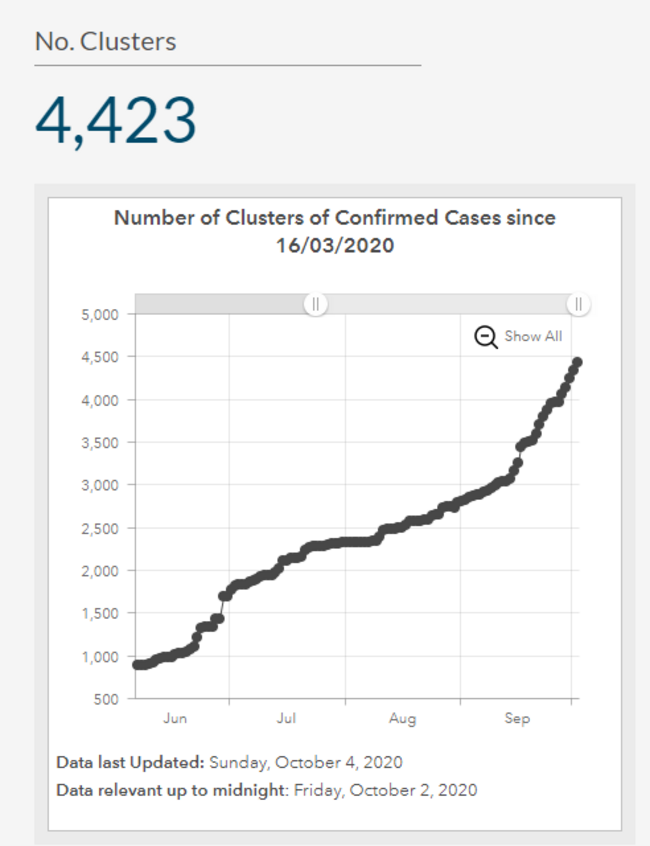
However, the number of clusters has increased significantly during September: from 2,810 clusters logged by 1 September to 4,330 clusters by 1 October.
Speaking on RTÉ’s Morning Ireland today, NPHET member and former president of Irish College of General Practitioners Dr Mary Favier said GPs are very concerned about the increase in Covid-19 cases, and said that this could lead to no available occupancy in ICUs by next month.
“There’s been a doubling of cases in the last few weeks, there’s been a doubling of cases in the over 65s,” she said.
“If we keep going on the current trajectory, by the beginning of November we’ll have between 1,500 to 2,000 cases a day and potentially not have ICU occupancy.”
She said that GPs have been under “a huge strain across the summer”, and that last week they referred around 60,000 people for testing which is an “extraordinary amount of work”.
Dr Favier said that it’s accepted that if we keep going the way we are, there might not be an intensive care bed capacity in November.
Moving to Level 3 made some difference in Dublin and Donegal, but not nearly enough. And the rise is exponential, this is where the rise doubles every couple of days, every week.
On Friday, in an interview with The Currency, Tánaiste Leo Varadkar said that the daily cases should no longer be the focus of how well Ireland is doing at tackling the virus.
Instead, hospitalisations, ICU capacity and deaths should form the core part of deciding on what restrictions to implement.
“It is a job for us as politicians to say to the public health people that maybe we should be focusing on that,” he said.
“The objective was to make sure our health service did not get overwhelmed, not to lock down the country and the economy until there was no Covid at all. That is not realistic.”
According to data in the Covid-19 Hub, in the last 24 hours there have been 15 hospital admissions, 150 hospital confirmed cases, and 21 people in Intensive Care Units.
Hospital and ICU numbers are a fraction of where they were in April, with only at 2.7% of the peak of the pandemic in mid-April. At the moment, just 1% of hospital beds are being used by patients with Covid-19, and about 7% ICU.
Ireland has over 250 ICU beds, but the Irish government and health authorities are claiming that this can be increased up to 400 if needed, and up to 1,000 patients can be ventilated.
According to the latest HSE operations update, there are 21 people with Covid-19 out of using a critical care bed, out of a total of 277. Just 39 of the remaining critical care beds are available.
Like many countries in western Europe, there has been an increase in cases but a relatively modest impact on hospitals and a relatively low death rate than had been experienced at the beginning of the pandemic.
This mostly because of contact tracing systems that are detecting far more asymptomatic and mild cases than was the case in April or May.
You can explore the data in more detail, or in your area at:
With reporting from Michelle Hennessy and Christina Finn.

To embed this post, copy the code below on your site












have your say