TheJournal.ie uses cookies. By continuing to browse this site you are agreeing to our use of cookies. Click here to find out more »
Dublin: 16 °C Monday 20 May, 2013

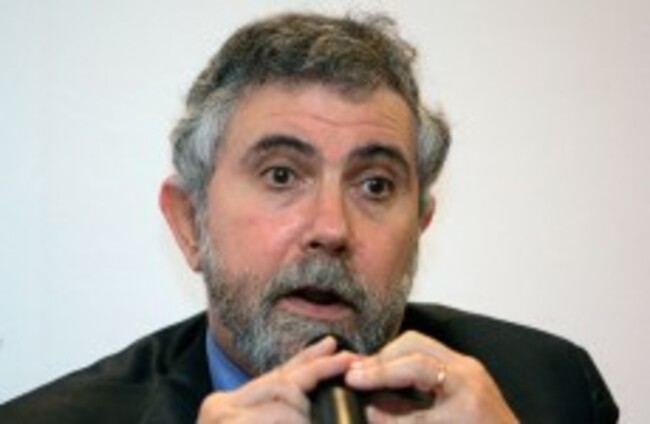
Paul Krugman says Irish voters should vote No

The Nobel prize-winning economist said that austerity is a deeply destructive policy which is failing dismally.

Paul Krugman
Paul Krugman
Image: AP Photo/Lai Seng Sin

NOBEL PRIZE-WINNING ECONOMIST Paul Krugman has advised Irish voters to vote No in Thursday’s referendum on the Fiscal Compact.

“I’ve thought about it, it’s hard. I would say vote No,” he said on BBC Radio 4 this morning. Krugman dismissed the suggestion that a No vote would anger Germany and see Ireland cut off from bailout funds or from the Eurozone.

“At this point the Germans need to face the reality that this cannot work and that the Irish, who’ve been such good soldiers in this crisis, if even the Irish say no then that would actually send a helpful message,” he said.

Krugman said that austerity is a “deeply destructive policy” which is “failing dismally”. He blamed the vanity of politicians for pursuing a policy which he said is not working.

“The whole intellectual framework has been tested to destruction in the Eurozone,” he said on the Today programme on BBC Radio 4 this morning.

Krugman said that the Eurozone was on the wrong track because it has a single currency without having a single government. “European currency union was a mistake since the day the Maastricht Treaty was signed,” he said.

The New York Times columnist and Princeton professor has long argued for a Keynesian approach to the current economic crisis which would focus on spending rather than cuts.

Column: Taoiseach Enda Kenny on why the government is calling for a Yes vote in tomorrow’s referendum >

Column: Sinn Féin leader Gerry Adams on why a No vote is needed in Thursday’s referendum >

Read next:

Comments (132 Comments)

  • Sarah 30/05/12 #

    The most crucial question is what will happen in the event (which is not beyond the realm of possibility at this point) that the German Bundestag don’t sign up to this treaty and Mr Hollande in France does the same. Is it possible that peripheral ‘economically quarantined’ states of the Eurozone will sign up to the fines system in this treaty but that the core of the Eurozone will be free to breach the Maastricht rules yet again in pursuit of a growth agenda as they have done in the past?

    we only went outside the Maastricht criteria in 2008 in circumstances that could only be described as unprecedented and exceptional. Germany and France meanwhile have frequently run roughshod over agreed European budget rules long before the economic crisis.

    The table here illustrates this point: http://en.wikipedia.org/wiki/Stability_and_Growth_Pact#Member_states_by_SGP_criteria.

    Will any of this change if we ratify the treaty? I think not.

    Reply
    • Well said..

      Reply
    • Maybe we shroud worry about a meteor hitting the earth too. What happens in the future will only become known in the future. We have the treaty in front of us now.

      Reply
    • should not shroud. :)

      Reply
    • @Gary why don’t yyou challenge the opinion instead of childish comments.If person maybe it seems funny,but in writing it just looks immature.

      Reply
    • Norman it’s meant to be very serious. Voting now on what… might.. could.. possibly… sorta… happen in the future is very foolish indeed.

      Reply
    • @ Sarah. That is a very good question.

      @ Gary is it not part of the reason “we are were we are” (to borrow a phase) because we did not look into the future and do a little bit of what if? Hollande has stayed before and after his election that he will not ratify the treaty as it currently stands. Merkel had to put of the vote on it because she could not get the numbers required to vote yes on it.

      Reply
    • Hollande has said

      Reply
    • Actually Kerry we didn’t need to look to the future to stop the mess we’re in. All we needed to do was look at what Fianna Fail were doing at the time. No crystal ball required. What we needed to do was stop voting for them at the time.

      Reply
    • @Gary

      What might happen in the future has everything to do with this treaty.

      This treaty grants further powers to foreign countries over our country. These same countries have demonstrated their determination to:

      1. Punish us for bailing out our banks so that they in turn could pay back their banks by charging punitive interest rates.

      2. Remove our tax rate sovereignty so that our success, well past success, in employment can never be replicated.

      What conditions do you think France and Germany, who will control the ESM, impose on us when our Stockholm Syndrome Central Bank boys come back begging for more sweets to shore up their fat pensions with?

      Reply
    • Eric De Red. Dear Jebus. What the hell is up with you people, the fúcking treaty doesn’t do those things.

      I have to laugh that you guys think that 16 other Eurozone countries would just sign up to having ‘foreign powers’ running their affairs. Are you kidding me, are all these countries stupid too?
      If anyone thinks about this logically for a moment you’d know immediately that cant be happening, nobody would sign up to it..

      Reply
    • censored 30/05/12 #

      Geez Gary – you’re telling me that now I need to worry about meteor strikes as well? Where is it going to land do you know?

      Reply
  • Austerity will be here next week, next month, and next year – and three years from now – with or without the treaty.

    Reply
    • What I can’t understand is this…
      All the fiscal limits in this treaty are already the law there, some from twenty years ago. The main thing being changed is that the rules stop being easily ignored. Also we borrow one third of all government spending, one third… it’s a massive problem. So what I’m trying to figure out here is he says that austerity (or balancing the books as some call it) is “deeply destructive policy” but how the hell do you actually pay for growth? Really I’d like to know? (and not that fantasy Gerry Adams spouted a couple of days ago)
      Stimulus costs a lot of money and isn’t always effective, you only have to look at the US (where he is from) to see that.

      Reply
    • Gary, are you going to try and suggest that you or any of the Irish economists can see the bigger picture than a Nobel prize winning international economist?
      He has zero vested interest in supporting a No vote. Is it not time that all the undecideds were made aware of this internationally respected commentator?

      Reply
    • Cal I don’t care if he’s king of the world, I’m asking very practical questions and so far I’m not seeing any answers. Does he explain why when the US has spent vast amount of money on stimulus, for little benefit, does he think it’ll work here? (and of course of debt position vs GDP is far worse than the US).

      This might be useful to you. https://en.wikipedia.org/wiki/Argument_from_authority

      Reply
    • Gary

      The interest rate on borrowing is the key.

      Japan has +twice+ the debt we have & is unconcerned. Why?

      Because, like all sovereign currency countries, they control their own borrowing interest rate. When they most need to extend borrowing to provide for increased unemployment costs plus some extra to stimulate growth, they can do it by forcing lower rates. Japanese policy over the last twenty years (since their own property bust) has wavered a couple of times as different governments were elected, but the effect of the periods of stimulus in the data is crystal clear. And whilst the US & Europe crashed, their unemployment has stayed relatively low, around 4 or 5 %.

      The ‘principal’ of national debts is never repaid, merely rolled over. Growth makes it sustainable – debt/GDP +ratio+. Therefore the cost +is+ the interest rate.

      Where countries like Japan, US, UK etc with much higher debt levels, pay ~ 1% interest, Euro countries, forced to borrow from profiteering ‘markets’ pay much more – 4 to 5 +times+ more. And the higher the debt level, the higher the interest demanded.

      A few percent doesn’t sound much, but it makes all the difference – €billions even for a small country like Ireland. Without it (spent in stimulus), recovery takes years longer – think a decade at least, if at all. The accumulated costs in lost output from so many without work are huge.

      Literally, the money we should be using, to provide the stimulus needed to recover, is being handed over to the banks of the financial ‘markets’ in interest payments several times what any none-Euro country is paying. Yes – those same banks that recklessly shovelled money at our own banks & property speculators & our gov insisted we make good when they went bankrupt.

      The Euro structure is deeply flawed, just as critics said it was. (And this interest rate issue is only one of them.)

      The problems we see now were absolutely inevitable at the first downturn in the natural ebb & flow of economies. Rather than act ‘counter-cyclically’ as in non-Euro countries, the borrowing costs in the Euro act +opposite+, ‘pro-cyclically’ – limiting what governments can do & making recessions much worse, precisely what we are seeing.

      Instead of addressing this massive flaw which is responsible for the worsening crisis, the Euro authorities are flatly ignoring it, & even potentially making matters in the future with the fiscal compact.

      Who gains from all this?

      The banks, the financial sector of course – the people who, in reality, designed the Euro system in the first place.

      It sounds crazy, but just as Irish political leaders have given banks everything at citizens’ expense, what is going on now demonstrates exactly & completely the same atitude among (near) all other EU leaders. (It remains to be seen what new President Hollande of France will propose.)

      A ‘yes’ vote now is exactly equivalent to, with full hindsight, voting ‘yes’ to the ruinous unlimited bank guarantee our gov gave 4 years ago. Precisely the same attitudes, thinking & interests (not ours) being served. Nothing has changed.

      If you want the real issues to be addressed in the flawed Euro structure, vote NO.

      Reply
    • Mike. Interest ratse are the key?

      Our market rate is near 7% but our rate from the ESM is 3.85%. And you want to vote no to the ESM? Really?

      (otherwise tl;dr)

      Reply
    • Gary where is the money going to come from to build up the ESM fund to €700 billion if required?

      Greece has signed up to supplying €19 billion to it. Where is Greece going to borrow that money from?
      Italy is committed to supplying 18% of the total value of the fund. Currently Italian 10 year bonds are over 6%. Are you suggesting that Italy is going to borrow at that rate to then watch the ESM lend it out 3.85% to Ireland.
      Spain is signed up to supply 12% of the fund. Same problem for them 10 year bonds running at over 6%. Do you think Spain will borrow at over 6% and then watch the money being lent to Ireland at 3.85% or even 5%?
      Where is Ireland going to borrow €11 billion from if the worst comes to the worst and we have to provide our full commitment. Is Ireland going to be able to borrow that from the markets?

      Reply
    • Gary, once more for slow readers… There is nothing in the fiscal compact to say
      1) We are guaranteed to get a bailout if we need one (whether we vote Yes or No).
      2) What interest rate or contract clauses will be included if we vote Yes or No

      Here is what we do know…
      1) We will be forced to give over 1.17 billion to join a club that may or may not be able to give us money if we need it in the future.
      1) If we vote Yes, we have definitely weakened our hand, if we go looking for the germans to take back the private banking debt, that should have fallen on their shoulders

      We need stability, VOTE NO.

      Reply
    • Gary, last point for you…

      I would 1 million times rather listen to an international Nobel prize winning economist than to someone who blindly follows FFg/Labour/FF around the place.
      If you feel so strongly that your arguments should supercede the Nobel winner, then please go off and get your degree in economics, win acclaim around the world, get recognized by the Nobel committee (because you know you are so good), and then come back on here and give inputs. I promise, when you do that, i will listen to you.

      In the meantime, i would rather listen to someone with a Nobel prize, than you… No offense.

      Reply
    • He has obviously thought about it more than you Gary, NO offence.

      Reply
    • Gary, strict fiscal discipline is entirely appropriate under normal circumstances. But an irrelevance given the dimensions and context of this crisis. It’s like going bear-hunting with a fishing rod.
      The EU & our government are not only failing to identify answers to this crisis. They are failing to come close to asking the right questions.
      There is no solution without debt restructuring.
      In the 1970’s some western economies fell into decline because their primary and manufacturing industries were uncompetitive compared with Asian and german. Much of this resulted from ill-concieved economic, social and labour policies implemented by interventionist or Social Democratic governments. These Governments attempted to remedy this by subsidising uncompetive industries.
      Thatcher and Reagan came to realise that this was not effective or sustainable and ended government subvention for uncompetitive industries while placing banking and financial services at the heart of their economies. Rather than servicing growing economies, banking & financial services became the main economic drivers for many western economies. While this has worked effectively for a number of decades and lead to sustained growth (mostly), Ron & Maggie had sold a hostage to fortune. Now a heavy ransom must be paid.
      World leaders have been placed in an impossible situation. Do they replicate the 70′s solution and allow the massively inflated banking system (their main economic driver) to fail? Or do the continue to support it from taxpayer funding?
      Do we take the Icelandic solution? Or the Japanese solution?
      I prefer the first. That’s why I’m voting no.
      http://e.businessinsider.com/public/472931

      Reply
    • Gary, in the event of a ‘no’ vote tomorrow, can everyone on the ‘no’ side bring you out on the beer or something to show our appreciation for your tireless and unrelenting work convincing undecideds to vote against the treaty?

      Reply
    • @ Gary

      3.85% from the ESM is not sustainable either & will simply gut the economy to try & pay it, ultimately ending up like Greece. (Why should we be paying 4 times more than US, UK or Japan etc.? What is the justification for this punitive rate?)

      Think about it. The average interest is already around that level. If we need to go to the ESM, ie cannot grow sufficiently with the present debt & interest rate, how is adding further to our debt at a similar rate going to help?

      Yet this is exactly what the authorities have pursued these last four years in Ireland & throughout the Eurozone periphery. That is why the crisis is deepening.

      You are framing what’s on offer as two options:-

      Will I cut off both your legs, or just one?

      You are responding – just one, please & thankyou!

      (Or is it the case you have sufficient wealth to buy your way to the back of the amputation queue, or out of it completely?)

      My response is NEITHER, I demand another, better option where I keep both legs, or I’m not going to play the ‘game’. ie VOTE NO.

      We are not alone, despite the incredibly insular nature of our mainstream media hiding much from us of the continuing mass strikes & demonstrations. Many other citizens in the Eurozone, as demonstrated by those in France, Holland, Greece, Spain & elsewhere have had enough of these failed ‘solutions’.

      Reply
    • Gary, you always champion “balancing the books”
      Well Simon Coveney admitted we will have to borrow €11bn to put in the ESM pot @ 3.85% then if we need a second bailout we borrow the money back from ESM at 3.85%. 7.7% interest does not good economic sense make. But you know better than Paul Krugman.

      Reply
    • Lads no matter what point I make or what proof I show you’ll just move the goalposts around. This whole campaign have been dishonest in the extreme, especially the no campaign. How the hell people are supposed to find the facts is beyond me.
      Look at this rogues gallery.
      http://www.boards.ie/vbulletin/showpost.php?p=78909677&postcount=1

      Reply
    • Speaking of dishonesty, Gary. Is Croke Park for the wood shed after the referendum?
      Is that the reason for the big panic with this poll?
      Shame the devil.
      You must have some contacts.

      Reply
    • Sean I read the treaty and I didn’t see anything in it about the Croke Park agreement.

      Reply
    • Gary – myself, Cal and Sean O’Keefe have asked you on several occassions over the past 3 weeks, your opinion of both Krugman and Stiglitzs opinions on the fiscal compact. You obviously have done no research into their opinions on this matter. Had you shown any interest I would have typed up one of each of their essays and sent them to you.

      Reply
    • Is that an official or unofficial denial Gary?
      I smell something fishy.

      Reply
    • Ann. I have just given my opinion on what Krugman said…. I try again specially for you.
      1. I like to know *exactly* how he thinks we can pay for a stimulus package. We’re borrowing one third of all government spending now.
      2. I’d like him to explain when the US stimulus package had such poor results for the vast amount of money spent why he thinks it’ll work here.
      These are very basic questions which I have not seen him answer, or anyone for that matter.

      Sean. How the hell do I know if the Croke park deal is going to be scrapped after the referendum. I’m very happy for it to go. And again there’s nothing in the fiscal compact about the croke park agreement.

      Reply
    • censored 30/05/12 #

      The US economy is growing. Krugman is on record pointing to the SMALL size of the US stimulus program which created a lot of unnecessary risks.

      As for stimulus, don’t you know that we’re rich – we’ll be putting at least 11 billion into the forthcoming Spanish bailout … just like we were the biggest per capita “donors” to Greece.

      http://www.guardian.co.uk/business/2010/may/20/ireland-second-biggest-bailout-donor?intcmp=239

      Reply
    • No point making sure the Eurozone obey the rules now that Europe is in tatters is there Gary?
      Seems to me the yes side want to put on their seat belts AFTER we’ve already ploughed into a wall.
      Better clear the wreckage first.
      Also Everything you say of others on here on the no side is true of you also. You’ve got your head in the sand.

      Reply
    • Mike Hall
      Japan is heading for disaster. The Debt/GDP ratio has been heading steadily upwards for 20 years with no end in sight. Every year they have a huge budget deficit. The population has peaked, very soon the working population will start to decline. People in Japan save a lot to fund their retirement. Until now there has been a huge pool of savings to finance the government deficits. People put their money into Banks, the Post Office & insurance policies. These institutions then use this money to buy government bonds, this keeps the interest rate low. These institutions invest in government bonds due to a lack of alternative investments. The property market has fallen 70% in 20 years, the same goes for the stock market, so they invest in government bonds. There is a huge number of people due to retire over the next 10 years, once they start drawing down their savings interest rates will sky rocket & the national debt will become unsustainable. The only outcome is default or massive inflation which will completely destroy people’s savings. This will bring disaster to Japan. This cannot be avoided. Even if the Japanese economy starts to pick up from now it will still bring disaster, savings diverted from Government bonds into the stock & property markets will cause a rise in interest rates. The outcome will be the same.
      As for the referendum I’m still not sure how to vote, I’m wavering, but probably no.

      Reply
    • Ando, I agree with you assessment of Japan’s economy. Their economy is possibly in an even more precarious position than Europe’s. You are also correct to point out that deficit spending has done nothing to remedy their economic decline. In my view, it has never been credibly shown to stimulate growth in any economy.
      However, Japan’s experience does offer an important parallel to our own crisis and should inform Irish voters decision on this referendum. Japan like Europe refused to face up to the dysfunction in it’s banking system. Restructuring of debt was not pursued as is now the case here.
      My view is that Irish voters should not ratify this treaty until debt restructuring is put on the table. That is why I have voted No.
      http://dealbook.nytimes.com/2012/05/03/europes-lessons-from-japans-lost-decade/

      Reply
    • So Gary it took 3 weeks to get an answer from you and you base it solely on the above article. Me thinks you were only interested in researching one side of the treaty instead of fully informing yourself. And as stated above I would have quite gladly given you links and typed up some of his articles had you shown any interest.

      Reply
  • Maybe he understand the complete lack of mathematical formula displayed in all the stories concerning the referendum.

    People really cannot choose anything without understanding the maths.

    Reply
  • Vote no and call their bluff. They can’t throw us out or refuse us a second bailout if they are worried about contagion. Also we need a stronger character representing us in these negotations, Enda just isn’t cut out 4 it.

    Reply
  • I listened to Simon Coveney doing his utmost to destroy the good name of Paul Krugman on RTE Radio News at lunchtime !
    I could not believe what I was listening to , that such a senior Minister in our Government could have let himself down so badly .
    Mr Krugman rightfully should expect an unconditional apology from Mr Coveney immediately .

    Reply
  • Will anyone actually listen? The general voting public don’t like upsetting the apple cart. I’ve been urging everyone I know to vote NO but I really wonder about the naivety of the Irish people. The majority really seem to be a gullible lot.

    Reply
  • Either way we will win. IF we vote YEs they will crucify ireland with unsustainble cuts.. then the people will revolt in one form or another particularly the middle class and the Govt will collapse. if they vote NO the govt will be forced to walk to Europe and act like men.. and we will win. sit back and watch.. they have painted themselves into a corner. There are millions around Europe and the world who are dog sick of imposed austerity through corrupt banking politcies. Thats a FACT. we the people and there are more of us than them are going to rise . the leaders will become our servants again. They have lost the plot. They serve us. No or yes this country will rise. and it wil be through the people.

    Reply
  • The always watchable and readable Krugman. The guy has an amazing knack for explaining things in laymans terms and always makes sense. Along with Mc Williams, the guy who gets it right, we would be wise to heed their words, especially ahead the economists taking the government coin.

    Reply
    • I still find it amusing that you guys keep recommending the man who suggested the bank guarantee… McWilliams.

      Reply
    • @Gary was it also McWilliams that said to only guarantee the secured bonds and not unsecured bonds?

      Reply
    • And McWilliams should have known that senior bonds hold a higher status than deposits.

      Reply
    • Thats right gary trust the ‘local boys’ over a nobel prize winner, in a country with one of the highest rates of white collar crime and corruption in the western world especially when 90 percent of those economists ridiculed the minority that warned us of the imminent collapse a few years back..remember eddie hobbes???

      Reply
    • Gary, your wrong about what McWilliams suggested to the Government should do, they only did half of what he said, they ignored the bit about letting some of the bigger banks go and with the remainder, all senior management was to be let go with no golden hand shake’s and to give a limited guarantee to what was left.
      http://www.davidmcwilliams.ie/2008/10/19/bank-guarantee-will-mean-survival-of-the-weakest
      Here’s his article, may I suggest you read it. If you also take a look at any of his ‘punk economics’ videos on youtube, there are four 10 min vid’s up, you will see that this is all to do with saving German banks and other private interests.
      What I don’t understand from the yes point of view is why you think we should be paying back this money ?
      I know we have our own debt but the banking side of things has nothing to do with us which amounts to 40% of our debt now.
      We see day in day out more lies, more pay cap’s being broken, G.E promises being broken, Enda and Big Phil of hiding, Richard B say’s we’ll have to vote again if No win’s ( Matt Copper show) Michael N say’s feta cheese is all we have in common with Greeks, Pascil O’D say’s it will be a disaster for us if Greece goes,so which is it? I’m voting no because the government have lied to us and when all around Europe countries are holding of ratifying it Enda is either to thick or of such a low moral standard he care’s not who and how this will affect and pushing ahead with it.

      Reply
    • Joe. Where id I say we should trust the local boys over Krugman? Krugman is making clear claims, which I’m not seeing him back up. He’s suggesting. as far as I can tell, doing what the US did which has been far from successful. Why should we follow it? How *exactly* do we pay for it? And of course if it was one ‘local boy’ but it’s 40 odd of our top economists who are looking for a Yes vote.

      Reply
    • Popcorn 30/05/12 #

      If Krugman says more NO, I don’t need a second opinion.

      Reply
    • That’s it Gary, keep on ignoring.

      Reply
  • Poignant words from a man of integrity and social conscience:

    http://politico.ie/latest-from-politico/tonight-with-vincent-browne-liveblog/8584-vinb-voting-no-treaty.html

    “We owe it to ourselves, to future generations and to the peoples of Europe, who are denied a part in this process, to oppose a trajectory that will vandalise society and impoverish lives throughout the Union.”

    Reply
    • “to the peoples of Europe, who are denied a part in this process”… Huh?
      The people of Europe get the vote the way their own countries are set up,, and we vote on it the way our country is set up. It’s the height of arrogance to assume that our way is the best way or the only way.

      Reply
    • our corrupt way is most definitely not the right way. But giving Tue people of Europe a got on this is the right way. At least Ireland has that.

      Reply
    • This page is about the treaty, brownes article is about the treaty. How many countries are getting a vote on the treaty gary?

      Reply
    • As I said Trueleft, the people’s of Europe will deal with this treaty according to their own laws. We are not in a position, given the mess here, to tell anyone our way is better than there’s. Really is the height or arrogance.

      Reply
  • Paul 30/05/12 #

    So we borrowed money to pay off the bank debts. The Government put the blame on the people’s shoulders to pay it back.
    We vote YES on the off chance that we get another loan to pay back the first at interest rates dictated to us.
    We vote NO and negotiate a loan to pay back the first at rates we can be more comfortable with.
    They can’t possibly refuse us a loan. If they refuse us, we default, what can they do?

    Reply
  • People will vote NO because they have nothing else to fear! So why not vote No? cant get much worse can it? or maybe Gary has a solution!!!!!!
    after all he seems to be the real scholar here.
    By the way the 90% of economists that our current gov say want a YES vote are all on there payroll…

    Have France and Germany fully ratified this treaty??

    How many times have both countries broken the rules on the Ma-strict treaty???

    I cant wait to see Merkle help with our budgets can you??

    MAKE NO MISTAKE THIS TREATY IS NOT ABOUT US ITS ABOUT THEM

    Reply
  • David McWilliams’ article from earlier today.
    Some might not like him but I have always found him to be a more reliable source of information than any politians, Yes or No.
    http://www.davidmcwilliams.ie/2012/05/29/its-not-a-fiscal-union-its-a-fiscal-straightjacket

    Reply
    • http://www.independent.ie/opinion/analysis/seamus-coffey-david-mcwilliams-analysis-of-private-debt-is-stark-but-it-also-100pc-wrong-3000117.html
      Seamus Coffey: David McWilliams’ analysis of private debt is stark … but it also 100pc wrong

      Wednesday January 25 2012

      DAVID McWilliams wrote an article for Wednesday’s Irish Independent under the heading “Private debt so enormous that default is only option”. The conclusion is stark: In Ireland, given the magnitude of the debt, it is very clear to me that only a fraction of this household and corporate debt will be actually paid off. The figures scream default.

      The figures in the piece do indeed scream default, but the figures are wrong. 100pc wrong.

      Studies have shown that an appropriate maximum ratio of mortgage debt to gross household income is around four. The data provided in the McWilliams article indicate that total debt in Ireland is more than eight times Gross National Product, a widely used measure of national income. For countries it has been argued that they should not have a debt greater than three times national income.

      If Irish debt were eight times national income, Ireland would indeed be bust and there would be no way the debt could even be carried, never mind paid off. With such a debt burden default would indeed be an inevitable outcome.

      However, Irish debt is actually around four times national income and using figures 100pc greater than this is misleading. The data come from the Bank of International Settlements (BIS) who try to use gross and unconsolidated data as a measure of overall indebtedness. This can lead to unusual results.

      Reply
  • The fact remains that 95% (I guess) of the people who vote tomorrow don’t really know what the consequences will be for either result.
    We are the patient in the waiting room while 10 consultants argue on what is the best form of treatment and we as the patient will have the final say.

    Reply
    • Sadly that might be true. But this kinds of rubbish doesn’t help.
      https://www.boards.ie/vbulletin/showpost.php?p=78909677&postcount=1

      Reply
    • We are lacking in leadership. The bank debt has to be sorted and not when Germany wants to. It was pointed out on TV3 last night that FG are in the same European group party as Merkel’s party. Merkel is desperate to retain power. Her general election comed upto in 2014. She will kick the can down the road as long as it takes so she can get reelected. We can only pray that the whole thing doesnt collapse before then. The German people dont want to hear that the euro will have to be printed just like has happened in the US. They are afraid it will drive inflation and increase prices putting pressure on to increase wages for workers. Kick the can Angela. Just be careful it doesnt blow up in your face.

      Reply
    • Tigerisinthezoo. There is no bank debt, only our debt. The last government made the bank debt our debt. No amount of saying ‘it’s not our debt’ will make so (sadly). The promissory notes are owned to our own Central Bank, how do you think we can refuse to pay those?

      Reply
    • Gary
      It Is NOT our debt . It is the bank’s debt.

      Reply
    • Susie. I don’t know what’s not clear about this. The last government made it our debt. You can stick your head in the sand and say “no no no no no” but it’ll still be our debt. I don’t like this, but it remains a fact.

      Reply
    • So Gary you are saying we will have to pay all the bank debt back. I dont think that will happen and I dont think our children or grandchildren will thank us when they are still paying it in 50 years time. The bank debt is paper. It can be eliminated by printing money.

      Reply
    • Tigerisinthezoo. I’m very much hoping we won’t have to pay it all back. I’m only pointing out that it is now, unfortunately, our debt.

      Reply
    • You are the one with your head in the sand Gary .
      You have just said that you don’t like it either
      Well I suggest you do something about it and object . Vote No Gary. Show how much you disliked it and I suggest that if you accept you do not like it as we have all seen you say then YOU are the one with their head stuck in the sand.

      Reply
    • People have mentioned that sending a message is going to do nothing. It has to be remembered that the prime minister of this country went out and told the world that all the Irish gambled and all the people would now pay back the debt. That is the message that was given and understood by the world. I think it is time to change that message.

      Reply
    • I can’t believe Gary that you are happy to be left saddled with debt that is not your’s. I don’t care that the last Government or even the King of the World, to use one of your phrase’s, left us in this mess, its not our mess and during the G.E both Enda and Gilmore made it quite clear it wasn’t our debt.

      Reply
    • Andrew. Where did I say anything even remotely like I’m “happy to be left saddled with debt”. I’m not happy at all, no tone tiny bit, I didn’t vote FF who made the decision either. I’m just trying to get across that the bank debt is now our debt. It’s not my opinion it’s a simple fact. You guys have got to stop listening to the likes of Ganley who make it sounds oh so easy to sort out what was the bank debt. If only it was so simple.

      Reply
    • We have to balance our budget as quickly as possible and is feasible. That way we will have the card of walking away from the euro. Until then Germany and the ECB will continue to dictate matters to us. Before we know it we would be having a referendum for a federal union. We’d then be like the farmers relying subsidies. The whole euro project has to be questioned.

      Reply
    • Its very simple Gary, If your neigbhour knocked on your door one day and said your paying all my debts would you?
      No you wouldn’t. Lets suspended all payments till a full investigation is held, and if it turn’s out we owe, we pay but if we don’t owe we dont pay.
      The very people that got us into the mess have either retired with hugh pensions or still have their job’s or if your one of the golden circle, have both !!!!
      Stand up for yourself Gary because from here its looks like you wanne take this lying down ! And if you’ll notice all your comments are getting a lot of red marks ( but I’m sure that won’t bother you )
      I’m not a nutty lefty or anti Euro or anti capitalism but whats happening here is wrong.

      Reply
    • Gary Kenny has stated repeatedly that he is (or rather the Irish tax payer) going to pay back all of the bank debt. I’d stop supporting Kenny if you want any chance of us not having to pay it all back.

      Reply
    • Lads it seems to me there are two things here. Morally we can argue that this former bank debt is not ours. Unfortunately legally it is ours. There’s just no way to change the reality here. I’d love a write-down on this debt, really I would but currently we legally owe it all. Maybe we’ll get a write and maybe we won’t, but Ganley is full of it with those posters.

      Reply
    • Lads it seems to me there are two things here. Morally we can argue that this former bank debt is not ours. Unfortunately legally it is ours

      Gary your wrong again..

      http://youtu.be/HAf7J4a_T1g

      Vincent Browne

      Reply
  • the Eurozone is in a mess too Gary, and they haven’t presented a workable solution to that mess.

    Reply
  • Tomorrow they shall ask us
    And we shall scream “NEIN!”
    And when they ask us again
    We shall scream “NEIN!”

    NINE times out of NINE
    We shall scream “NEIN!”
    Until the Germans learn
    That “NEIN!” means NEIN!”.

    Reply
  • And will our vain politicians and the scared sheeple listen? Of course not. Tomorrow the parasitic bankers will win again.

    Reply
  • Dogs on the street know to vote no!
    Balance the books my arse…its ready balance the books when there is nothing to balance…if we vote no does that mean no one in ireland can balance our books giver me a break…I think I’ll emigrate…nation of sheep we are

    Reply
  • pagan 30/05/12 #

    People are sick and tired of this government and will vent there anger over house hold charges,water charges and all the cuts that have been thrown at them by voting no.FG and Labour know this and that’s why there coming out with scare tactics about social welfare cuts,harsher budgets and we will run of money by 2013.
    My whole family is voting no,What have we to lose?Our right as a nation to run our country as voted by its people,not to be dictated to by Germany or France.

    Reply
    • You think voting no has no consequences… wow.

      Reply
    • The problem is when we govern ourselves see what happens.
      A part of me wants to be run from elsewhere as when we are given the opportunity to govern ourselves we destroy our nation.

      Reply
    • We do govern ourselves, hence the mess we’re in.

      Reply
    • But Gary our current government is advocating a Yes vote. Should we trust their advice if as you suggest we are incapable of governing ourselves?

      Reply
    • The treaty is only 11 pages, just read it… who cares what FG or Lab think. But given our action over many years anyone who thinks enforceable fiscal limits are not a good thing is very very forgetful.

      Reply
    • Gary, as this 11 page treaty has been linked intrinsically to the ESM treaty due to the clause that was added with no objection from our government would you not agree that it is pertinent to consider BOTH?
      The fiscal compact alone has some merit – in normal circumstances, but as the ESM is the main reason for voting yes, then it is vital to know what it is and how it works.
      How it works is by enshrining the problems that got us into this mess in the first place.
      Unelected officials playing with other peoples money and enjoying complete legal immunity and zero accountability for doing so..

      Reply
  • We have been down this road before in the not too distant past when protectionist policies towards markets and economies almost annihilating the Irish people. Our Constitution has embedded into its framework measures that will not allow this to happen again, but our Government are eroding its corner stones and Europe are infiltrating it to tear at our strengths as a small nation.

    Reply
  • they are not going to throw us out of the eu. and dont worry bout money situation because of the no vote. they cannot allow it to happen for 1. then they’ll never see any repayment from ireland, 2. the euro currency would fall to the lowest point in its history. 3. sie germans would lose on the international markets and then each country within the eu can write off their bad debt.
    so dont panic and vote no…

    Reply
  • I’m not convinced by the “send a message” arguments, which seem to be one of the pillars of the “no” vote. I’m also not convinced voting “no” will mean less austerity.

    I’m still making up my mind and would really appreciate it If anyone could point me to further articles promoting the “no” side, which don’t rely on the above arguments.

    Thanks.

    Reply
    • Hi Simian Itell you why to vote NO because if we vote yes we will be like a county council in Europe with no contol over what laws we pass for ever.

      Reply
    • You’re right, “sending a message” to Europe does nothing to help the government secure a bank debt deal or better terms on our bailout. As we saw with the UK’s use of the veto it only serves to worsen relations and leave a country on the outside.

      Reply
    • David, your dear leader stated categorically in the dail that he is not looking for a deal on the bank debt. As he’s refusing to do the job he was elected to do we must send this signal ourselves the only way we can, by voting NO.

      Reply
    • Its nothing to do with “sending a message”, this treaty will require all future Irish governments to follow only a policy of austerity. The arguments of why austerity is a terrible idea for the economy are still just as valid as above. This treaty is about requiring the government to continue to follow the same thing which has caused the recession. If you think the austerity over the last 5 budgets has made our situation better then that’s good for you and voting yes may make sense to you. If on the other hand you think that austerity hasn’t helped and that its actually helped to fuel the downward spiral that instead we need to put money back into the economy then this treaty then not only doesn’t help but will actually make the situation worse.

      That is why I feel it is accurate to label this treaty as the austerity treaty, because this treaty locks austerity as the only solution to the current situation. If you agree with that then off you go with your yes badge in toe. But don’t believe that it will prevent future economic disasters like this, because government deficits were not the cause of this, government deficits are good for the economy when its a deficit being caused by inward investment and through job creation, just ask FDR and his New Deal. Reducing expenditure by the government always always always leads to contraction of the economy, sometimes that’s required to help cool down an economy that is growing too fast, but cutting government expenditure in the middle of a recession, even a mild one, let alone a huge one like the one we have now, is simply insanity. The Obama administration is adding large amounts to its debt at the moment and we have seen real, albeit small growth in the US, not the fictional ones here which only seem to exist within government soundbites.

      Reply
    • Continent. All the Fiscal limits in this treaty are already the law here, some form 20 years ago. We have no message to send, we don’t owe enough for Europe to care. They don’t need us, but we certainly need them.
      https://www.boards.ie/vbulletin/forumdisplay.php?f=1431
      You’ll get answers there.

      Reply
    • David Mc Williams had a good article in last Sunday’s Business Post. I would ask you to look at the treaty ignoring the link to funding (I know this is hard but it is very important) for a moment. You need to ask yourself “Would I vote for this treaty as is?” If your answer is only linked to the funding clause I ask you to conceder some of my thoughts on it. Why did they need to retrospectively add the clause to funding? Why have some countries delayed passing this treaty? (I find the fact Angela can’t ratify it at present in Germany very interesting)
      We have been told that this is the only option we have, we have been told every time since 2008 that there is only one option to save Ireland. Look what this policy has done to us so far.
      On austerity, this is a joke on both sides. We have to have it either way. But we can decide the manner in which to introduce it and we need it to be from the top down. So far our government have introduced it from the bottom up. Right now we have sovereignty over these issues and the government are still not listening so I can’t imagine how we will be able to have any influence once we have given it away. What we need is to change our systems to introduce fairness, accountability and transparency to insure whatever government we have can and does listen to the people of Ireland
      If Europe wants to undo the massive mistake it made when launching the Euro then it should do it democratically not behind closed doors. If they want the people of Europe to hand over their powers then it should also be Fair, transparent and be accountable to its people!

      Reply
    • Simian
      It was never claimed that Austerity can be avoided , in fact it can not be . We all know this. But if you vote NO and the treaty is rejected then austerity will not be written into our constitution as FG want .They want Europe have control over our budgets from now on. Impossible !

      Reply
    • Susie “It was never claimed that Austerity can be avoided”
      Really?? perhaps you should peruse the no posters here and see if that’s true.
      https://www.boards.ie/vbulletin/showpost.php?p=78909677&postcount=1

      Reply
    • Gary
      That link is NOT accredited ! So means nothing. Only opinion based and is nonsense, Did you write it yourself ? As I said Austerity cannot be avoided . BUT we should not vote it into our constitution.It will destroy our economy and we will suffer 6 billion euros OPN TOP of what we are already suffering … VOTE NO.I will be .

      Reply
    • Susie. hahahaha ‘not accredited’ what??
      They are actual pictures of the no posters taken in Dublin city centre the other day.

      Reply
    • No there are not . Not on that link …. Any way I believe that No is the way to go ,truely believe and know it., unlike you , who knows things are bad but chooses not to stand by the courage of your convictions. …. (As you said below )

      Reply
    • “Securing better terms on our bailout”
      Who is going to negotiate that? Enda (we pay debts) Kenny or the Stockholm Syndrome gang.

      “The negotiations went downhill from there. On one side was the European Central Bank, unabashedly representing Ireland’s creditors and insisting on full repayment of bank bonds. On the other was the IMF, arguing that Irish taxpayers would be doing well to balance their government’s books, let alone repay the losses of private banks. And the Irish? On the side of the ECB, naturally.
      “In the circumstances, the ECB walked away with everything it wanted. The IMF was scathing of the Irish performance, with one staffer describing the eagerness of some Irish negotiators to side with the ECB as displaying elements of Stockholm Syndrome.
      “The bailout represents almost as much of a scandal for the IMF as it does for Ireland. The IMF found itself outmanoeuvred by ECB negotiators, their low opinion of whom they are not at pains to conceal. More importantly, the IMF was forced by the obduracy of Geithner and the spinelessness, or worse, of the Irish to lend their imprimatur, and €30bn of their capital to a deal that its negotiators privately admit will end in Irish bankruptcy.
      “Lending to an insolvent state, which has no hope of reducing its debt enough to borrow in markets again, breaches the most fundamental rule of the IMF, and a heated debate continues there over the legality of the Irish deal.”
      Indo

      Reply
  • I’ve read all the comments both for and against . The NO vote will not stop austerity. That’s a fact. The YES vote will not guarantee future protection of what MIGHT happen. The lefties are definitely controlling this comments thread. The sole YES man possibly needs to understand that others have very valid points to make.
    Let’s all be very aware that we are only the same population of Birmingham and yet we believe that others actually care for the future of Ireland’s economy . They don’t and that I obvious .
    I don’t actually believe that all of the EU will ratify this piece. Unfortunately they are all looking to see our outcome as a guide for future votes.
    For me ,I don’t believe that a NO vote is actually going to progress anything . Although am I ready to be locked in to austerity measures for the next 10 plus years ?
    I’m going to decide on the way to the polling station. Still looking for a eureka moment !

    Reply
    • Colm

      If you’re unsure, the best option is to vote NO.

      There is nothing urgent in this treaty, as it addreses precisely nothing of the immediate crisis with Greece & Spain.

      Voting NO sends the politicians back to the negotiating table, hopefully to work out & present us with the comprehensive package to re-design what is without doubt a failed shared currency structure. Some kind of fiscal compact may be a part of that, but very much more is needed.

      The mainstream Irish economists, for example Irish Fiscal Council member John McHale, believe the compact is poor economics, but advocate yes on the basis that it somehow encourages the Germans toward a reformed gov financing system, like Eurobonds that everyone knows is needed. I think we’ve had quite enough of this ‘nod & a wink’ politics – just like the two year ‘negotiation’ on the €30B of Anglo promissory notes & the always ‘imminent’ deal that always fails to show up. Economists like McHale have demonstrated they could care less about unemployment. Why would they? They either work for the bloated financial sector that’s milking the rest of us or pick up fat public sector salaries with solid gold guaranteed pensions.

      Time we had something immediate to address the large & still growing lack of jobs in the whole Eurozone – basically, real measures for gowth, not some bullsh1t ‘confidence’ fairy PR guff.

      Time the Germans were told it’s a shared currency & requires real partnership, not diktat.

      Time a whole new deal is put on the table. A two tier Eurozone of rich creditors & impoverished debt serfs has no future, especially not for Ireland – guess which tier we get to be in? If it can’t be worked out, there’s no way we’d be worse off returning to our own currency & repudiating the ‘odious’ debt (per internationally recognised principles).

      I’m off to vote (NO).

      Reply
  • censored 30/05/12 #

    @Gary Clowry – you’re investing a huge amount of effort trying to convince people to vote yes. Why?

    And why are you trying so hard to convince us that the whole discussion has to be confined to this specific treaty alone, no discussion of bank debt, no discussion of the policies and ideology behind this treaty, no discussion of the fact that the treaty has nothing to do with the crisis, does not offer a solution, and is probably already obsolete?

    Reply
    • The way Gary operates on this site leads me to believe that commenting here is his job. He ignores all the good arguments repeats the same drivel time after time. And I think most regular readers see that now. He doesn’t contribute to the debate, he just shouts, ignores the arguments, refuses to answer people who raise legitimate concerns or possible solutions then accuses people of never having facts.
      It got old months ago. He’s definitely stepped it up a gear lately though.

      Reply
    • It’s easier to argue the merits of “good housekeeping” and keeping your books in order when you look directly at that concept, but put that in context with the big picture in the Eurozone and it doesn’t make any sense, in fact it’s really quite damaging. He has to confine it to the content of the treaty because that’s the only way it works. Unfortunately we don’t live in that world.

      Reply
  • Tom, instead of slagging Gary Clowry off, why don’t you disprove what he is saying with facts and logic?

    Reply
  • There are many good reasons to vote NO. NO is the sensible choice for creating a better deal for Ireland.

    Austerity is not working – it has unjustly resulted in massive emigration and social suffering in order to pay the debts of private banks (which are not our debts).

    Ireland would have to pay 11 billion to the esm! (which would have to be borrowed at rates higher than GDP growth pushing us into more debt) This contribution amount can be increased at any time If we don’t meet requirements!, then the unelected ECB can dictate details of our budget.(why would you put into our constitution that a group of unelected non-Irish people can dictate the budgets of the Irish nation ?) All national assets (forests, water, hospitals, highways…) will be sold off to pay debts (that were not our debts) of private banks and international bondholders.

    The esm will not be able to cover the banking debts of Spain, Italy, France which are not yet fully disclosed

    If we ratify this treaty, the (unelected) European Commission will have powers to dictate Irish budgets and to sell Irish state assets in the future when their rules are not met. Ireland should say NO to this treaty that will lead to the give away of our nations assets to foreign speculators.

    Requirements of ESM and Fiscal Treaty are that Deficit must come down to 3% of GDP = which will mean further cuts of €4 billion/year until this achieved.

    The long term effect of austerity: Decreasing GDP, requiring even more cuts, Result: ever-increasing debt and austerity, not recovery – plus loss of all assets

    FG are in the same european voting block as the German Angela Merkel who is pushing the failed austerity across Europe.

    Only 4 countries (out of 25) have ratified this treaty and that it the President of France clearly stated france will not ratify without additional demands being met in relation to growth pact. Our government should negotiate the bank debt (remember Greece received a 100 billion debt write off)

    How did we get into this situation? Banks flooded Europe and USA with unlimited cheap credit and bad loans. BIS (Bank of International Settlements) allowed banks to pretend this was good debt. September 2008, the BIS changed the rules, and instantly many banks became insolvent. (The power of the BIS to make or break economies was demonstrated when the controversial Basel Accord II required banks to adjust the value of their marketable securities to the “market price” of the security, a rule called “mark to market”. The rule has theoretical merit, but the problem is timing: it was imposed ex post facto, after the banks already had the hard-to-market assets on their books. Lenders that had been considered sufficiently well capitalized to make new loans suddenly found they were insolvent) Banks and governments lied and said it was a liquidity crisis. The insane bailouts transformed bank insolvency into sovereign insolvency (citizens were forced to pay debts that were not their debts i.e the debts of private banks). Some view this as an intentional debt trap, a money-lender scam that has been standard procedure of the IMF in the third world for decades – either way the situation remains the same.

    * How could Ireland get out of this situation? The first step is to vote NO to this treaty.,” A yes vote effectively means the final nail in the coffin of Ireland as a sovereign nation. The next step is to repudiate or renegotiate the fraudulent, odious sovereign debts (that were actually bank debts), thereby reducing the sovereign debt,

    (if we repudiate the odious bank debt the actual gap between income and expenditure would then only be €3.1 billion – which is much easier to balance than the current 24 billion deficit),”

    a sensible step is to utilse the positive trade surpus sensibly remember Irelands Balance of Trade = €40 billion positive! (mostly food exports).

    The current and last government have been destroying the country. It is time for Ireland to explore other options rather than accepting this treaty. Say NO – stand up for Ireland, your family and your children. Vote NO and keep Irelands options open for negotiating a better on the odious bank debt (that was not our debt). NO is the sensible choice for negotiating a better deal for Ireland.

    In addition, there is no evidence that the flawed Euro can be saved – so why should we give away the country to save a currency that is still likely to fail. Ireland must also create a PLAN B to prepare for this possibility. It should be noted that the U.K., Denmark and Sweden are in the EU but have their own currencies. It is time to analyse new options for Ireland. If Ireland wanted it could easily exit the Euro and issue our own debt-free currency for the internal economy and remain with EU like Denmark, UK, and Sweden. This could also be used a negotiating card. We can issue and print our own currency, and keep our low corporate tax rate – instead of acquiring more interest based euro loans that cannot be payed back in euros we dont have. (Remember our corporate tax rate will likely go when the european commission gain more control of our fiscal policy) We can pay our ‘actual debts’ in the new currency and there is no longer an issue of deficit when you issue your own curency. We would then aim to utilise the equivalent €40 billion/year national profit from trade sensibly. This option should be explored as a backup plan. It is a foolish government that has no PLAN B.

    See also http://www.constructireland.ie/index.php?option=com_myblog&Itemid=107&lang=en&show=Bailout-talks-four-truths-Ireland-cant-ignore.html

    * Some facts about the Irish economy (Amounts approximate, different sources state slightly different figures) Sovereign debt: €180 billion GDP: €150 billion Government income: €40 billion Government expenditures: €64 billion Deficit: €24 billion, 15% of GDP Balance of Trade: €40 billion positive! (mostly food exports)

    Reply
  • Fagan's 30/05/12 #

    This boyo Krugman and McWilliams etc, they said that Irish property was over valued 5-6 years ago. I bet they regret saying that now, they must have missed out on some wonderful investment opportunities. Don’t listen to this looser, he wouldn’t last a minute in a fine bank like AIB or BOI.

    Reply
  • The Irish Times editorial has recommended a yes vote as we should treat the compact as a single issue vote and the right option. In some cases the contextual issues around a legislative provision are critical and we should not vote on single issues but must explore our conscience. In this case, the bank bailout, austerity and the fiscal compact are intimately linked and we should see them as such.

    Even if we were to leave aside the issue above of austerity and J.M. Keynes deficit spending in a recession (as some argue that the intended treaty permits this, although we don’t have evidence of this in current application in the bailout countries) a thorn in the side remains. The troika have said, that Irish citizens must pay back all of the private bank debts, responsibility will not be shared, even if it comes with large and avoidable social costs. To quote Olli Rehn: “pacta sunt servanda” even in the most expensive bank bailout in history.

    With the Irish bank bailout an economic pragmatism is being applied in the EU that is ethically troubled. The treaty is like giving a stick to your neighbour. If the neighbour is kindly and trustworthy you can give them the stick. If the neighbour is harsh or mean better keep the stick to yourself.

    Reply
  • haha Tom I get to mention this again. I have only ever been called that in primary school and on The Journal. I think that says it all.

    Reply
  • Vote yes orno it won’t make a difference. This is a europewide problem and requires a europewide solution including a re-distribution of the debt burden between member states transferring some of the debt from the weaker states to the stronger. This is never going to happen as we all know. This treaty is already dead in the water as it passed its sell by date months ago. Both events and the markets have moved on.

    Reply

Add New Comment