Sign in. It’s quick, free and it’s up to you.
An account is an optional way to support the work we do. Find out more.
Sign in. It’s quick, free and it’s up to you.
An account is an optional way to support the work we do. Find out more.
LAST UPDATE | 6 hrs ago
MANY SOLICITORS WILL do “extremely well” out of criminal legal aid reforms, the Minister for Justice Jim O’Callaghan has said, as he defended situations where the fee is more than double what it was under the old system.
O’Callaghan has also defended his approach to the reforms as solicitors staged another walkout from the Central Criminal Court and the Chief Justice raised “concern” over the dispute.
The Fianna Fáil TD said he would “not make changes based on pressure” put upon him by solicitors withdrawing services.
The new €520 flat fee is supposed to represent five appearances – the average for criminal legal aid cases – plus an 8% increase in fees given to all criminal lawyers.
Under the old system, solicitors were given €240 for a first appearance with a legal aid client and €60 thereafter.
O’Callaghan has said there have been more than 2,400 legal aid certificates issued since introducing his reforms, with 75% of cases concluding “in one day”.
These cases attract the new flat rate fee of €520 – more than double what a single appearance attracted in the past.
O’Callaghan also said that 99% of the cases attached to the recent certificates concluded within five appearances.
Asked how he justified the new system paying solicitors more in cases involving single appearances, O’Callaghan said he wanted to speed up the process of justice in the district court.
“In terms of the budgetary aspect, I’m aware that there’ll be many instances where solicitors are going to do extremely well out of this because previously they were just getting €240, and now they’re getting €520,” he added.
“But in terms of balancing it out, I believe that the efficiencies I’m going to introduce into the district court is going to improve the administration of justice.”
O’Callaghan’s comments came as striking solicitors raised “serious concerns” about his position.
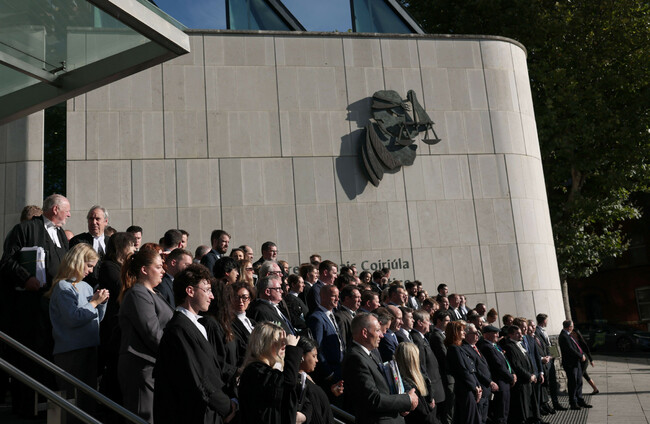
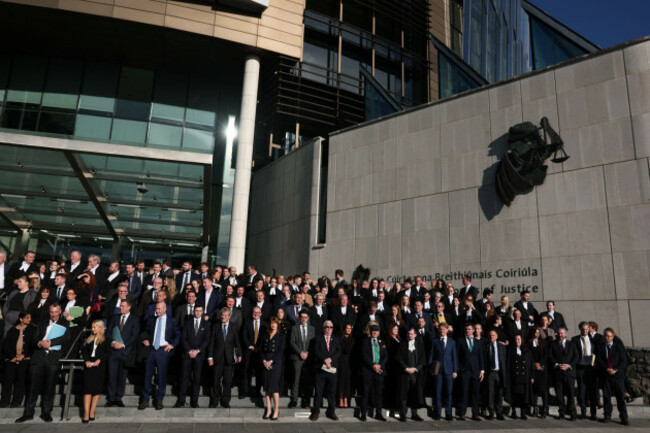
Around 200 criminal defence solicitors and barristers walked out of the Criminal Courts of Justice today to protest over a lack of action from O’Callaghan to settle pay disputes.
Meanwhile, Chief Justice Donal O’Donnell has also expressed “concern” over the ongoing dispute.
Speaking at the Four Courts to open the legal year, he said: “It would be remiss of me on this occasion not to recognise that there is a long-running dispute between solicitors on the criminal legal aid panel and the Department of Justice.
“Some issues relating to that are before the courts including the Supreme Court and that limits what I can say, but I think I can say that the continuation of the dispute is a matter of concern to me and, I believe, judges generally I do hope the dispute can be brought to a conclusion soon.”
Holly Laher, a criminal defence solicitor for Ferrys Solicitors, said confidence in the minister has eroded and criticised his level of engagement.
“I think it’s kind of a cynical ploy. I think that he’s hoping that this actually unfolds and that he doesn’t want to budge on the system,” she said.
“But I don’t think he’s done his homework in relation to it. It won’t be sustainable for the profession to continue. It has a huge impact. It’ll cause a massive backlog, worse than it had been during Covid. The minister needs to negotiate.
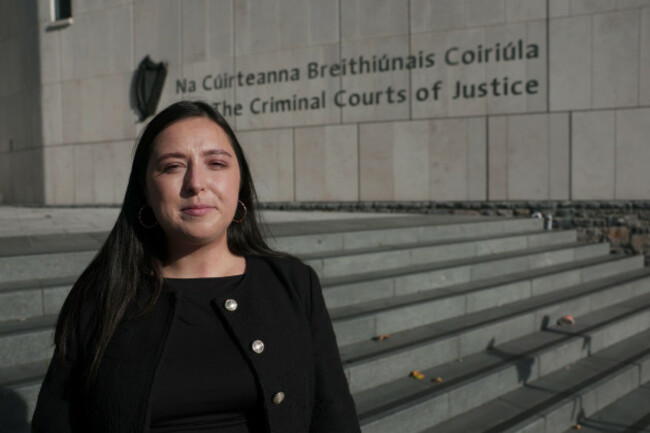
“I think that I have a severe lack of confidence in circumstances where he’s made claims that have no baseline. He has often asserted that delays were caused by solicitors, which he had no data to actually back up. Many inefficiencies are state-led, and I would have serious concerns about the tenability of his position in this circumstance.”
O’Callaghan said he had “very good engagement” with the Law Society and said he would meet them again while keeping “an open mind”.
However, he said he was not going to “make changes based on pressure that’s been put on me through people withdrawing their services from Dublin”.
Asked why he had not released data on the reforms sought by the Law Society, O’Callaghan said: “It is difficult for me to give data that I have as a data controller to somebody who’s not entitled to it.”
The dispute over criminal legal aid arose when O’Callaghan replaced a per-appearance fee with a flat rate in July, prompting hundreds of solicitors to withdraw their services.
Striking solicitors say they are open to reforms but have rejected the flat fee model, which the minister said equates to the average of fee appearances under the old system.
The Law Society said it is happy to compromise. It is calling for additional payment for cases of extended duration and appearances, as well as multiple legal aid certificates for matters with multiple charges, with a cap of five legal aid certs.
However, Amanda Connolly a criminal defence solicitor and vice-chairwoman of the Criminal Law Committee for the Law Society, said there was “nothing to stop him engaging with us prior to that”.
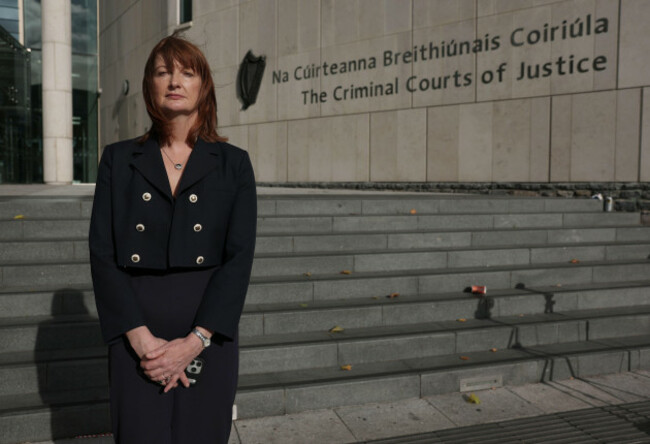
“No dispute is ever resolved without people sitting down and meaningfully engaging with each other. That’s all we’re asking for,” she said.
“It’s going to have a huge impact, especially on people who are waiting… victims of crime, their families, injured parties, who have been waiting for this day for a long time, only to turn up to court and find that their cases are not getting on. It’s regrettable but it is a solvable problem.
More than 100 criminal defence solicitors who practise in Dublin have voted unanimously to extend their withdrawal of services into October as the impasse remains unresolved.
Luke O’Higgins, a criminal barrister protesting alongside the solicitors on Monday, said the dispute is affecting everyone who works in the courts system.
Junior barristers, he said, will have to leave if the issue is not addressed.
“The only possible consequence I see is that solicitors are going to have to do work and not be paid for it,” he said. “All they’re asking for is to be paid for the work they do.
“The courts are quite a delicate ecosystem. A barrister cannot work without the instructions of a solicitor.
“So every single person within this building is being affected.”
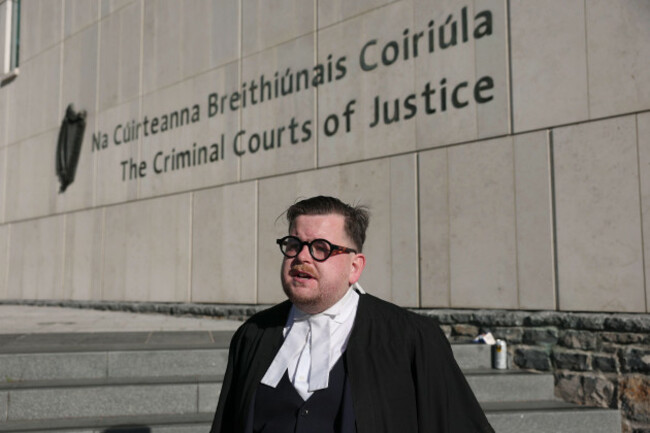
O’Callaghan said the criminal courts are running “effectively” despite the dispute, but O’Higgins rejected this: “The lists are being adjourned en masse today, all dealing with extremely serious matters.
“They return today for an extremely busy term, and nearly all of the cases are going to be adjourned.
“Victims are going to be left waiting. Victims who may have been left waiting before are going to be left waiting again and everything is just going to build up.
“There is already a build-up. We just dealt with the Covid backlog and we’re entering into another backlog again.”

To embed this post, copy the code below on your site












have your say