TheJournal.ie uses cookies. By continuing to browse this site you are agreeing to our use of cookies. Click here to find out more »
Dublin: 11 °C Wednesday 19 June, 2013

Column: Sharing power is bad for the health of junior coalition partners

Sharing government can be like a bad marriage, writes Rory Costello – and it certainly looks that way for Labour.

Rory Costello

COALITION GOVERNMENTS CAN sometimes seem like abusive marriages, with the smaller partner locked into a damaging relationship that it is seemingly unable to leave.

The Fine Gael-Labour coalition has begun to look a bit like this in recent months. Labour has been hurt in recent tussles between the two, most notably the events surrounding the resignation of Róisín Shorthall. If recent opinion polls are anything to go by, Labour also seems to be taking much of the flak for unpopular decisions the government has made. This raises the question: is government always bad for the health of the junior coalition partner?

Examples of small parties faring badly in government are easy to come by. The PDs were nearly wiped-out in 2007 following a long period in government with Fianna Fáil, and later disbanded as a political party. The Greens lost all six of their representatives in the Dáil following their sole stint in government. Looking across the water, support for the Liberal Democrats plummeted when they reneged on some key election promises soon after entering into government with the Conservatives.

Little impact

A lot depends on the circumstances in which the coalition is formed, and in particular whether or not the junior coalition partner can protect itself with a strong programme for government (a kind of pre-nuptial agreement). The PDs in 2002 were in a weak bargaining position, as Fianna Fáil had other options to fall back on; so too were the Greens in 2007. In such circumstances, a small party is unlikely to be able to dictate the terms of the programme for government and can expect to have little impact once the government term gets underway. However, a small party can find itself in the position of kingmaker in the negotiations following an election, being essential to all of the alternative coalitions that could realistically form. It can then play hard-ball during the negotiations and secure key ministerial posts and important policy concessions in the ensuing deal.

A good example of this is the Fianna Fáil-PD coalition formed in 1997. The PDs were in a strong negotiating position, as Fianna Fáil had no realistic alternative partner (Labour had ruled out such a partnership before the election). Despite having only four TDs, they secured the position of Tánaiste and two junior ministries and succeeded in implementing many of their key election promises. They were rewarded in the next election with a doubling of their seats.

Indeed, the evidence internationally suggests that small parties should have nothing to fear from entering into government. Small parties in government tend to get marginally more ministerial positions than they would if it was determined by size alone. Studies also suggest that small parties often punch above their weight when it comes to getting their election pledges into the programme for government. Furthermore, while all parties tend to lose some votes following a period in office (due to the unpopular decisions they must inevitably make), it is the party of the Prime Minister that typically sees the greatest decline in its vote share.

Bargaining position

In this light, it is something of a puzzle as to why Labour has not done better this time out. On the face of it, it would seem that they were in a strong bargaining position after the last election. Fine Gael desperately wanted a coalition with Labour, as the alternatives (Fianna Fáil or Sinn Féin) were unpalatable. Labour, in contrast, would have very likely benefited from a period as the largest party in opposition during a time of severe cut-backs, and so should only have been tempted to enter a coalition under their terms.

As it played out, Labour leaders did not play their hand particularly well. They seemed over-eager to enter government (perhaps with noble intentions of helping to get the country back on track) and as a result did not strike a particularly good deal. The division of ministerial posts was proportional to the size of the two parties (with Fine Gael getting 10 ministers, Labour 5) and the agreed programme for government was noticeably vague on detail.  This means that Fine Gael now have greater scope to determine government policy: they hold the majority of cabinet seats, and are not constrained by a detailed list of commitments in the programme for government.

However, Labour’s current unpopularity cannot just be attributed to a poor coalition deal. Implementing an austerity programme is politically more damaging for a left-wing party like Labour (a long-term advocate for strong social welfare and public spending) than it is for Fine Gael. More deep cuts to public spending will be announced in the upcoming budget and Labour’s poll ratings will most likely continue to slide. Whatever their reasons were for going into government, it would appear to have been the wrong decision for the long term health of the party.

Rory Costello is a lecturer in the Department of Politics and Public Administration at the University of Limerick, specialising in EU politics and political representation.

Column: Why hasn’t a far-right party like Golden Dawn emerged in Ireland?>

  • Share on Facebook
  • Email this article
  •  

Read next:

Comments (24 Comments)

  • They were experienced long term politicians, they went in with their eyes open, they promised, what they knew was not possible, before the election. They negotiated a wishy washy programme for government. They wanted power after years in opposition. The trappings were the target, the people are only a vote to them in the power money game. They are worse than the rest of them because of the betrayal of the vulnerable who believed their words. Would Connolly be proud of them now.

    Reply
  • The PD’s and the Greens were destroyed by going into colition as juniors. Labour are doomed to repeat the mistakes of the past…

    Reply
    • Both had a common denminator…FF! Coalitions tend to work ok in other countries (UK being the big exception) but it’s the political model in this country destroys political partnerships. From day 1 it’s a ‘protect de set’ mentality kicks in. Therefore the two partners don’t work for the good of the nation but rather the good of each others parties…uneasy bedfellows whose policies might be polar opposites but are thrown together just to form a government. When you think of it..who else did poor ole Enda have to talk to? As a result Labour are thundering happily along to oblivion safe in the knowledge they are set up financially. Their party however is destined for the politcal wasteland for a while.

      Reply
  • Gilmore! Egotistical maniac! I used to think he was a man of integrity, prepared to stand up for what he believed in, no matter what. How wrong was I.

    Reply
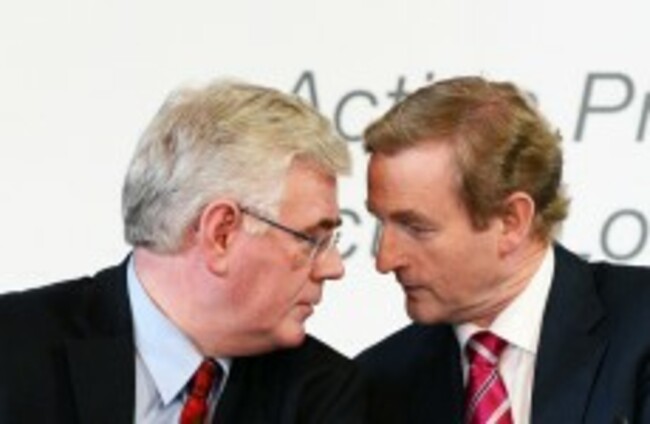
  • ha how sweet a photo of. gilmore and enda about to kiss and make up

    Reply
  • They labour under the direction of FG and the troika ,that,s what labour do ,that,s their function all the oldie,s know they are goner,s , the only thing left for them are the big pension,s just like the FF,s

    Reply
  • Labour has lost any credibility or trust. They will be demolished at the next election (if they make it that far).
    They have formed the worst and most dispised govrrnments this country has ever seen.
    They turned out to be lieing sleeveens and lapdogs for kenny as fg play buddy buddy politics.

    Reply
  • Yeah but think of all that extra salary and pension money Gilmore is clocking up. That job for his wife as well. They are coining it in. Who cares what the public think when you are loaded.

    Reply
  • Labour historically gets 10% of the vote. In the latest poll they are on 14%, down from the 19% they got in 2011 but above what they were used to getting in most elections. If an election were held today, the most likely outcome would be either a re-elected FG/Lab coalition perhaps with the support of independents or a FG/FF coalition, which would suit Labour and SF. With FF gone from a 40% party to a 20% party, the old rules about coalition partners and election outcomes for small parties coming out of coalitions may have changed.

    Reply
  • I had hoped Labour would act as a social conscience to tame FG’s Thatcherite tendencies. How wrong and naive I have proved to be. There is not a modicum of care for the impoverished people of our land and Labour ministers seem to be puppets.
    That they didn’t stand by their own and instead allowed bully boy Reilly to stay in his post…means as long as they are led by Greedy Gilmore, they won’t be getting my vote… Anyone know if there are any socially minded centrist politicians?

    Reply
  • Whose breath smells worse, from all the shite they talk…?? Pair of clowns…!!!

    Reply
  • Labour’s next election slogan….

    Vote Labour, one hundred years experience doing a capital job.

    Reply
  • “Furthermore, while all parties tend to lose some votes following a period in office (due to the unpopular decisions they must inevitably make), it is the party of the Prime Minister that typically sees the greatest decline in its vote share.”

    That’s a bit of an indictment of liberal democracy really isn’t it? If governments really made decisions in the ‘public interest’ rather than the interests of elites, then they wouldn’t ‘inevitably’ make unpopular decisions and so would gain votes in the next election. Or are the general public just too thick to know what’s good for them? I suspect the author has a fairly elitist view of how ‘democracy’ should work.

    Reply
    • Yes. That viewpoint, widely shared, infantilises the population. Enda and Eamon are the ‘firm but fair’ parents making the ‘tough decisions’ that will inevitably makes us cry but are good for us!

      As you rightly say, if their decisions were in the general interest of the collective (impossible to please everyone, granted) it would make them popular, not the opposite.

      Reply
    • It’s not an elitist view, it’s just that being in government involves making decisions that please some but not others. There is a negativity bias – we tend to remember the decisions that we didn’t like more than the ones we did. This is why governments tend to lose votes at the next election. Opposition parties can simply criticise every government decision and they benefit from this.

      Reply
    • Democracy when it becomes populism is a highly dangerous things.., most modern dictators (in Europe at least) swept to power by the popular vote.. (Hitler & Mussolini to name the best known). Closer to home the FF government of 2007 was elected by popular vote and did exactly what the electorate wanted ( totally disregarding financial best practice).
      Before others click the red thumb, I absolutely agree the views of the people need to be considered and should never be sidestepped… We should be fully informed and treated as adults but also lets be honest.. we can act out of self interest … We will try to avoid pain, even if others lose out… That’s why we need leaders.. People who take a more objective view….and yes this can mean.. Going against the populist view.. Otherwise, women would still not have the vote, slavery would still be legal and racism would still be accepted…
      Just because a majority want something does not of itself make it right/ good any more than something is good/right simply because someone in a position of power says it is.

      Reply
  • Dick Spring as Labour leader was swept out of power in the last coalition labour were involved in.labors years in the political wilderness in opposition to whatever traitorous party is in power will be serenity and looks like Goebbels Gilmore will lead the Champagne Socialists labour party to oblivion like the Green party but also hope Fine Gael and fianna fail are also l hope will be wiped by the electorate if they have any balls.

    Reply
  • @Shane everyone who’s elected ‘sweeps to power by popular vote’ so I don’t see the point you’re trying to make there. And I do think it’s fundamentally undemocratic to imply that leaders being popular is ‘highly dangerous’ rather than a sign they might be doing a good job. For example, Hugo Chavez in Venezuela has consistently had one of the highest approval ratings of any head of state because he has been redistributing wealth to the poor majority of the population, who keep voting him back in. He is extremely unpopular with most of the population and very unpopular with the Venezuelan elite.

    By contrast, most governments rule in the interests of a narrow elite, while making various concessions to the majority in order to maintain social stability. FF is a classic example of such a party. When economic times were good, it could make more concessions to the general population and so was very popular. When times got bad it quickly revealed its true colours and protected the elite by bailing out the banks and the developers and getting everyone else to pay for it.

    FF then got booted out at the next election and people voted in FG and Labour who assured everyone during the election that they would be different and rule in the people’s interest. Now that it’s patently obvious that FG-Lab are just as loyal to the elite as FF, they are losing support – especially Labour which leaned less on the ‘keeping Ireland safe for business is good for everyone’ trickle-down argument than FG. Capitalism is the reason all governing parties tend to lose out at the next election, not democracy.

    Reply

Add New Comment