Sign in. It’s quick, free and it’s up to you.
An account is an optional way to support the work we do. Find out more.
Sign in. It’s quick, free and it’s up to you.
An account is an optional way to support the work we do. Find out more.
LAST UPDATE | 29 May 2025
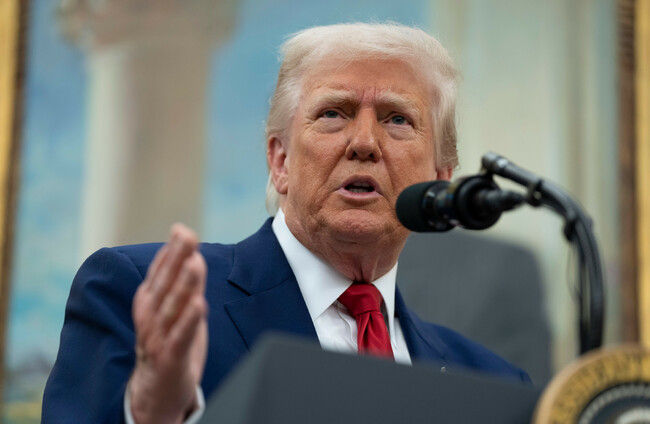
THE UNITED STATES has temporarily reinstated Donald Trump’s tariffs after a ruling blocking them was challenged.
The order from the US Court of Appeals for the Federal Circuit, known as an administrative stay, means that for the time being, the tariffs remain in effect.
Prior to the appeals court decision, the Trump administration had been given ten days to complete the process of halting affected tariffs.
The White House had blasted the “blatantly wrong” decision to block many of the sweeping tariffs, which was a momentary setback for the president.
Since returning to the presidency in January, Trump has moved to unilaterally redraw US trade ties with the world, using tariffs as a tactic to pressure foreign governments into negotiating.
But the stop-start rollout of levies, impacting both friend and foe, has roiled markets and snarled supply chains.
On Wednesday, the three-judge Court of International Trade in New York ruled that Trump had overstepped his authority, and barred most of the duties announced since he took office.
The judges said the case rested on whether the International Emergency Economic Powers Act of 1977 (IEEPA) delegates such powers to the president “in the form of authority to impose unlimited tariffs on goods from nearly every country in the world.”
They stated that any interpretation of the IEEPA that “delegates unlimited tariff authority is unconstitutional.”
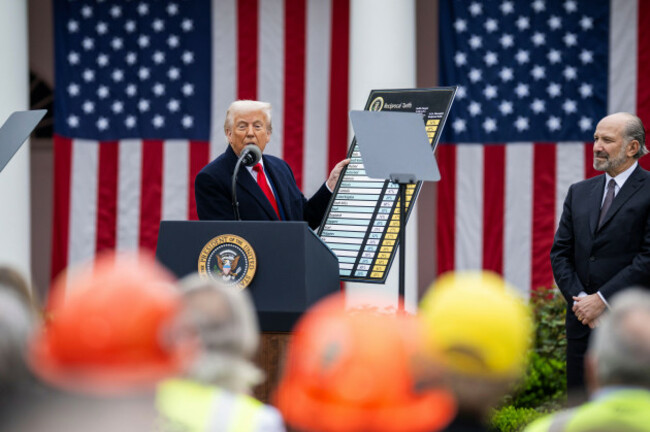
White House spokeswoman Karoline Leavitt told reporters that the judges “brazenly abused their judicial power to usurp the authority of President Trump”.
Stocks worldwide began to rise following the court’s decision. The S&P 500 was 0.8% higher in early trading on Thursday, while the Dow Jones Industrial Average was up 64 points, or 0.1%, and the Nasdaq composite was 1.4% higher.
Trump had said he would impose of 50% tariffs on all EU imports to the US from 1 June.
He has since postponed the move to 9 July following a “very nice call” with European Commission president Ursula von der Leyen.
Tánaiste Simon Harris urged “calm” and “measured” dialogue on both sides.
“The continuing uncertainty over tariffs is the source of serious concern for businesses, here in Ireland but also across the EU and the US,” he said.
“Businesses that are concerned about their cost base, their workers, and their plans to invest.”
Trump’s trade advisor Peter Navarro told Bloomberg Television after the tariff halt: “Nothing’s really changed.”
Before it was appealed, Kevin Hassett, director of the National Economic Council, told Fox Business that “hiccups” because of decisions by “activist judges” would not affect negotiations with other trading partners, adding that three deals are close to finalization.
Trump’s global trade war has knocked markets with import levies aimed at punishing economies that sell more to the United States than they buy.
He argued that resulting trade deficits and the threat posed by drug smuggling constituted a “national emergency” that justified the widespread tariffs which the court ruled against.
Trump has been using tariffs as leverage in trade negotiations, including with the EU and China.
The federal court’s ruling momentarily squashed duties that Trump imposed on Canada, Mexico and China separately using emergency powers.
But it left intact 25% duties on imported autos, steel and aluminum.
Beijing, which was hit by additional 145% tariffs before they were temporarily reduced to give space for negotiations, reacted by saying Washington should scrap the levies.
“China urges the United States to heed the rational voices from the international community and domestic stakeholders and fully cancel the wrongful unilateral tariff measures,” said commerce ministry spokeswoman He Yongqian.
With reporting from AFP and PA.
To embed this post, copy the code below on your site












have your say