Sign in. It’s quick, free and it’s up to you.
An account is an optional way to support the work we do. Find out more.
Sign in. It’s quick, free and it’s up to you.
An account is an optional way to support the work we do. Find out more.
LATE LAST WEEK, the US government went into a partial shutdown over an impasse on how President Donald Trump’s proposed US-Mexico border wall would be funded.
It followed his continued demands for $5 billion (€4.4 billion) for the construction of the wall to curb illegal immigration, something to which Democrats are staunchly opposed.
The partial shutdown grabbed headlines over Christmas, and overshadowed a major bipartisan victory for the president last week: the passing of the First Step Act.
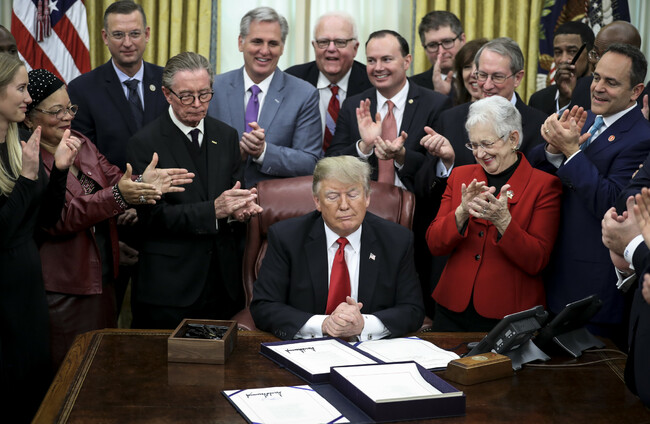
That bill was signed into law on Friday 21 December, after passing in the Senate by a vote of 87-12 earlier in the week.
Its passing has paved the way for the most significant changes to the US criminal justice system in decades – but what is it all about?
What is the bill?
In short, the First Step Act is an attempt to reform the US federal prison system by reducing rates of re-offending and changing some aspects of sentencing.
It applies only to federal prisons – national prisons which operate under the control of the federal government, as opposed to state governments – which are home to about 180,000 prisoners, less than 10% of all inmates in the United States.
But its provisions will ease heavy sentences for certain offenders, give judges more discretion in sentencing low-level criminals, and improve prison conditions for women and terminally ill prisoners, among others.
Many also believe it will offer a path to freedom for hundreds of black and Latino inmates who were incarcerated in a justice system that critics have argued unfairly affects minorities.
What does the bill contain?
The major provisions of the First Step Act for those already serving time are as follows:
Will it change how offenders are sentenced?
Some of the most significant changes that have been brought about by the bill involve how offenders are sentenced:
What part did Donald Trump play in getting the bill passed?
It’s worth noting the efforts of Trump’s predecessor Barack Obama to see how the current president actually got the bill over the line.
During his presidency, Obama sought to make criminal justice reform part of his legacy and became the first president to visit a federal prison while in office.
And he made some changes to the criminal justice system in 2010, when he introduced legislation that reduced the disparities between mandatory crack and powder cocaine sentences.
But some of his other efforts to reform the system - such as proposed laws which would have relaxed mandatory minimum sentences – failed despite having significant bipartisan support.
Many Republicans simply didn’t want to be seen to be handing Obama a key victory during his presidency.
In fact, many features of the First Step Act were introduced in 2015, passing in the Senate Judiciary Committee, before stalling with some Republicans adamantly opposed to it.
However, Trump’s support for the bill changed this dynamic, as it provided political cover to Republicans who had previously considered supporting it.
“America is the greatest country in the world and my job is to fight for all citizens even those who have made mistakes,” Trump tweeted after the Senate passed the bill last week.
What other reaction has there been?
Certain advocacy groups have been critical of the bill for not going far enough, saying that changes which eased the severity of mandatory minimum sentences should have applied retroactively.
That would have meant that prisoners sentenced to life in prison under the ‘three strikes’ rule should have been able to petition for the 25-year minimum that will be established under the legislation.
Others have also argued that the bill’s provisions contain too much overlap between drug dealers and violent offenders, with the nonviolent drug offenders seen as benefiting from the bill actually amounting to a very small portion of the prison population.
Nevertheless, the passing of the bill has been celebrated by top Democrats and Republicans.
Democrat leader Nancy Pelosi said the legislation “will bring hope, healing and renewal to thousands of lives”.
“Members of Congress came together to write a bill that reduces the impact of draconian mandatory minimums, and makes progress to address discriminatory sentencing laws,” she said.
Her sentiments were echoed by outgoing House Speaker Paul Ryan, who said: “These reforms to our criminal justice system will not only reduce recidivism and make communities safer, but they will help people into lives of purpose.”
So despite some criticism, the passing of the First Step Act is clearly being seen as one of the bigger successes of Trump’s presidency.
With additional reporting from Associated Press.

To embed this post, copy the code below on your site














have your say