Sign in. It’s quick, free and it’s up to you.
An account is an optional way to support the work we do. Find out more.
Sign in. It’s quick, free and it’s up to you.
An account is an optional way to support the work we do. Find out more.
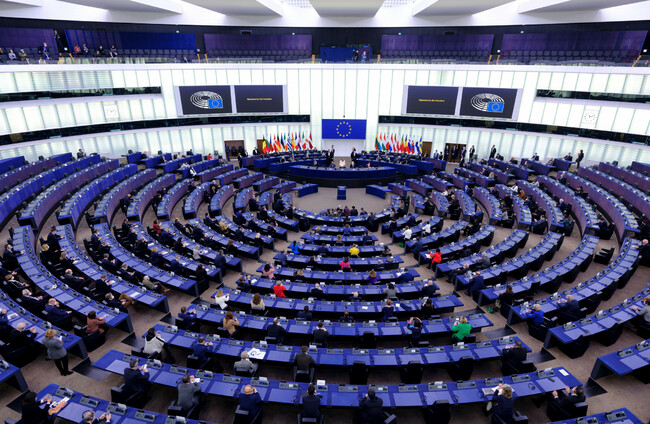
FOUR IRISH MEPS have been criticised for not supporting a European Parliament resolution which condemns “continuous efforts” by Russia to interfere in European democracy.
The resolution was passed today with 433 votes in favour, 56 against and 18 abstentions.
The resolution also expressed alarm at “alleged relations between Catalan secessionists and the Russian administration”.
Independent Irish MEPs Luke Ming Flanagan, Clare Daly and Mick Wallace were among the 56 to vote against the motion while Sinn Féin’s Chris MacManus abstained.
The passed resolution text expressed “deep concern” about reports that Latvian MEP Tatjana Ždanoka may have acted as an informant for Russian security service FSB.
Last week, emails between Ždanoka and her alleged Russian handlers were leaked by an independent investigative outlet in Latvia. Following this, the European Parliament announced a probe into the allegations.
In addition to this, today’s resolution also stated that MEPs are worried about Russia “providing narratives to far-right parties and actors across the EU in order to subvert support for Ukraine”.
Additionally it said that the parliament is “alarmed” about alleged relations between Catalan secessionists and the Russian government.
Green Party MEPs Ciarán Cuffe and Grace O’Sullivan, alongside Fianna Fáil MEPs Barry Andrews and Billy Kelleher, also voted against the inclusion of an amendment which said the alleged relations between Catalan secessionists and the Russian administration were “extremely concerning”.
However, the four MEPs voted in favour of the resolution as a whole, as did Fine Gael’s 5 MEPs.
Barry Andrews explained that he voted against the particular amendment which named Catalan leaders because he felt that as it is a matter already before the Spanish courts, it would not be appropriate for the European Parliament committee to examine it.
Ming Flanagan told The Journal that he would have voted in favour of the resolution if it did not include the references to the Catalan independence movement.
He said he saw today’s text as a means of giving the movement “a kicking”.
“I support their right to self determination so I couldn’t support this attack on their movement.
“MEPs should have stuck to the topic and then I’d have supported it. But they didn’t. As with all European Parliament resolutions the devil is in the detail,” he said.
Likewise, MacManus told The Journal that he abstained from the vote because it “was an attempt to settle scores on a range of unrelated issues”.
“I take the whole issue of Russian interference in democratic processes very seriously, as well as interference by other countries and companies. I am particularly concerned by clear Russian links to right-wing parties and movements,” he said.
MacManus added that he believes the resolution is an attempt to “bypass due process, and cast innuendo on political opponents, such as supporters of Catalan independence.”
Criticism
Fine Gael MEP Séan Kelly criticised the Irish MEPs who voted against the resolution, telling The Journal:
“I find it difficult to understand that MEP’s who have the privilege of living in a democracy, turn a blind eye to actors trying to undermine and destroy that democracy.”
Similarly, Labour TD Aodhán Ó Ríordáin who is running in this year’s European Parliament elections said the actions of some Irish MEPs to vote against the resolution was “shameful and shocking”.
“Russia has displaced entire communities, destroyed their homes, and continues to put lives at risk. It is completely unacceptable that MEPs would vote against investigating any ties the Kremlin has with European politics,” Ó Ríordáin said.
Additional reporting from AFP.

To embed this post, copy the code below on your site













have your say