Sign in. It’s quick, free and it’s up to you.
An account is an optional way to support the work we do. Find out more.
Sign in. It’s quick, free and it’s up to you.
An account is an optional way to support the work we do. Find out more.

LAST UPDATE | 27 Aug
GLOBAL STRIFE AND climate change have yet again put the focus on food production and its vulnerabilities, and many Irish farms have struggled this year. While much of the narrative has been dominated by larger scale producers at the commodity end of the supply chain, there has been a quieter revolution from farmers across the country who have not struggled in the same way. Change is afoot.
Ireland is a small country. And despite all the ‘feeding-the-world’ claims, it produces food for less than 0.5% of the world’s population… at the continued expense of our natural resources.
We import vast quantities of fossil fuel-based fertiliser (we are the EU’s highest user per hectare according to Eurostat) to support exports from our grass-based livestock system, leaving behind the excessive pollutants. Consequently, we’ve been unable to decouple pollution from this business-as-usual model of agriculture in any significant way.
And for decades, we’ve been told there is no other way, because:
Under this model, the economy always wins out… at the expense of the environment.
Surrendering ourselves to the highly competitive global commodity market has put us at a distinct disadvantage as a small country. We are simply too small to compete on volume, and so we must therefore compete on quality – something we are struggling to achieve of late. Our milk prices have been under significant pressure due to global overproduction, and Irish beef seems to be under constant threat from imports into the EU. Remember Mercosur, anyone?
Are there any solutions to this agricultural model which sees farmers vulnerable to volatile markets, input costs and weather, a model which continues to extract from our natural resources, polluting and degenerating as it goes?
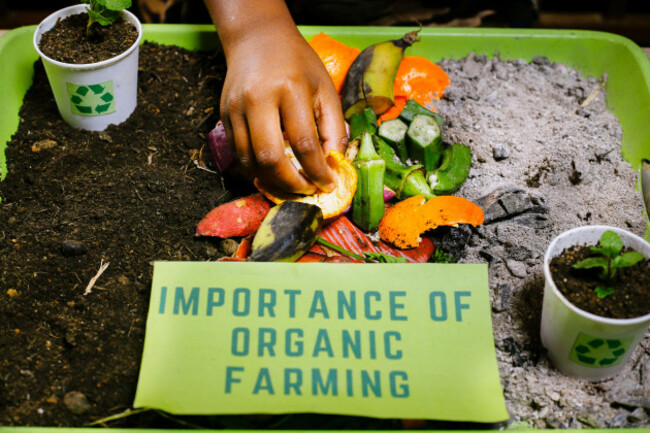
Going Organic is one such solution. A suggestion which will send a chill down the spine of every fertiliser and agrochemical company CEO in Ireland. And maybe not such a crazy idea as people might think.
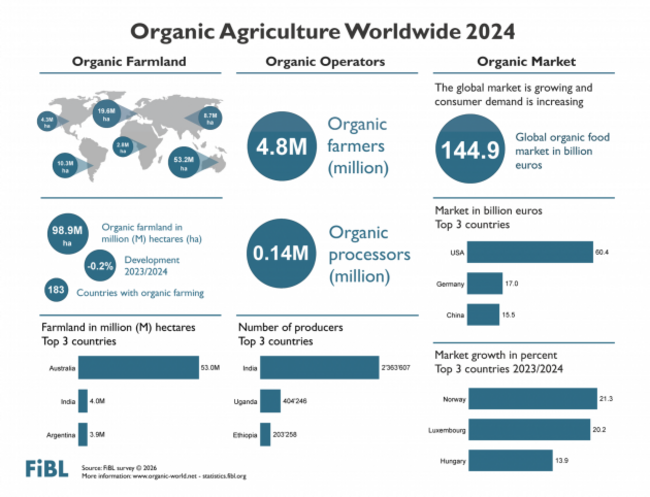
Organic farming is a widely recognised, certified and regulated system of farming which works with nature to grow crops and produce food. The global organic market is worth about €150 billion per year, and some projections indicate that this will grow to €575 billion by 2034. Ireland’s total agri-food exports currently stand at about €19 billion per year.
Let’s look at a few figures:
Ireland’s use of fossil fuel-based Nitrogen fertiliser contributes over 20% of the total GHG emissions from agriculture (CSO data). Blended with finite mined minerals, phosphorus and potassium, this synthetic mix drives pollution and overproduction, it impacts negatively on soil health and water quality, and it puts a hole in farm profits.
Gone are the days of cheap fertiliser and the predictable weather that is needed to support its function in monocrop production.
Pesticide use is known to harm biodiversity (above and below ground), and supports a globalised system of trading that lacks diversity, resilience and stewardship – with a small number of giant corporations controlling more than half of the seed and pesticide markets.
And pesticide residues in our water and in our bodies are a real concern.
Going Organic removes all of those complications.
Opponents of organic agriculture often quote the example of Sri Lanka, when in 2021, sought to support organic farming by banning the importation of fertilisers and pesticides. Anyone with an ounce of agronomical sense would know that turning the chemical tap off like this would be like going cold turkey for a heroin addict. The withdrawal symptoms are too great, and a much more progressive and structured approach is needed if it is to be successful.
The transition towards using natural ecology (rather than chemical technology) to grow crops and food needs time. Farmers need time to change the way they think and farm; soil biology needs time to recover; and crops need time to move away from their lazy spoon-fed ways and start seeking out their own nutrients from the soil, and not from a bag. Developing resilience to pests and diseases is only possible when you don’t rely on a poisonous chemical to do the job for you.
But back to the possibilities… Ireland has a target of 10% of the agricultural land to be farmed organically by 2030 (which will be a sizeable increase on the 1.6% in 2020). While we are currently on target at 5% and 5,500 farmers are already on that journey, continued backsliding from the current Government in terms of support is likely to make this target unattainable.
Yet in May 2024, when I was Minister of State in the Department of Agriculture, Food and the Marine with responsibility for the organic sector, I was proud to hear one of the most progressive officials in my Department question in a public forum why our ambition wasn’t much bigger – proposing 100% by 2050, and bringing with it the potential to market Ireland as an organic island across the world. It certainly ruffled a few feathers. Some might see it as pie-in-the-sky, but I think it’s a proposal worthy of serious consideration.
The benefits for our tourism, our water quality, our biodiversity, our emissions profile and our food quality would be immeasurable. Coupling that with an all-island approach would bring substantial benefits across this whole island.
Critics will say it can’t be done; that billions will be wiped off our economy, that jobs will be lost. I disagree.
Think about our increased attractiveness for investment, and the added value to all aspects of our domestic economy. We’d be leading out on a new and unique economy model built on restoring rather than depleting our natural resources, and building resilience across our economy as a whole. And our farmers would lead the charge in driving this new economy, working collectively to deliver a more sustainable future for our island.
Picture a situation where Irish farming is so resilient, that the government doesn’t have to bail out fertiliser strapped farmers because a global conflict has impacted supplies, and the EU’s Carbon Border Adjustment Mechanism (CBAM) is no longer a threat.
Imagine an Ireland where our water quality gets a chance to return to a pristine state, our habitats are restored, and our biodiversity makes a comeback. Reversing the damage of decades of intensified agriculture.
We are facing some massive fines into the future for non-compliance with our climate commitments, and Europe will soon grow tired of turning a blind eye to Ireland and its repeated calls for special status.
We have the potential to be the world’s leading producer of organic food — think how that would look on Bord Bia trade stands across the world. No more ducking and diving and avoiding ever-increasing scrutiny. An Origin Green brand to be proud of, and no need to reinvent the wheel on certification to produce a product aimed at the premium end of conscientious global consumers.
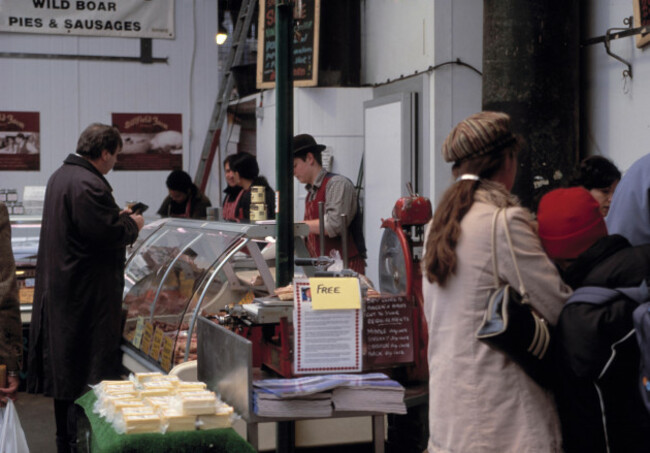
And we would no longer be competing against Australia or South America or New Zealand – because our beef and our milk, and our grain and our horticulture would be best in class, beyond the conventional competition. Yes – our challenged grain and horticulture sectors might finally get the space to grow and reach their full potential to ensure true food security on our own island for the first time in generations.
Going Organic could fix so many of our problems: no more GMOs in our animal feeds, no MCPA in our drinking water, and no risk of pesticide residues in our food. No more battles on nitrates derogations. No need for a fertiliser register or for pesticide training, and a farming system that is no longer dependent on fossil-fuel-based fertilisers and finite mined minerals.
Better water, better biodiversity, better health.
A real circular economy which does not expel its excess nutrients into our air and water, but which makes efficient use of nature’s abundant resources.
It’s not beyond the realms of possibility. It can be done. And we have 25 years to support farmers and our land to do it.
I rest my case.
Dr Pippa Hackett is a former Green Party Minister of State in the Department of Agriculture, Food and the Marine. She has a PhD and runs a farming and bloodstock enterprise with her husband in Co Offaly.
To embed this post, copy the code below on your site









have your say