Sign in. It’s quick, free and it’s up to you.
An account is an optional way to support the work we do. Find out more.
Sign in. It’s quick, free and it’s up to you.
An account is an optional way to support the work we do. Find out more.
LAST UPDATE | 27 Aug
IRELAND’S DEPARTMENT OF Foreign Affairs confirmed it is working to account for two Irish citizens missing in Nepal.
In a statement, the department said it continues to “closely monitor the situation”, “and, together with partners, is working to account for two Irish citizens visiting the area”.
It said it would not comment on the detail of individual cases.
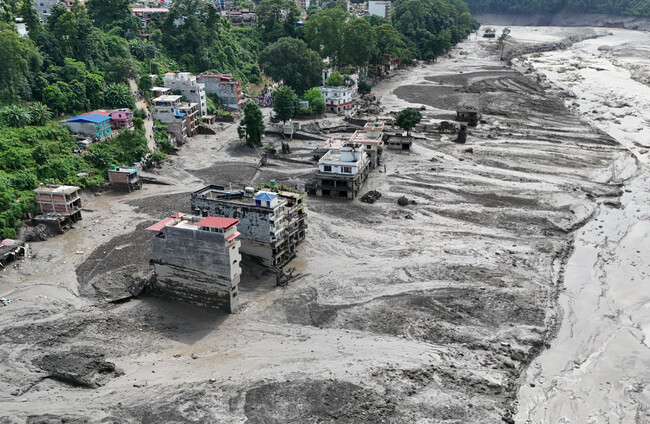
Rescue teams are searching for more than 1,400 people missing on the Nepal-Tibet border after devastating flash floods and landslides killed at least 392 people and swept away entire villages.
Officials said the sudden torrent was likely caused by a flood involving a glacier and resulting landslide. The tsunami-like rumble of water and mud struck villages and towns on the path of two rivers – Bhote Koshi and Trishuli.
Nepali police have recovered 392 bodies, as of 5pm Irish time. The country’s disaster agency said some 823 people remain out of contact.
The Nepal Tourism Agency said that 667 who were travelling with tourism agencies are reported missing.
Among those are 540 foreign tourists, including the two Irish nationals who are believed missing in the Rasuwa region, where they had been on an excursion.
The Irish Department of Foreign Affairs earlier said: “The Department, including the Embassy of Ireland to India which covers Nepal, will provide consular assistance to impacted Irish citizens and their families.”
While Ireland does not have a full embassy in Nepal, Irish citizens requiring assistance can contact the Embassy of Ireland in India at +9111 4940 3200.
The Nepal Tourism Board also said that 31 foreign nationals had so far been rescued, from India, South Korea, Russia, Italy, Bulgaria, Switzerland and the US.
विपद प्रतिकार्यमा नेपाल प्रहरी pic.twitter.com/xqa4GcSRnO
— Nepal Police (@NepalPoliceHQ) August 26, 2026
Emergency teams were racing to evacuate survivors from affected zones, fearing new flash floods.
Nepali soldiers used sniffer dogs to search for bodies buried under thick grey sludge.
“Everything is finished,” Omkar Joshi, 35, a Nepali customs agent rescued from a hilltop in the border town of Timure, told AFP.
“It is a giant graveyard. All that is left are sand and pebbles, soaked red by human blood.”
Tour operator Alpine Eco Trek said a 13-year-old girl was among 12 missing British nationals. The firm, which offers guided tours and expeditions in Nepal, confirmed four of its Nepalese tour guides are missing as well.
Sunil Sharma, a tourism board spokesman, said 133 of those missing were from India on pilgrimage to Mount Kailash in Tibet – a sacred site for Hindus.
Also among the missing were 47 people from the US, 34 from Australia, and 24 from Canada, he added.
In China, state media said the “mudslide disaster” at the Gyirong Port in Tibet killed three people, while 558 people, including 260 foreigners, are missing.
Raju Bhadel, a businessman in Nepal’s Nuwakot district, recounted receiving a call from his brother-in-law in distress.
SCENES THAT LEAVE YOU COLD
— Rahul Shivshankar (@RShivshankar) August 26, 2026
Chinese government immigration office at Rasuwagadhi border crossing in CHINESE OCCUPIED TIBET swept away.
Chinese President Xi Jinping has ordered all-out efforts to search and rescue people who are missing after the "mudslide" in China controlled… pic.twitter.com/EiXvyVtqBo
“They were crying and said their entire house had been swept away. Three family members were rescued, but his brother is still missing,” he said.
Also at Nuwakot, teacher Manok Mishra witnessed “nine trucks being swept away by the floods including people”.
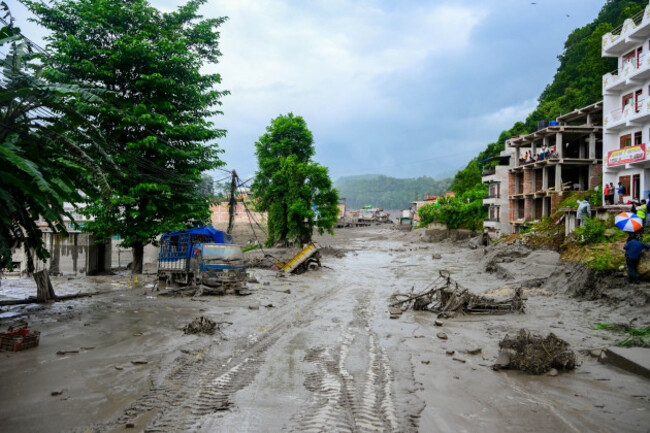
Rescuers waded through mud and sludge to look for survivors after floodwaters buried the lower floors of multi-storey buildings.
Among those hunting for their missing family members was Subash Khatani, who told AFP he was looking for his big brother.
“He is among the missing from Rasuwa. That’s why we are out to search for him,” he said.
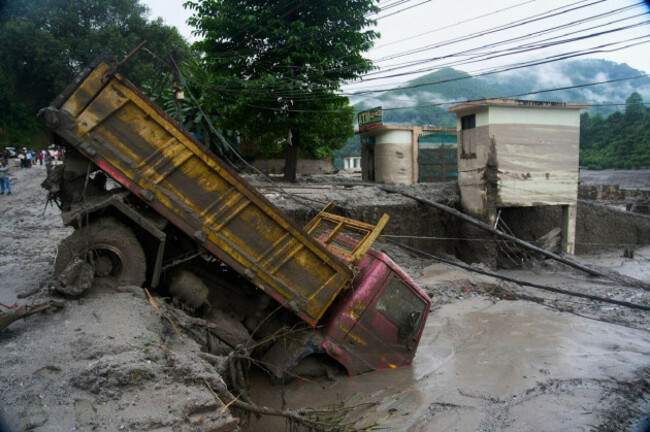
The sudden rush of mud and debris was “like an inland tsunami, travelling nearly 170 kilometres down the Bhote Koshi valley into Central Nepal,” said environmental historian Ruth Gamble of La Trobe University in Australia.
“It is a popular route for international tourists travelling from Kathmandu to Lhasa,” she added.
Rasuwa, in the north of Nepal, was the first district to be affected. But deaths have been reported from seven Nepali districts in total as the flood waters raged through to Chitwan in the south, on the border with India.
The Nepali Army was carrying out flights and had rescued scores of people, while others living near the river in danger zones had been told to relocate.
China’s leader Xi Jinping said that “the most urgent task is doing everything possible to search for and rescue the missing people”, according to CCTV.
On Thursday, Chinese Premier Li Qian arrived the Gyirong Town area on the China-Nepal border to oversee search efforts for more than 500 people missing there, state news agency Xinhua reported.
Tibet government officials mobilised nearly 800 emergency workers and 150 vehicles as well as sniffer dogs and speed boats to help the rescue efforts, China’s state-run news agency Xinhua said.
The International Federation of Red Cross and Red Crescent Societies (IFRC) said it was dispatching emergency supplies including blankets, first aid kits, stretchers and body bags.
The cause of the disaster was not immediately clear in the hours after it occurred early Wednesday, but the US Geological Survey said it was a glacial collapse that caused seismic activity and the “catastrophic” downstream impacts in Nepal and Tibet.
“This event was initially reported as a magnitude 4.4 earthquake,” it said.
“Additional analysis of nearby seismic stations, long period seismic waves, and satellite imagery led to the determination that the seismic event was instead a glacial collapse and debris flow, and that no earthquake had occurred.”
Climate change is causing glaciers to melt worldwide, increasing the risks of glacial lake floods and glacial collapses.
Qianggong Zhang, head of climate and environmental risks at the Kathmandu-based International Centre for Integrated Mountain Development (ICIMOD), warned of the potential for a second flood.
“With a blockage still lodged upstream on the Nepal-China border river, authorities warn a second flood may occur,” he told AFP.
Many trekking companies were not running tours during the monsoon season, but there remain significant numbers of travellers including pilgrims in the region.
Among sites hit by the flood was Syabrubesi, the gateway to the popular trekking areas, as well as by pilgrims travelling to the base of Mount Kailash, a holy site for Buddhists and Hindus.
Traffic authorities in Tibet’s Shigatse said roads in the area were “at risk of mudslides and unsafe for passage”.
With reporting from © AFP 2026

To embed this post, copy the code below on your site












have your say