Sign in. It’s quick, free and it’s up to you.
An account is an optional way to support the work we do. Find out more.
Sign in. It’s quick, free and it’s up to you.
An account is an optional way to support the work we do. Find out more.
LAST UPDATE | 18 May
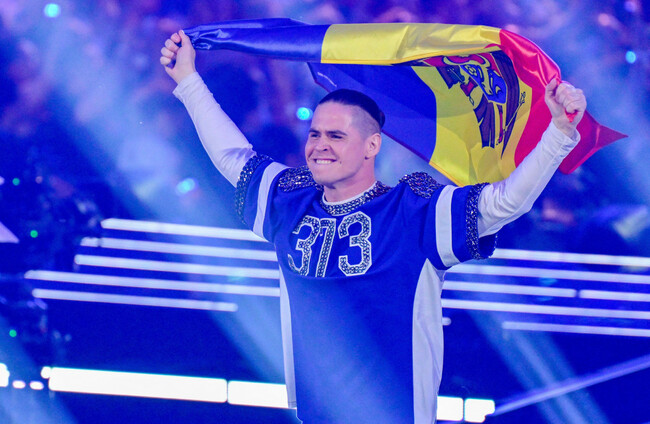
THE HEAD OF Moldova’s public broadcaster has announced his resignation after the country’s jury threw its support mainly behind Israel and Poland in the weekend’s Eurovision competition.
The final of the 70th Eurovision Song Contest – hit by an unprecedented boycott over Israel’s participation – took place Saturday, with juries and the public in each of the 35 participating countries giving points to whoever they thought should win.
Moldova’s jury gave the highest points to Poland with 12 points, followed with 10 for Israel, and gave only three points to Romania and zero to Ukraine, sparking a storm of criticism by Romanians and Moldovans on social networks.
Teleradio Moldova director Vlad Turcanu announced his resignation, citing the “extraordinary” and “serious” event of the jury failing to take into account “sensitivities” between Moldova and its neighbours Romania and Ukraine.
Turcanu is Teleradio Moldova’s equivalent to RTÉ’s Kevin Bakhurst.
“Our stance toward Ukraine is not one of zero points, and our feelings toward Romania can only be ones of love,” said Turcanu, adding that while he did not give instructions to the jury on how to vote, he bears a responsibility for what happened.
Moldova’s public gave Romania the maximum 12 points.
Romania’s Alexandra Capitanescu and her rock song “Choke Me” came third in the contest, with the overwhelming help of the public vote.
Bulgarian singer Dara with Bangaranga won, followed by Israel in second place.
Capitanescu, 22, said she had no hard feelings, thanking Moldovans who voted for her.
“We aren’t upset with the Moldovan jury, which scored the entries as it saw fit, and it’s not right for an entire nation to be held accountable for the decision of just seven people,” Capitanescu wrote on Instagram.
Jury member Viktoria Cusnir said she regretted having accepted the invitation to be in the jury, evoking “a public lynching experience” over the vote, which she didn’t consider “an expression of anti-Romanian sentiment”.
“The issue of the neighbourhood vote should be discussed from the outset, if it is the most important criterion imposed on the jury,” she wrote on Facebook.
Meanwhile, Russia’s foreign affairs minister today claimed that participation in the Eurovision Song Contest requires “outright Satanism”.
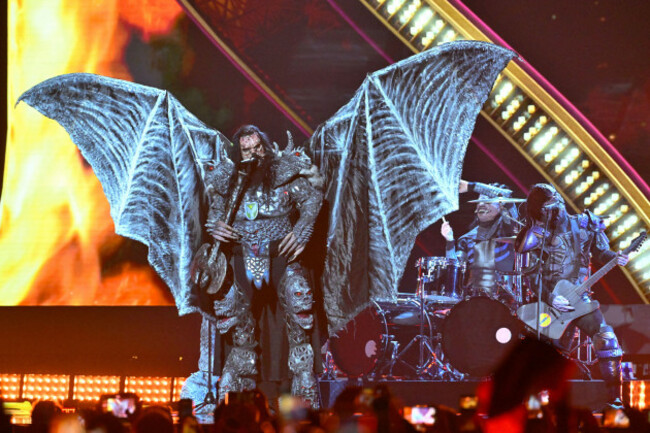
The Eurovision Song Contest is organised by the European Broadcasting Union (EBU), which banned Russia in 2022 following the invasion of Ukraine.
In the immediate aftermath of the invasion, the EBU said it was “monitoring the situation” and that Russia would remain in that year’s competition.
However, that decision was reversed within 24 hours, with the EBU stating that “in light of the unprecedented crisis in Ukraine, the inclusion of a Russian entry would bring the competition into disrepute”.
Russia’s state-owned news agency TASS today released remarks from Sergei Lavrov commenting on the Eurovision.
He claimed that Russia “won’t be able to meet the criteria currently used to determine Eurovision participants, which are truly outright Satanism”.
“We won’t be able to meet them, honestly,” he added.
Last week, Eurovision director Martin Green said that Russia could “theoretically” be admitted back into the song contest, even if the war in Ukraine remained ongoing.
One MP labelled this “moral cowardice”.
However, Green has since said there are “no conversations going on on the return of the Russian broadcaster to Eurovision, there are no plans for that to happen”.
Last year, Russia launched its answer to the Eurovision, the “Intervision Song Contest”.
It was originally launched in 1965 as the Soviet Bloc’s answer to Eurovision but ended in 1968, before coming back for a few years in the late 70s, as well as a one-off in 2008.
Russia president Vladimir Putin hailed Intervision as a “respecting traditional values and different cultures”.
Russia’s closest allies such as Belarus, Kazakhstan and Cuba, alongside BRICS partners China, India, Brazil and South Africa were among 22 countries to perform last year.
This year’s version of Intervision is due to take place in Saudi Arabia.
- With additional reporting from © AFP 2026

To embed this post, copy the code below on your site













have your say