We need your help now

Support from readers like you keeps The Journal open.

You are visiting us because we have something you value. Independent, unbiased news that tells the truth. Advertising revenue goes some way to support our mission, but this year it has not been enough.

If you've seen value in our reporting, please contribute what you can, so we can continue to produce accurate and meaningful journalism. For everyone who needs it.

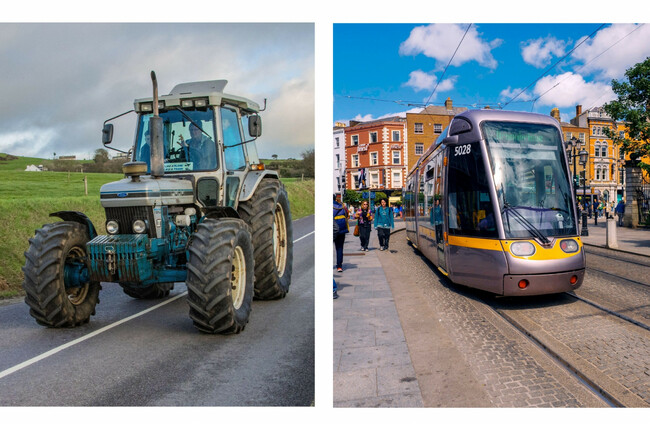
A tractor in Co Cork and a Luas tram in Dublin city centre

'No evidence' of a rural-urban divide on climate change, new study finds

The ESRI also found that farmers and non-farmers hold misperceptions of each other’s attitudes.

THERE IS NO evidence of an urban-rural divide when it comes to people’s level of worry and willingness to take action in response to climate change, a new study from the Economic and Social Reseach Institute (ESRI) has found. 

The ESRI has also found that farmers and non-farmers each underestimate the other group’s level of worry and willingness to act.

The ESRI’s behavioural research unit surveyed 467 farmers and 1,200 non-farmers, split evenly between rural and urban residents.

In the ESRI survey published today, farmers were asked about adopting sustainable farming methods such as green technologies, while non-farmers were asked about changing transport habits, diet and energy use. Participants were also asked how they perceived the views of others.

“The findings reveal widespread misperceptions,” the ESRI said.

On average, both farmers and non-farmers expressed worry about climate change and willingness to take action, but non-farmers underestimated farmers’ actual level of worry and willingness. All groups underestimated the general public’s level of worry and willingness.

The study found no evidence of a difference in attitude between rural and urban areas.

“Rural and urban residents do not differ in how much they worry about climate change, their willingness to change their behaviour to help reduce climate change, or their perceptions of others’ attitudes,” the ESRI said. 

The study also found that people tend to wrongly believe that their own opinions are largely reflected in the wider population.

“Respondents who were least worried and willing to act assumed, incorrectly, that others share their views, while those who were most worried and willing to act were more likely to think that others feel the same,” the study’s authors said. 

“This study reveals misperceptions within and across groups in Irish society that could undermine climate cooperation,” said Lucie Martin, lead author of the study and research officer at the ESRI.

“Evidence shows that most people decide whether to act based on whether they think others will, too.”

Professor Pete Lunn, head of the behavioural research unit and a senior author of the study said that “damaging misperceptions” can arise when it comes to willingness to change habits “if people do not see other people acting as part of the same climate effort”.

Unsure of what exactly is happening with the earth’s climate? Check out our FactCheck Knowledge Bank for essential reads and guides to finding good information online.

Readers like you are keeping these stories free for everyone...
A mix of advertising and supporting contributions helps keep paywalls away from valuable information like this article. Over 5,000 readers like you have already stepped up and support us with a monthly payment or a once-off donation.

Close
13 Comments
This is YOUR comments community. Stay civil, stay constructive, stay on topic. Please familiarise yourself with our comments policy here before taking part.
Leave a Comment
    Submit a report
    Please help us understand how this comment violates our community guidelines.
    Thank you for the feedback
    Your feedback has been sent to our team for review.

    Leave a commentcancel

     
    JournalTv
    News in 60 seconds