Sign in. It’s quick, free and it’s up to you.
An account is an optional way to support the work we do. Find out more.
Sign in. It’s quick, free and it’s up to you.
An account is an optional way to support the work we do. Find out more.

LAST UPDATE | 28 Jul

The FOI Files is a series from our team at The Journal Investigates. Each week, one of our investigative journalists brings you inside the fight for information that we’re all entitled to. They’ll share their documents, their stories – and tips on how to take the journey for yourself.
This week’s file is from investigative journalist Patricia Devlin.
See here for The Journal Investigates’ most recent investigations.
LAST YEAR I asked Tusla for records it held on incidents involving children who had gone missing from State care.
Tusla granted the request, providing documents that showed it had recorded a total of 6,972 “missing in care” incidents between January 2020 and September 2025. The figures related only to children housed in its own residential care facilities.
While the figures were striking, they didn’t answer a very important question – were thousands of different children going missing from residential homes every year, or were some children repeatedly disappearing?
So, on top of asking Tusla for the total number of incidents, I also asked for the number of individual children represented within them, with one extra question – the highest number of reports involving any single child in each year.
That question led to the focal point of our investigation which revealed how a child in Tusla care was reported missing 274 times in a single year
The Journal Investigates made the FOI request came in the wake of a series of serious and high profile cases involving children known to the agency.
This included the alleged sexual assault of a 10-year-old child who had gone missing from a residential care facility hours prior to the alleged attack.
In response, Tusla provided a number of different tables answering my questions. The FOI data relates specifically to Tusla-operated residential centres – including general, high-support and special care units – where children are placed when other forms of care are considered unsuitable or unsafe.
The agency said “missing from care” refers to any case where a child’s whereabouts are unknown for 15 minutes or longer and where there are concerns for their safety, though most are located within 24 hours.
In 2024 alone, 19 young people were reported missing more than 10 times, while others were recorded as missing on two to five occasions.
Tusla’s figures also show that the highest number of missing reports for an individual child remained in the hundreds every year between 2020 and 2025.
Between 2020 and 2025, the number of annual “missing from care” reports ranged from 1,048 to 1,523.
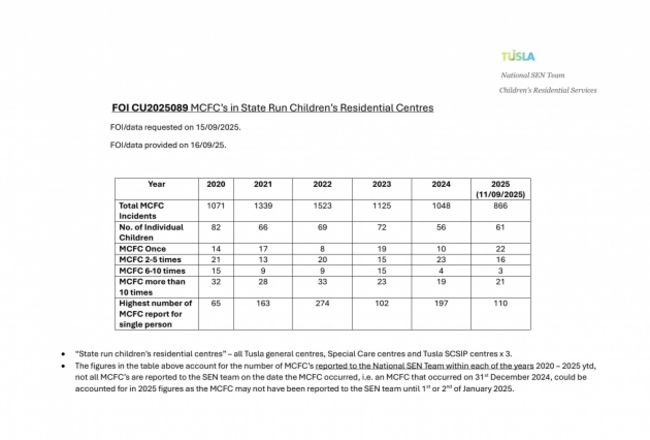
The records Tusla released showed why it was important to ask the same question in different ways when requesting information.
In 2020, 82 children accounted for 1,071 incidents. In 2021, the number of children fell to 66, but the number of reports increased to 1,339.
The following year, there were 1,523 incidents involving 69 children – the highest annual number contained in the records.
Of those 69 children, 33 had been reported missing more than 10 times. One had generated 274 separate reports.
In 2023, 72 children accounted for 1,125 incidents, with one young person reported missing 102 times.
In 2024, there were 1,048 incidents involving 56 children. The highest number relating to one child was 197.
By 11 September 2025, Tusla had already recorded another 866 incidents involving 61 children. One had been reported missing on 110 occasions.
The figures showed that this was not simply a story about the overall volume of missing reports.
It was also a story about a much smaller group of children repeatedly leaving their placements – in some cases dozens or even hundreds of times.
That pattern would have remained hidden had the request asked only for an annual total.
FOI records can provide the foundation for an investigation, but they do not always explain the full meaning of the information.
Tusla’s decision letter said a child is classified as “missing from care” when their whereabouts are unknown and their individual absence management plan indicates concern for their safety.
It also cautioned that most of the incidents involved children who were missing for less than 24 hours.
Tusla’s data covered its general residential centres, Special Care centres and three centres operated for separated children seeking international protection.
The agency also stated that the figures were based on when an incident was reported to its national team, rather than necessarily the date on which it occurred.
For example, an incident late in December could appear in the following year’s figures if it was not submitted until January.
The records did not show how long each child was missing, where they went or what happened to them while they were away.
However, what the data did reveal was a clear pattern of repeated disappearances involving children living under the care of the State.
Children’s rights and social care experts told us that children living in residential care often have complex histories of trauma and can be at higher risk of exploitation.
They also stressed that Tusla cannot restrict a young person’s movements in the same way a parent might, while residential staff must follow formal protocols when a child’s whereabouts are unknown.
Tusla told us that most children return after a brief absence and that it works under a joint protocol with An Garda Síochána.
Once a child is reported missing, gardaí take primary responsibility for investigating their whereabouts, while social workers and carers continue making inquiries.
If you have a burning FOI question about how to get certain records or why your request was refused, you can get in touch with our team at investigates@thejournal.ie. The Journal Investigates team will be back with another instalment of The FOI Files next Tuesday.

To embed this post, copy the code below on your site














have your say