Sign in. It’s quick, free and it’s up to you.
An account is an optional way to support the work we do. Find out more.
Sign in. It’s quick, free and it’s up to you.
An account is an optional way to support the work we do. Find out more.
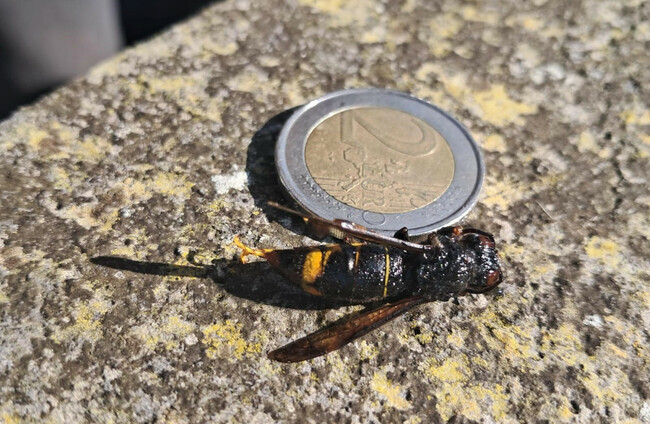
A SECOND NEST of the deadly Asian hornets is suspected to have been discovered in Co Cork.
According to the State research centre in charge of Ireland’s biodiversity, tests are being carried out to examine whether it is in addition to the nest that was located and dismantled last week.
The wasp, also known as the yellow-legged hornet, is indigenous to Southeast Asia and is of concern as an invasive species in most of Europe.
They pose a threat to biodiversity because they have the capacity to devastate honeybee populations by hunting them down and ‘colonising’ their hives. The knock-on effects of a decrease in bee population are considered disastrous to food production and farming due to the role bees play as pollinators.
In recent days, rangers from Ireland’s National Parks and Wildlife Service have captured a second individual hornet in Cork.
They are currently examining whether that insect hails from the original nest, or lost his way from a second, undiscovered nest.
John Kelly, the invasive species program manager at the National Biodiversity Data Centre, told RTÉ Radio One’s Claire Byrne programme that the investigations are continuing in the area.
“We received a report from a member of public about Asian hornets to the southeast of Cork city,” he said.
Rangers from the National Parks and Wildlife Service were contacted, setting up bait stations and traps in the area, partly to see if more could be discovered about the Asian hornets.
As a result of that effort, the new individual hornet was captured. It has since died but is undergoing genetic testing to see if it is a relation of the original nest.
Kelly said there was a “low probability” that this newly trapped hornet was simply blown off course by strong northwestern winds last weekend, adding to the chance that it is in fact from a second nest.
“There is a small possibility that the winds blew hornets there off course. But that’s not what we think is going on in the area,” he said, adding that the biodiversity centre can’t give certainty on the origin of the hornet at present.
A spokesperson for the National Parks and Wildlife Service told The Journal that it is investigating any additional reports as they come in about the possibility of new nests.
Individual sightings can be reported to invasives.ie.

To embed this post, copy the code below on your site














have your say