Sign in. It’s quick, free and it’s up to you.
An account is an optional way to support the work we do. Find out more.
Sign in. It’s quick, free and it’s up to you.
An account is an optional way to support the work we do. Find out more.
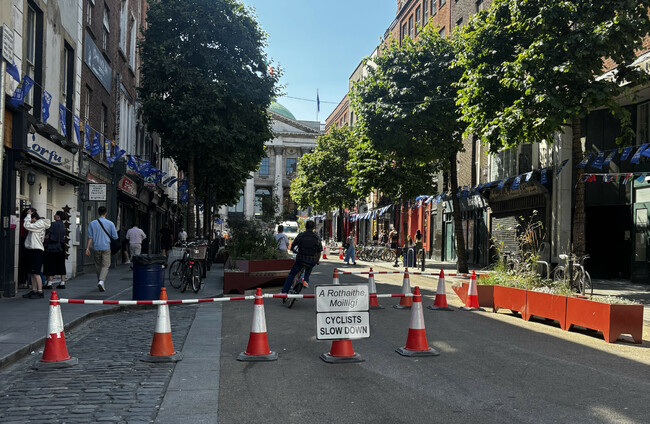
CYCLIST BARRIERS ON Capel Street and Parliament Street in Dublin have been removed following an attempt by Dublin City Council to slow down bike and scooter traffic.
Targeted especially at e-bikes and scooters, Dublin City Council installed physical chicane barriers and warning signs along the streets.
However, after just 10 days the barriers have now been removed with reports of cyclists and pedestrians having to swerve onto footpaths.
Speaking to The Journal, a representative for Dublin City Council said that the barriers were put in place as a temporary measure as the council “has become increasingly concerned that the behaviour of a minority of users will lead to unsafe interactions with pedestrians and other users of the street”.
The chicanes were intended not to impact a cyclist travelling at normal speeds but to require faster road users to slow down.
“It was to emphasise that pedestrians have priority and that the speed that a cyclist or e-scooter use the street should be that at which they can easily stop and give way to pedestrians,” the representative said.
The restrictions were also put in place to determine what permanent changes might be necessary.
Fine Gael’s Danny Byrne viewed the restrictions as an appropriate response to “bad behaviour from some who did not understand or chose to ignore that those two streets are a shared space”.
“I would support any intervention which improves safety, most especially for the elderly, children and less abled persons,” he noted.
Green Party councillor Micheal Pigeon said he understands the issues with speeding in the area but believed that the obstructions are “a wild overkill”.
“They would never use if there was a problem with speeding cars… it’s a very strange approach to dealing with the real issue,” he said, speaking to The Journal.
Capel Street has experienced some issues with scooter users and cyclists since it was pedestrianised in 2o22, with one councillor claiming at the time that the street was being used like a ‘‘racetrack”.
Rather than altering the street or implementing barriers, Pigeon advocated for enforcement against overpowered e-bikes and mopeds.
“The speed and capacity of them is simply too great for a street like that,” he said.
The government is putting in place a number of new regulations that specifically target e-scooters, including new registration laws and raising the riding age from 16 to 18 years old.
It follows an increased number of brain injuries in children as a result of e-scooter related accidents.
Dublin Labour Party councillor Dermot Lacey said he believed that the “obstacle course of barriers looked crazy”, but that the issue of speeding was a key concern, especially with courier cyclists.
“I happened to sit on Parliament Street last week. I was just there reading the paper, and I was nearly knocked down four times by courier cyclists,” he said.
Lacey raised that drivers are often paid per delivery, suggesting that this needs to be reviewed. ”It’s the need to speed that is the cause of the problems,” he said.
”I would prefer if we didn’t have restrictive rules on cycling in the pedestrian areas, but you can only have that if people behave.”
Pigeon said that the council works constantly to undo “50 or 60 years of a city that prioritised the car above the cyclist”.
However, he stressed that stronger enforcement on vehicles such as e-bikes and scooters would be the most effective solution rather than physical barriers on streets that impede both cyclists and pedestrians.
To embed this post, copy the code below on your site












have your say