Sign in. It’s quick, free and it’s up to you.
An account is an optional way to support the work we do. Find out more.
Sign in. It’s quick, free and it’s up to you.
An account is an optional way to support the work we do. Find out more.
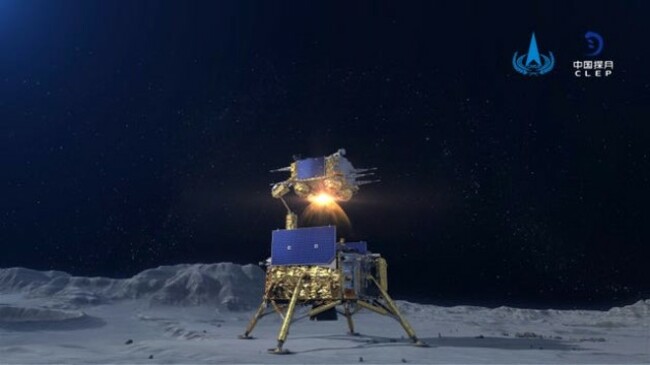
A CHINESE SPACECRAFT has lifted off from the moon with a load of lunar rocks en route back to earth.
The Chang’e 5 touched down on Tuesday on the Sea of Storms on the moon’s near side.
The ascent vehicle lifted off from the moon shortly after 11pm Beijing time on Thursday (3pm Irish time) and was due to rendezvous with a return vehicle in lunar orbit, then transfer the samples to a capsule, according to the China National Space Administration.
It is the third Chinese spacecraft to land on the moon and the first to take off from it again. The project is the latest in a series of increasingly ambitious missions for Beijing’s space programme, which also has an orbiter and rover headed to Mars.
Its mission was to collect about 2kg of lunar rocks and bring them back to Earth, the first return of samples since a Soviet spacecraft did so in the 1970s.
Earlier, the US Apollo astronauts brought back hundreds of pounds of moon rocks.
Chang’e 5 landed near a formation called the Mons Rumker which scientists believe contains rocks billions of years younger than those retrieved in earlier missions.
The moon rocks and debris were sealed inside a special canister to avoid contamination.
It was not clear when the linkup would occur. After the transfer, the ascent module would be ejected and the capsule would remain in lunar orbit for about a week, awaiting the optimal time to make the trip back to Earth.
Chinese officials have said the capsule with the samples is due to land on Earth around the middle of the month.
Touchdown is planned for the grasslands of Inner Mongolia, where China’s astronauts have made their return in Shenzhou spacecraft.
Chang’e 5’s lander, which remained on the moon, was capable of scooping samples from the surface and drilling two metres.
While retrieving samples was its main task, the lander was also equipped to extensively photograph the area, map conditions below the surface with ground-penetrating radar and analyse the lunar soil for minerals and water content.
Right before the ascent vehicle lifted off, the lander unfurled what the space administration called the first free-standing Chinese flag on the moon.
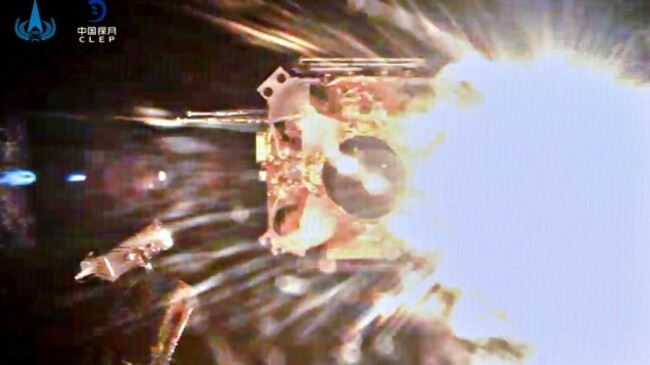
The agency posted an image, apparently taken from the lander, of the vehicle firing its engines as it took off.
Chang’e 5 has revived talk of China one day sending astronauts to the moon and possibly building a scientific base there, although no timeline has been proposed for such projects.
China launched its first temporary orbiting laboratory in 2011 and a second in 2016. Plans call for a permanent space station after 2022, possibly to be serviced by a reusable space plane.
While China is boosting cooperation with the European Space Agency and others, interactions with Nasa are severely limited by US concerns over the secretive nature and close military links of the Chinese programme.
- Additional reporting Niall O’Connor

To embed this post, copy the code below on your site













have your say