Sign in. It’s quick, free and it’s up to you.
An account is an optional way to support the work we do. Find out more.
Sign in. It’s quick, free and it’s up to you.
An account is an optional way to support the work we do. Find out more.
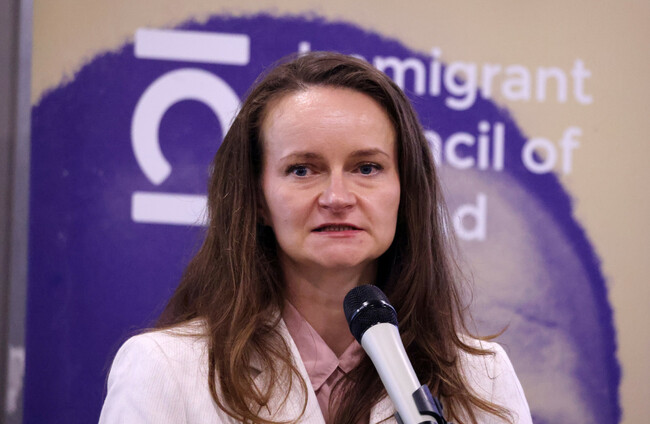
THE HEAD OF the Immigrant Council of Ireland has said she was “appalled” by comments from the Taoiseach last week in relation to asylum seekers and citizenship.
Speaking to The Journal, Teresa Buczkowska said her organisation, an NGO that advocates on behalf of immigrants, has been inundated with correspondence from people who are concerned about how the incoming citizenship reforms are going to affect them and their families.
While in New York for the UN General Assembly, the Taoiseach was asked by The Journal about the rule changes, which include increasing the period of reckonable residency for citizenship from five to eight years.
He signalled that immigrant workers already in Ireland may be able to qualify for citizenship under the existing five-year rule, despite the incoming reforms.
However, he also claimed that part of the reason the rules were in need of reform was that some people who came to Ireland through the asylum process were being granted citizenship after five years. He said this was due to a “combination of reasons” including administrative delays.
Taoiseach Micheál Martin has signalled that immigrant workers already in Ireland may be able to qualify for citizenship under the existing five year rule.
— TheJournal Politics (@TJ_Politics) September 24, 2026
This is despite the incoming law change requiring a person be resident in Ireland for eight years. pic.twitter.com/ZCqPG52Fzk
Buczkowska highlighted that a person’s time seeking asylum does not count towards reckonable residency and said the Taoiseach’s comments demonstrated that he “does not understand how the law is working”.
“Reckonable residency only starts counting from the day of receiving [international protection] status. So somebody might be here 10 years waiting for a decision. They get a decision, and then from that day they have to wait another five years to apply for citizenship,” she said.
“I was absolutely appalled to learn that the leader of our country does not understand how the law is working, and he is seeking to change that law,” Buczkowska said.
The same point was made by People Before Profit TD Paul Murphy, who accused the Taoiseach of going “full Trump while in the US” and “dog whistling to justify the government’s citizenship proposal”.
Murphy argued that the reforms are a “solution to a non-existent problem”.
“It is simply designed to distract from the government’s failures. It won’t make life better for anybody in this country, but will just make life harder for people who are contributing to our society and want to become citizens,” he said.
The proposals are also being opposed by the Labour Party and the Social Democrats, with Labour justice spokesman Alan Kelly arguing that they are “performative politics that will do little to improve Ireland’s immigration system”.
The Taoiseach, however, has argued that the move will more closely align Ireland with the requirements of other EU member states.
The legislation is set to go before the Oireachtas Justice Committee for pre-legislative scrutiny imminently.
Under the reforms being brought forward by Justice Minister Jim O’Callaghan, a language test and civics test will also be introduced alongside the increase to the five-year rule.
Buczkowska argued that the rule changes will have a negative economic impact on Ireland.
“Right now, migrants in Ireland have no avenue to secure their residence, except for acquiring citizenship. Otherwise, they are stuck in a vicious annual cycle of reapplying for a residence permit, paying high fees of €300 per person every year,” she said.
Buczkowska noted that administrative delays in the system and the high annual cost of residency permits, particularly for families, already act as challenges for people and that securing citizenship is a way of getting out of the “vicious cycle” of temporary permits.
She said extending the cycle by a further three years will lead a lot of workers, particularly high earners, to make the calculation that it is easier to “pack their bags” and go elsewhere.
Buczkowska added that the government has already introduced reforms that make it more difficult for migrant workers to be reunited with their spouses and children.
“So, if a migrant worker comes to Ireland, let’s say a nurse, they often have trouble bringing their spouse and children to live with them here. So if somebody is already experiencing trouble with family reunification, and on top of that they know that they’re going to struggle with the system for another three years, the calculation for them might not make any sense any more in terms of the benefits of living in Ireland,” she said.
Buczkowska said the Immigrant Council’s position is that the government’s citizenship reforms should not proceed at all, but that if the government insists on making the changes, they should introduce a permanent residency visa to help migrant workers, who may not even wish to become Irish citizens in the first place.
In addition to this, she said the Immigrant Council have concerns about the proposed language test, particularly for people with disabilities.
She called for an exemption for vulnerable individuals.
The cost of such tests is also a concern, with Buczkowska arguing they should be free and run by the government rather than outsourced to a private company.
“We don’t want another private company getting a million euros reward contract for running citizenship tests or language tests for migrants, because Irish citizenship is already the second most expensive citizenship in Europe,” she said.

To embed this post, copy the code below on your site













have your say