Sign in. It’s quick, free and it’s up to you.
An account is an optional way to support the work we do. Find out more.
Sign in. It’s quick, free and it’s up to you.
An account is an optional way to support the work we do. Find out more.

FOUR GOVERNMENT DEPARTMENTS had only one responsibility assigned to them in the second quarter of this year under the Climate Action Plan – and none of them were completed on time.
The government has published its latest progress update on the Climate Action Plan 2023 showing the actions that were and were not completed in April, May and June.
Overall, 63% of actions due to be completed during the quarter were finished on time.
The remaining 37% were delayed, including plans to launch a new retrofitting scheme for businesses and to establish a Just Transition Commission.
The Department of Environment was responsible for the largest number of actions of any department last quarter; 29, of which it completed 20.
All other departments had fewer than 10 actions assigned to them, with varying rates of success.
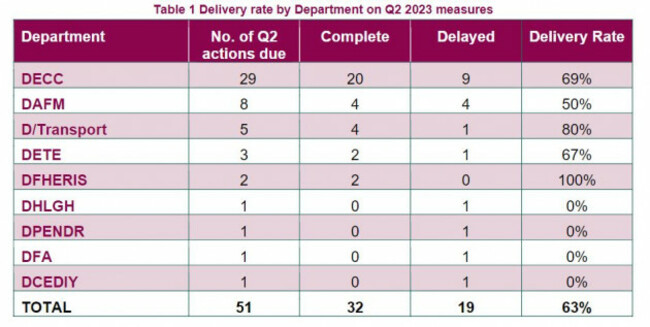
Four departments – housing, public expenditure, foreign affairs, and children and youth, each had only one action they were responsible for, but they failed to complete them.
The Department of Housing was meant to establish a new state agency known as the Maritime Area Regulatory Authority, while the Department of Public Expenditure and Reform was supposed to publish a report on the capacity of the public sector to deliver climate action.
The Department of Foreign Affairs should have published a new national strategy for Ireland’s engagement with small island developing states as part of plans to provide international climate aid, but the strategy was only approved by Cabinet on 27 June and so was not published in the allocated time frame.
And the Department of Children and Youth, which hosted the annual National Youth Assembly on Climate in March, was meant to publish a short report on the assembly in Q2.
Other actions that were not completed on time in the second quarter include:
The Sustainable Energy Authority of Ireland (SEAI) was due to launch a new non-domestic retrofitting scheme aimed at SMEs. However, today’s progress update said a new IT system is required in the SEAI to manage the pilot scheme and it is now not expected to be completed until September.
However, many other actions were completed on time.
An auction was held for offshore energy development and the high-level design for a small-scale generation scheme was published.
A “net of grant” option to have grants discounted from the cost of retrofitting works was introduced and the National Hydrogen Strategy was developed.
In addition to the measures completed between April to May, four measures that had been delayed between January and March have since been completed, though five actions are still outstanding from the first quarter of the year.
The annual climate action plans set out how Ireland intends to tackle climate change, which is increasingly posing threats around the globe.
The government has been criticised for not going far enough in its ambition, and for gaps between the ambition it does have and the actual implementation of policy in practice.
Only today, the Climate Change Advisory Council has warned that the country is likely to overshoot legally-binding carbon budgets between now and 2030 unless major action is taken to get back on track.
In a statement this afternoon, Tánaiste Micheál Martin said that “the past few weeks have demonstrated the alarming reality of climate change across the globe”.
“Heat domes across North America, North Africa and Asia, along with record-high water temperatures in the Atlantic, are resulting in extreme heat, forest fires, and threats to public health. We know that the most vulnerable are at risk, which is why rapid action is needed to both adapt to and mitigate climate change,” the Tánaiste said.
“Delays in implementing climate policy are no longer acceptable, and further ambition and acceleration of climate action are urgently required. I welcome the positive actions achieved this quarter in the Climate Action Plan, and the work undertaken by all those involved. However, more is to be done to meet the pace of the Climate Emergency which is unfolding before our eyes.”
Minister for Climate Eamon Ryan added that it is “clear that we can no longer turn away from the consequences of our actions as a largely fossil-fuelled global economy and society”.
“Everywhere we turn, we see the outputs of putting more and more emissions into the atmosphere, to the point where June 2023 was the hottest month ever recorded in Ireland while July is looking to be the hottest month ever recorded globally,” he said.
“There have been significant achievements undertaken as part of the Climate Action Plan in transport, energy, agriculture, and buildings among others. These actions have taken a lot of work across the system to get over the line. We are making progress.
“However, recent reports from the EPA are demonstrating to us that we need to be even more ambitious, put in more work, and do all of this faster.
“Work on Climate Action Plan 2024 is currently underway, and this provides for an opportunity to increase and strengthen our high-impact actions for each sector, continuing the good work and meeting the challenge with determination, realism, and enthusiasm.”

To embed this post, copy the code below on your site













have your say