Sign in. It’s quick, free and it’s up to you.
An account is an optional way to support the work we do. Find out more.
Sign in. It’s quick, free and it’s up to you.
An account is an optional way to support the work we do. Find out more.
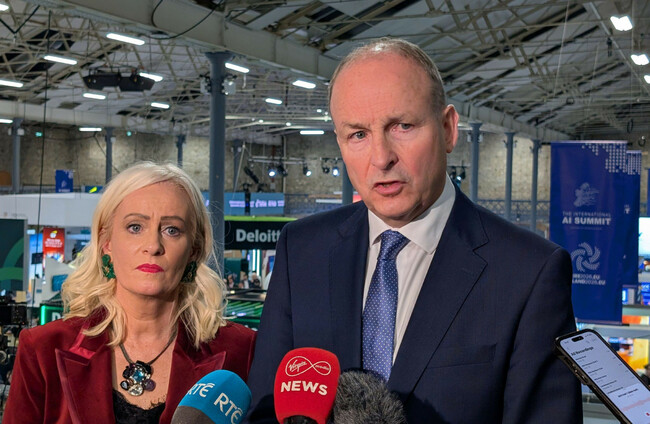
TAOISEACH MICHEÁL MARTIN has said he believes “the foundations are there” for an agreement between government and public sector unions to avoid another day of strike action next week.
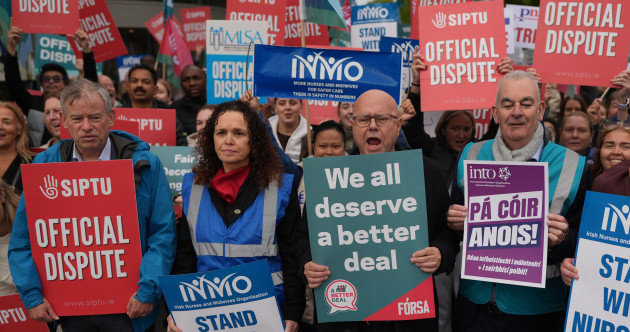
About 300,000 public sector workers are engaging in industrial action today, resulting in swathes of public amenities and offices being closed for the day.
Speaking to reporters this morning at the International AI Summit being hosted at the RDS, the Taoiseach said his government was “very focused on how we can bring this to a conclusion”.
“How we can enable negotiations and dialogue to commence with the public service unions, so that we can negotiate a new national pay agreement,” he said.
Asked whether it was embarrassing that the strike action was taking place as the government hosted a centrepiece AI summit during its EU presidency, Martin said that those attending know Ireland is a democracy.
“No, I mean that’s life. I think most people who come to this summit have a lot of experience of life, so it’s not a bad look in that sense. I mean, we have a democracy. We have very fundamental freedoms and going on strike as one of those.”
Cost-of living
Speaking about public sector pay, the Taoiseach made reference the budgetary measures introduced last week which he says benefitted all workers. He added that his goverment has “made provision” for a new potential public service pay deal.
Funding of €1.2 billion was allocated in Budget 2027 for a new pay agreement, but unions have said that the allocation is not enough to solve the issue.
Unions have also demanded that the issue of pay be the first matter on the table in any pay talks but the government has merely said that it would be part of the discussions.
Last night, Minister for Public Expenditure Jack Chambers said that pay could be the starting point for negotiations, something that has been met positively by unions.
Asked this morning about this development and whether this moved the dispute into a better space, the Taoiseach said:
I would like to think that, and without overstating it and I understand fully the pressures people are on, the pressures public servants are on, and workers are on. So our focus is on trying to get a process going that can lead to a satisfactory outcome in terms of a new national pay agreement, which is what we want to put in place.
Unions have earmarked 21 October for a second day of strikes and, asked whether this was avoidable, Martin said he hoped it was.
“I would hope so yes, but I mean that’s a matter in the first instance for the trade union movement. We will spare no effort to get talks going and we will continue to try and open up a process of dialogue here.”
Pay deal
The origin of the strike is the expiration of the previous public sector pay deal agreed between unions and the government which ended on 30 June.
As it stands, there is no successor to this agreement and unions and the government cannot agree on the terms of restarting negotiations.
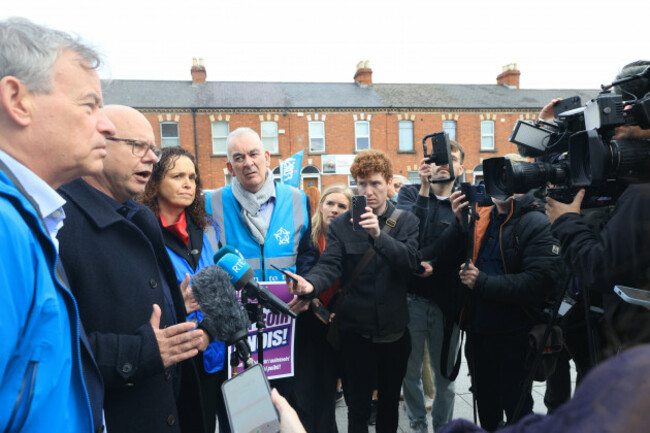
Union leaders have been attending various picket lines this morning, with leaders from a number of unions speaking to The Journal outside the Mater Hospital in Dublin
Adrian Kane of Siptu said unions needed a “credible framework” to be in place and he called for a “senior political intervention to shape a framework for talks”.
Asked what the main issues he wanted to be discussed were, he said:
“The four things that we have been talking about; Pay up front, some pay offer for ’26, and to make good the deficit that has arisen between inflation and public sector wages, and then looking at the money on the table going forward to address cost of living. There are the four things we need language around that.”
Kane also made reference to the comments of Chambers last night, saying: “The question was repeatedly put to him in terms of would he be prepared to talk about pay up front? And eventually, he acquiesced. I think that’s a positive development.
I think it would have been better if he had said it back in May or June, and we may not have found ourselves here today. So it was better late than never, but certainly for today was too little, too late.
Fórsa’s Kevin Callinan said there has been a “fundamental breakdown in industrial relations” and that there has been a “breach of trust” by the government.
He claimed that initial talks with the government in June amounted to an attempt “to enforce a pay freeze on public servants in a cost of living crisis”.
“We need that confidence to be restored, so the ball is very much in the government’s court, it’s with the Taoiseach, I made that clear on RTÉ this morning. So we’ll wait and see if they take that seriously. If they don’t, we’re in for a long dispute that will be very difficult to resolve.”
- With reporting by Sophie Finn and Hannah Power

To embed this post, copy the code below on your site














have your say