Sign in. It’s quick, free and it’s up to you.
An account is an optional way to support the work we do. Find out more.
Sign in. It’s quick, free and it’s up to you.
An account is an optional way to support the work we do. Find out more.
LAST UPDATE | 11 Jun
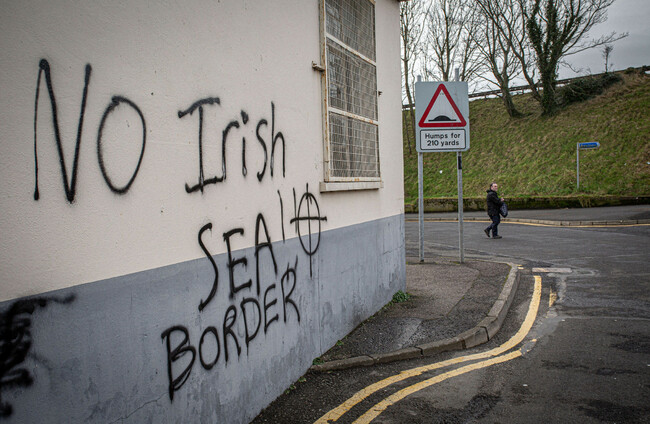
UK POLITICIANS ARE continuing to take aim at the Common Travel Area today, as the conversation since Monday’s knife attack in Belfast shifts to a debate around borders and immigration checks in Northern Ireland.
A number of UK politicians have pointed to the Common Travel Area between the UK and Ireland as a weak spot and “backdoor route” into the UK, as senior Irish politicians defend the longstanding agreement.
The Common Travel Area agreement between both countries was established in 1922 and reaffirmed in 2019.
It allows Irish and British citizens to travel freely between the UK and Ireland and reside in either jurisdiction.
On Monday, a man in his 40s suffered serious injuries to his neck and back, and also lost his left eye in the knife attack that has sparked violent riots in Northern Ireland.
Hadid Alodid, a 30-year-old Sudanese man, has appeared in court charged with attempted murder.
Northern Ireland Secretary Hilary Benn said Irish authorities have questions to answer after it emerged Alodid entered the island of Ireland at Dublin before travelling to Belfast in 2023.
The same year, Alodid was granted refugee status in Northern Ireland.
Benn has been in contact with Minister for Foreign Affairs Helen McEntee and Minister for Justice Jim O’Callaghan since the attack and has said questions exist for Irish authorities over what they knew about Alodid.
Speaking this evening at British ambassador to Ireland’s residence in Dublin, McEntee condemned the violence in Northern Ireland over the past two nights.
“The consequences, we know, are lasting. We know that only too well in dealing with legacy issues in Northern Ireland.
“This has been an enormously challenging issue for all of us, but we are Collectively working together with Secretary of State Hilary Benn in publishing a joint framework on legacy.
“While there’s much work to do ahead, our message has been very clear and the message to us has been clear, get it done, implement it, deliver it so that we can start to move forward,” McEntee said.
British Ambassador to Ireland Kara Owen said there is a need to protect the Common Travel Area, which “brings our country so much opportunity”, as well as maintaining “all of the aims” of the peace process.
Today, some UK newspapers have focused on the common travel area, with the Telegraph’s front page reporting that smugglers guarantee entry to the UK via Ireland, framing the Common Travel Area as a “backdoor route” into the UK.
Speaking on RTÉ Radio 1′s Morning Ireland programme today, Deputy First Minister of Northern Ireland Emma Little-Pengelly said there are “questions to be asked” about UK immigration policy and cooperation with Ireland following Monday night’s attack.
She condemned the actions of masked men in Northern Ireland this week and said their actions were “simply racist”, but said there are questions over vetting and the checks conducted when people arrive in Dublin.
“I’ve raised this with the Irish government on a number of occasions as well. There has to be a process of rigorous vetting for people who come in here, there must be that cooperation,” she said.
Little-Pengelly’s comments come after the UK Labour Party’s chairwoman, Anna Turley, said there is a “live conversation” among ministers to ensure the Common Travel Area is “not used as a back route for people to come here and exploit our asylum system”.
Speaking to Sky News, Turley said: “That’s not what it’s there for.
“It’s been in existence for over 100 years and it’s absolutely right that people can travel between Ireland and Northern Ireland freely.
“But it’s really important we make sure that we have a fair system that is led by data and intelligence, and we make sure that people are not able to exploit the asylum system or the Common Travel Agreement.”
Meanwhile, Little-Pengelly’s DUP colleague, MP Carla Lockhart, has called for the British government to review the common travel area.
Speaking on the Today programme on BBC Radio 4 on Wednesday, Lockhart said: “That’s where this problem lies, and unless the Government step up, I fear we will continue to see significant unrest within our communities.”
Asked why freedom of movement matters when the Sudanese suspect entered the country legally, Lockhart said: “Well, ultimately, this individual came from Paris to Dublin flew then from Dublin to Northern Ireland, you know, that’s unacceptable. He came with no checks. He should have been seeking asylum where he first positioned himself.”
Today, UK media reports that the UK government is set to intensify its crackdown on illegal migration via the Common Travel Area.
According to the BCC, the UK Home Office is working towards a “surge in intelligence-led operations” carried out by Immigration Enforcement officers and Border Force personnel along Common Travel Area routes.
In Dublin, senior politicians have been stressing the importance of the common travel area.
On Wednesday, Taoiseach Micheál Martin insisted it is of benefit to both UK and Irish citizens, though he acknowledged some “abuse” of the framework.
Speaking to The Journal’s political podcast, The Candidate, Tánaiste Simon Harris said it’s “really important that the two governments work closely when it comes to the issue of migration because we share a common travel area”.
“Nobody wants to see a hard border on the island of Ireland, far from it,” said Harris.
“But it does show the broader need to continue to work very closely together.”
Harris remarked that “migration policies in one country can have a knock-on impact on another” and that the common travel area “was never meant to be for migration” and was rather to be “for citizens of both Ireland and the UK”.
He added that there is no threat to the common travel area because “the benefits of it are immense”.
Meanwhile, on Wednesday, Foreign Affairs Minister Helen McEntee said the common travel area is something that citizens have enjoyed for many years, adding that it has contributed to both countries from an economic and social perspective, and has encouraged prosperity.
At a press conference on Tuesday, Northern Ireland justice minister Naomi Long said she recognises challenges to being able to move freely across Northern Ireland and the Republic of Ireland.
She said she had raised the issue with the UK Home Office in the past around human trafficking and also with Minister for Justice Jim O’Callaghan.
“I recognise that there are challenges when you can travel freely, and what we don’t want on either side of the border is to see the common travel area being exploited for ill purposes. We have been clear about that,” she said.
Following Justice Minister Jim O’Callaghan discussions with Long and Benn yesterday, Ireland’s Department of Justice said in a statement:
“The invisible border on the island of Ireland is among the most tangible gains of the peace process and is essential to the continuing normalisation of relationships.
“They discussed stronger co-operation and enforcement to prevent abuse of the Common Travel Area.
“Minister O’Callaghan emphasised that significant Border Management Unit doorstop operations now take place at Dublin Airport. The number of people landing without documentation has reduced significantly since 2023.
“Northern Ireland Minister for Justice Naomi Long and Secretary of State for Northern Ireland, Hilary Benn, agreed to work with Minister O’Callaghan to prevent abuse of the CTA.”
Similar conversations about the Common Travel Area flared in 2024, after then minister for justice Helen McEntee said that 80% of asylum seekers in Ireland were entering from Northern Ireland.
Monday night’s stabbing in Belfast triggered a wave of disorder across the city in which mobs set homes, a bus and cars on fire, with people targeted based on their race.
Some 27 families have been made homeless by the disorder.
Additional reporting by Christina Finn

To embed this post, copy the code below on your site












have your say