Sign in. It’s quick, free and it’s up to you.
An account is an optional way to support the work we do. Find out more.
Sign in. It’s quick, free and it’s up to you.
An account is an optional way to support the work we do. Find out more.
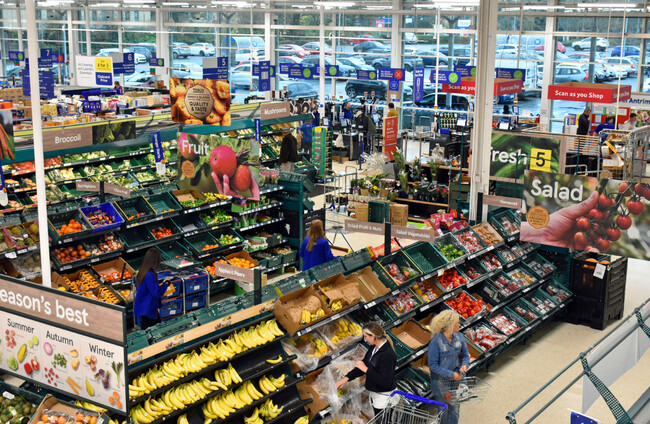
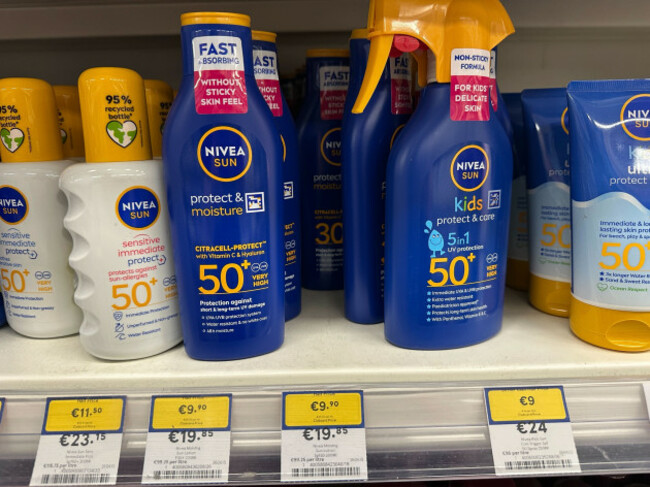
DURING LAST WEEK’S hot spell, on Dublin branch of Tesco was selling a 250ml bottle of Nivea children’s sunscreen for €24, but members of the supermarket’s Clubcard programme could buy the product for significantly less at only €9.
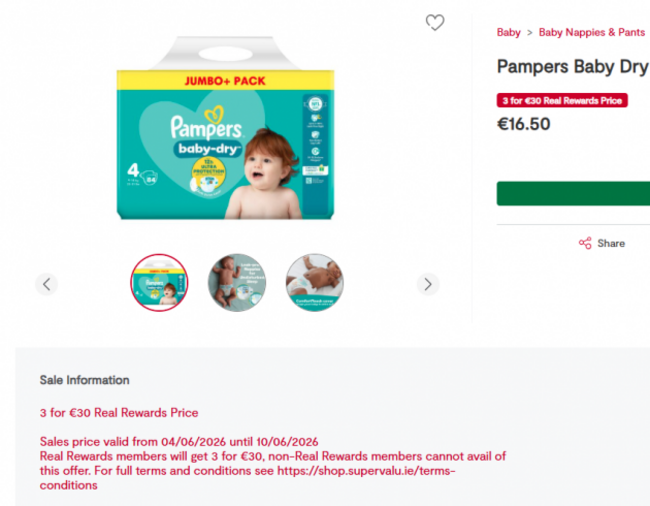
Over at Supervalu, members of the Real Rewards loyalty scheme can order three jumbo packs of size 4 Pampers nappies online for €30. For non-members the price is €16.50 per pack — a saving of €19.50 on three.
For many shoppers, savings of this scale are a no-brainer. Now, the Irish Council for Civil Liberties (ICCL) has warned these steep price differences may undermine consumers’ ability to give genuine consent to join loyalty programmes — a pressure the current cost of living crisis is only making more acute.
Loyalty schemes are becoming increasingly ubiquitous in Ireland — and increasingly popular. A recent survey by KPMG found that as financial pressure intensifies, more people are making use of these programmes, with 62% of consumers saying loyalty schemes drive where they shop, up from 57% last year.
The shift to mobile phone tap-and-pay is also integrating loyalty schemes into how under-35s shop, KPMG said, as most major loyalty programmes can now be used through Apple Wallet or Google Wallet.
Most of the major supermarkets in Ireland now offer a loyalty programme, with convenience chain Centra recently launching a scheme too. SuperValu offers the Real Rewards programme, while Dunnes has Valueclub and Lidl has Lidl Plus.
Dunnes Stores’ Valueclub programme allows customers to earn points across food, fashion and homeware and in its cafés.
SuperValu’s Real Rewards programme offers discount vouchers in return for points earned on purchases, as well as discounted prices for members, similar to the Tesco Clubcard. The Lidl Plus App allows customers to access discounts and earn points, as well as offering coupons.
As well as discounts, Tesco’s programmes also allows shoppers to gain points which can be redeemed for money off vouchers for groceries or for third-parties such as Dublin Zoo and Irish Ferries.
Last month, Centra launched the My Centra App, which gives members access to offers and meal deals.
Membership of these loyalty programmes is generally free, but details like name, email address, home address and phone number may be required, and information about shopping habits may be collected.
Speaking to The Journal, senior policy officer at the ICCL Olga Cronin said that “a significant question mark arises” around consent under the EU’s General Data Protection Regulation (GDPR) when there is a “genuine imbalance of power”, as consent must be specific, informed and unambiguous.
Cronin pointed to Article 4 of the EU Data Protection Regulation, which requires consent to be “freely given, specific, informed and unambiguous” when it comes to sharing personal data.
“If a person suffered a detriment as a consequence of not consenting to something, there’s a big question mark over whether or not that’s consent,” she said.
“There is a tension there, especially in a cost of living crisis, on top of a pre-existing housing crisis, if a shop offers a product for a tenner, but for a fiver for people who have a card. Is the person choosing to hand over their data or are they being compelled to?
“Many people may feel they have really little choice but to agree to share personal data, and that’s when you wonder, are people signing up for discounts, or are they just signing up to not be charged for not signing up?”
Cronin said that the stakes around this consent become “even higher” depending on the product involved. She said that data collected around health-related purchases are “very sensitive”.
The Competition and Consumer Protection Commission (CCPC) told The Journal, that in general, businesses in Ireland are free to set their own prices, as long as they do so independently and in compliance with consumer protection law.
“At present, there are no laws restricting retailers from offering different prices to loyalty scheme members and non-members,” the watchdog said.
“The CCPC will continue to closely monitor the impact of these schemes on consumers and assess whether the balance between consumer benefits and consumer experience remains the right one.”
The Data Protection Commission (DPC) told The Journal it has recently conducted a compliance assessment in the supermarket and convenience store sector and will soon publish a report.
Deputy commissioner Graham Doyle said: “Entities operating in this sector collectively undertake a significant proportion of data processing activities within Ireland’s retail sector, some of which include processing of personal data through loyalty programmes.”
“The DPC is currently preparing a report of this assessment for publication.”
Tesco told The Journal that it takes its responsibilities regarding the use of customer data collected through its Clubcard scheme “extremely seriously”.
“We are open and transparent about how we use customer data and it’s easy for our customers to make choices about what they share with us. We do not sell any data we collect from customers to third parties,” a spokesperson said.
The supermarket said that data shared by customers is used to identify and enhance offers and optimise the products and services offered in stores. Customers can have a Clubcard and benefit from Clubcard prices while choosing not to receive targeted marketing.
Dunnes, Lidl and Musgraves Group, the parent company of Supervalu and Centra, were contacted for comment.
In Cronin’s view, loyalty cards are essentially “a means for chain stores to carry out this large scale data collection in order to track our habits and behaviours”.
There is no evidence that supermarkets operating in Ireland are transferring members’ data to third parties.
Cronin said that, if shared unlawfully or without safeguards, the information collected through loyalty programmes could enable third parties to create “highly detailed profiles of individuals” and potentially expose sensitive aspects of their lives.
Cronin said the type of data collected through loyalty schemes could include details on how much a person spends, what they buy, where they buy it, when, and how often, as well their personal information such as email address, home address and phone number.
In general, data about people’s habits behaviour can allow for very precise conclusions to be drawn about their private lives – and if that kind of data is sold on or shared or combined with other data sets, it can become a very powerful profiling tool, Cronin said.
Article 4 of the EU Data Protection Regulation defines profiling as “any form of automated processing of personal data consisting of the use of personal data to evaluate certain personal aspects relating to a natural person, in particular to analyse or predict aspects concerning that natural person’s performance at work, economic situation, health, personal preferences, interests, reliability, behaviour, location or movements”.
Meanwhile, Article 5 lays out seven principles relating to processing of personal data that must be complied with, including lawfulness, fairness and transparency, purpose limitation, data minimisation, accuracy, storage limitation, integrity and confidentiality and accountability.

To embed this post, copy the code below on your site
















have your say