Sign in. It’s quick, free and it’s up to you.
An account is an optional way to support the work we do. Find out more.
Sign in. It’s quick, free and it’s up to you.
An account is an optional way to support the work we do. Find out more.
ENGLAND’S FOUR-WEEK national lockdown could be extended beyond 2 December if coronavirus infection rates do not significantly fall, a Cabinet minister has admitted.
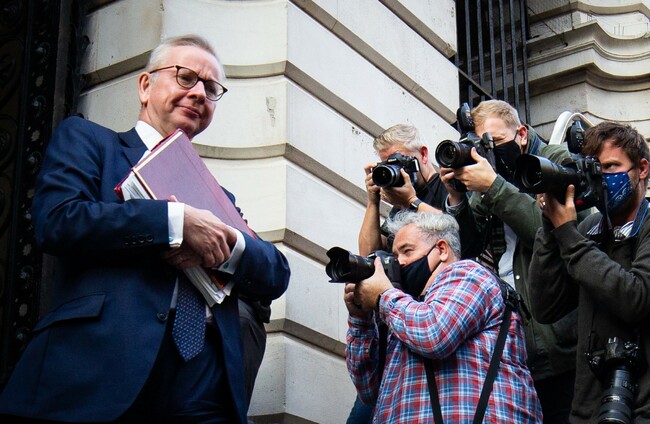
Michael Gove said he believed the restrictions announced by Boris Johnson would bring down the R value, but warned that people may have to stay at home for longer if not.
Pubs, bars, restaurants and non-essential retail will close from Thursday for four weeks across England, with furlough payments at 80% extended for the duration of the new measures.
People will be allowed to exercise and socialise in public spaces outside with their household or one other person, but not indoors or in private gardens, and will be able to travel to work if they cannot work from home.
Yet unlike in the lockdown during the first wave of the pandemic, schools, colleges and nurseries will remain open.
The Prime Minister said the restrictions would end on 2 December, when the Government would reintroduce local restrictions based on the latest data and trends.
But Cabinet Office Minister Gove said it would be “foolish” to predict what would happen with the pandemic over the next four weeks, and conceded the lockdown may have to be extended.
Asked during an interview on Sky News’ Sophy Ridge On Sunday whether the national lockdown could be extended, he replied: “Yes.”
Gove said: “We want to be in a position where we can – and I believe that this is likely to be the case – have an approach where if we bring down the rate of infection sufficiently we can reduce measures nationally and also reduce measures regionally.
“Because the regional approach is one that, wherever possible, we want to take because again we recognise it may be the case in the future that having reduced R below 1, having reduced national restrictions, we may see a specific upsurge in specific areas which will require specific regional measures.”
His warning was echoed by former chief scientific adviser Sir Mark Walport, who said there was “obviously a possibility” that the restrictions could last longer than the first lockdown.
He told Ridge: “The lockdown is not as severe as it was first time round, so the only way to know is to see how quickly the new cases start dropping.
“As we know, there’s a lag between the case developing, hospitalisation and the horrible consequences of severe illness or death…
It’s unlikely this time to come down quite as fast as it did during the first lockdown because we have got schools open.
Johnson, speaking last night from Downing Street, said “no responsible Prime Minister can ignore” the rising rates of Covid-19 infections, as he acknowledged that cases had not come down fast enough in the worst affected areas.
“We know the cost of these restrictions – the impact on jobs and livelihoods, and people’s mental health. No-one wants to be imposing these measures,” he added.
The Prime Minister warned that the virus is “spreading even faster than the reasonable worst-case scenario of our scientific advisers”.
He said: “Unless we act, we could see deaths in this country running at several thousand a day – a peak of mortality, alas, bigger than the one we saw in April.”
The Prime Minister said overrunning of the NHS would be a “medical and moral disaster, beyond the raw loss of life”.
The Government also said another 326 people had died within 28 days of testing positive for Covid-19 as of yesterday.

To embed this post, copy the code below on your site














have your say