Sign in. It’s quick, free and it’s up to you.
An account is an optional way to support the work we do. Find out more.
Sign in. It’s quick, free and it’s up to you.
An account is an optional way to support the work we do. Find out more.
SOCIAL MEDIA USERS have falsely claimed that Green Party leader Roderic O’Gorman invited asylum seekers to come to Ireland – a gross distortion of some of his old social media posts.
The claim has spread sporadically since 2021, when O’Gorman, who was then Minister for Intergration, released a white paper on changing the asylum system in Ireland.
It has since reappeared as a spurious explanation for spikes in asylum claims since then.
The claim recently resurfaced in social media videos decrying supporters of Catherine Connolly’s presidential campaign, which included O’Gorman.
These include claims posted in videos by Michael McCarthy, a social media personality known for spreading misinformation, particularly about immigration.
“His name is Roderic O’Gorman. He sent out tweets in eight different languages,” the host says at the start of the video.
“Eight different languages asking people to come to Ireland, saying he’ll give them a free house and a free apartment within four months.
“After he sent those tweets, asylum applications rose by 400 percent.”
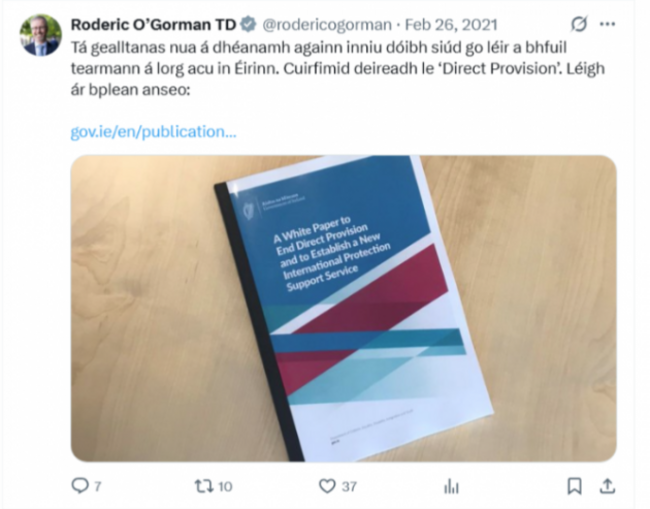
Onscreen can be read two of these posts by O’Gorman, posted to Twitter (now X); one in Arabic, the other in Somali.
However, they do not invite anyone to Ireland. Instead, they translate to: “We are making a new commitment to all asylum seekers in Ireland. We are ending direct provision. Read our plan here,” followed with a link.
In all the tweets, “direct provision” is spelled in English, as it is not a commonly understood term internationally.
These are real tweets, posted by O’Gorman in February of 2021.
O’Gorman subsequently explained that he sent the posts in the eight languages – which included English and Irish – because they were the languages most commonly spoken by those already living in the Direct Provision system.
However, as can be seen by the translation of the tweets, they did not invite asylum seekers to come to Ireland.
The tweets were to announce the launch of a White Paper on Ending Direct Provision, the executive summary of which was available in all the languages O’Gorman had tweeted in: Irish, English, Albanian, Arabic, French, Georgian, Somali, and Urdu.
The paper is still available on government websites.
The 177-page full document outlines a plan to replace Direct Provision – the system Ireland uses to process asylum claims, whereby the government provides accommodation and food to asylum seekers, who are initially not allowed to work.
This is the system that is still in place in Ireland; the plan was delayed by Covid-19 and the war in Ukraine, and O’Gorman was unable to achieve the goals set out in that paper while in office.
Neither the posts nor the paper they linked to were invitations for asylum seekers to come to Ireland. But could they have been responsible for a wave of asylum claims anyway?
Asylum claims in Ireland rose in the latter half of 2021, and more sharply in subsequent years, mirroring wider European trends – In this time period, asylum applications per year more than doubled in the UK and EU.
But there are strong reasons to think this was not due to a few tweets: the plan to end direct provision never happened; the tweets never received strong engagement; and later increases in asylum applications in Ireland were mirrored across Europe.
Ascribing increases in asylum application to these tweets requires a very specific, and unlikely, pattern of behaviours to have happened.
For this to be true, people outside Ireland saw online a plan to end “direct provision” (a term not used outside of Ireland), and clicked through to a link to a white paper about a plan to improve the asylum process. After reading this, they decided, en masse, to move to Ireland without waiting to for the plan to be implemented (which it never was).
This is an extremely tenuous scenario, and would require that huge numbers of people saw the tweets – this does not appear to be the case.
The tweets in eight languages, including ones in Irish and English, are still online. However, they have never received much engagement.
Collectively, the eight posts have been shared just 301 times since they were first posted in 2021.
To put this in context, a video posted by O’Gorman on Twitter that same day, outlining the plan in English, was retweeted 322 times, more than the other eight posts combined.
(That video also did not contain an invitation to come to Ireland).
Data show no discernible increase in asylum applications in the months following the tweets.
Here are the monthly asylum applications from December 2020 to July 2022. If there is any bump in applicants during this time period, it is hard to discern with the naked eye.
After this period, there would be a steady and significant increase in the number of asylum applications in Ireland – however, the same increase was seen Europe-wide.
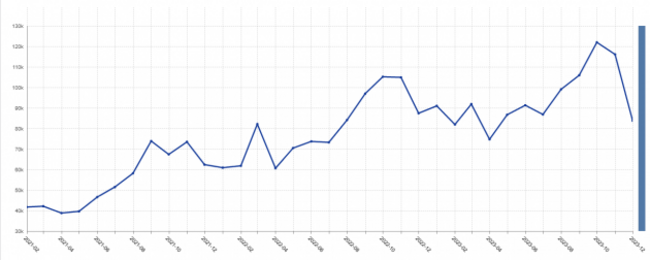
This strongly indicates that there were larger reasons causing an increase of asylum applications in Ireland.
There is no evidence that O’Gorman’s multilingual tweets invited people to move to Ireland or influenced asylum claims. The messages were part of a domestic policy announcement aimed at reforming — not expanding — Ireland’s asylum system.

To embed this post, copy the code below on your site















have your say