Sign in. It’s quick, free and it’s up to you.
An account is an optional way to support the work we do. Find out more.
Sign in. It’s quick, free and it’s up to you.
An account is an optional way to support the work we do. Find out more.

In this brand-new series, journalist and spoken word artist Cormac Fitzgerald travels to a different town or suburb each week to cover the gigs and cultural experiences you rarely see covered by Irish media outlets.
This week’s subject: A Friday night at the bingo in Whitehall.
*****
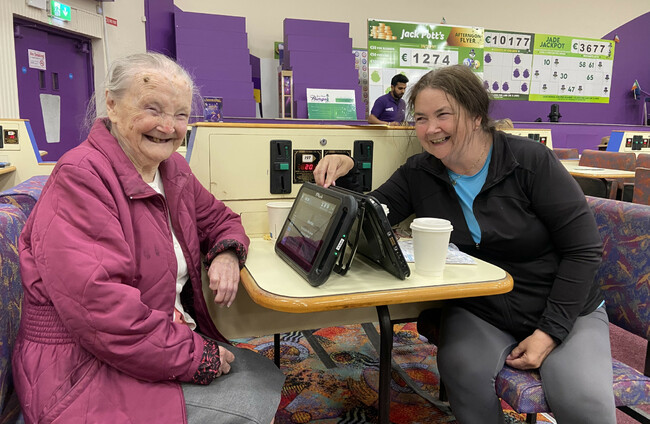
ELLEN HILL HAS been playing bingo in clubs around Dublin for decades.
Living in Portland Row in the north inner city, Ellen used to play in the popular Macushla Ballroom at the corner of Foley Street and Buckingham Street before it shut down in the late ’80s. Now aged 92, she has been coming to the bingo in Whitehall, in Dublin’s northside, for over 20 years.
“She’s coming years and years and years,” her daughter, Valerie, told me during a break in play on a mild Friday night in June.
“She comes on a Friday, Sunday and Tuesday. She loves the bingo, that’s her life now – bingo. She’s a bingoaholoic. She’ll tell you, she doesn’t drink or smoke, she only plays the bingo.”
Linda remembers going to the Macushla with her mother, the room choked with cigarette smoke. After it closed, they went to other halls around the city before settling on Whitehall.
Ellen has won big a few times over the years, but it wouldn’t be a regular occurrence.
“I think a lot of people come for the social aspect of it,” Linda said.
“There’s one woman, I’ve never seen her winning, but she keeps coming. She wouldn’t be coming if it was just to win.”
Ellen, smiling and half-listening as her daughter talks, said the bingo was “just a bit of fun”.
“I don’t drink and I don’t smoke, so this is it!”
I had passed by the Whitehall Grand building many times in my life, heading up and down to Parnell Park in nearby Donnycarney, but this was my first time actually stepping inside the doors.
Located on the traffic-clogged Collins Avenue, the imposing two-storey concrete structure sits incongruous among a row of shops, squeezed in between a pharmacy and a Chinese takeaway, across the road from Whitehall GAA Club.
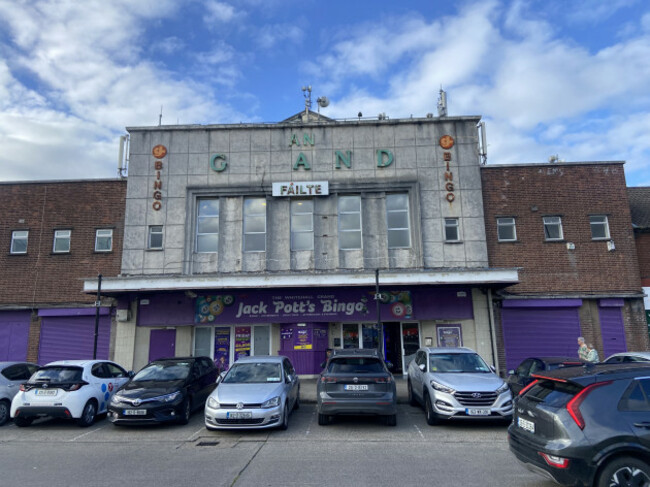
Built in the 1950s as a 1,000-seater cinema, the Grand was converted into a full-time bingo hall in the 1970s and was run for decades by Gael Linn, the Irish language organisation, before being sold in the 2000s. It has been operating for a long time, an alternative thing to do for people in the evenings instead of staying in, eating out, or going to the pub.
I have always known it as Whitehall Bingo Club, but these days it is owned and operated by Capital Entertainment & Leisure – who also own and run bingo halls and slot machines in Cabra, Crumlin and Tallaght – under the Jack Pott’s Bingo brand. The company directors, Iain Finnegan and Wil Byrne, also run a US-based gaming and real-estate firm, Wilton Capital, and have a wide portfolio of business interests in Ireland and abroad.
Coming in off the street, the foyer of the Grand is like a miniature casino, crammed with big, flashing slot machines and games. But walk past these into the bingo hall itself, and it is like stepping into a time capsule of the 1980s or 1990s.
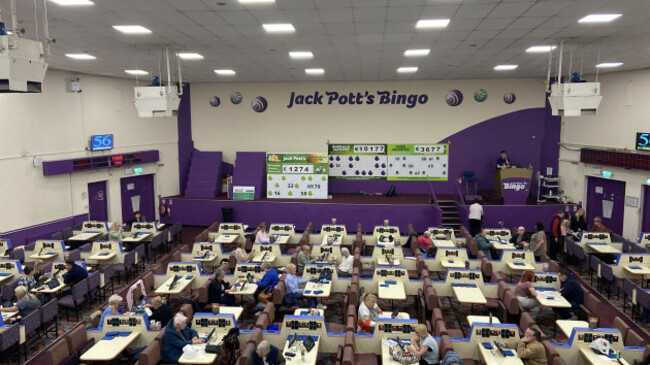
Rows upon rows of fixed plastic tables and cushioned seats line the old cinema theatre above a colourful patterned carpet. There are coin slots at each table for playing “pongo”, a rapid-fire kind of bingo that takes place during breaks in the main action.
A good few hundred could fit into the space easily, but these days the upstairs is closed off. The Grand is a protected structure, and the old aesthetic is a breath of fresh air in a city rapidly being taken over by smooth, frictionless interiors and insipid, modern design.
On a stage, an announcer calls out the numbers as they come up. It’s cash only, no card payments, and apart from the purple Jack Pott’s branding, you might think that not much has changed here in decades.
But beneath the surface, a lot has changed in the world of bingo since the old Macushla and Gael Linn days.
As soon as I arrived, I was greeted by Karen O’Connor, head of business development with Capital, who showed me around the place.
I sat with Karen’s family, a friendly bunch who were there to play as well. Dwayne, the manager, set me up with a “bee”, a digital tablet that can be used to play the bingo as well as other games.
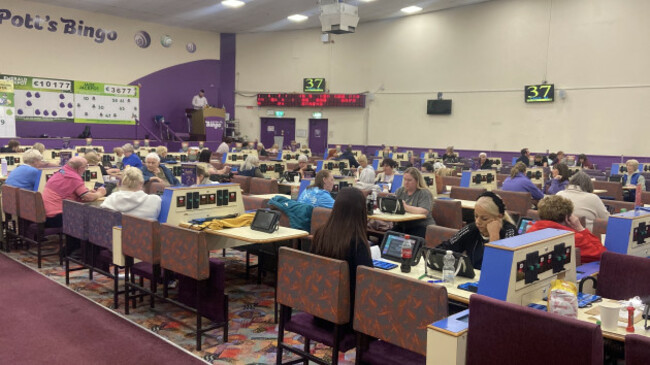
The main game usually kicks off at 8.15pm. The vast room seemed quite empty when I first arrived, but filled up quickly as the clock moved towards start time. Most – but not all – of the punters were women, the majority aged over 60. But there were a few men and some younger bodies scattered throughout the crowd – some accompanying their mothers or relatives, others sitting alone.
Most people there seemed like regulars, sitting in their own seats, chatting and laughing with one another, helping themselves to free tea, coffee and biscuits.
Once people were settled, Tonight’s Gonna Be a Good Night by the Black Eyed Peas started to play out of the speakers and a hush fell over the room. The players got their blotters ready to go, and we all got down to the bingo.
If you’re new to bingo, it can all seem impossibly confusing and fast-paced at first, but you catch on quick enough.
I won’t go fully into it, but the idea is to mark numbers from 1-90 as they are called out, with prizes being won if you fill a line, two lines, or get a “full house” of 15 numbers (you have to shout “Check!” whenever these happen). The game ends after the full house, and a new round starts.
Prizes typically ranged from €50 upwards, and climbed higher as the night progressed. Some games were linked up with the other bingo halls across Dublin, with €700 going at one point for a full house (but with the odds of winning reduced).
At the start, I didn’t have a clue what was happening, as the numbers were called out so fast. But it didn’t really matter, as I was using a bee, which meant my numbers were marked automatically. All I had to do was call “Check!” when the time was right.
After a few games, my companion next to me noticed my screen was glowing, telling me I was one number off the winner. My number appeared and I meekly called “Check!” (I was here to observe, not to win!) for a full house. Everything was in order and just like that, €100 was deposited onto my bee. I had that adrenaline rush that came with gambling, the buzz of suddenly having more money than I came in with.
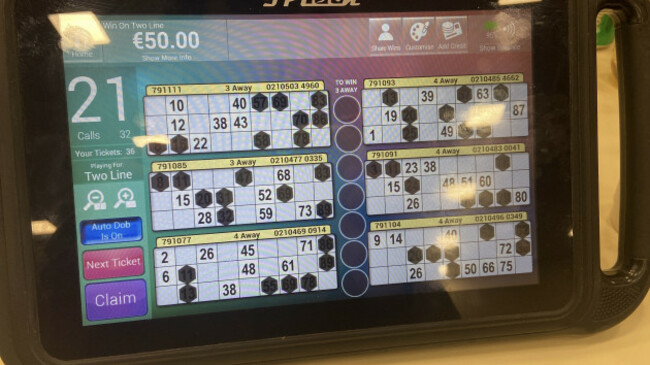
Despite my win, I realised quickly that the electronic way wasn’t much fun to play. With all the work done for you, there was nothing to do but watch the screen and wait.
But the bees are the main way to play and win at bingo at Jack Pott’s.
While you can get a typical paper book for as little as €5, the bees greatly increase your chances of winning. Whereas a typical book will only give you six panels per game, bees give you many multiples of that, as well as additional games to play. On a Friday night, prices range from €25 for a basic “Bronze” bee, right up to €70 for the “Maximum”, which significantly increases your chances of winning the games (but also costs a lot more).
Bingo runs six nights a week in Whitehall, with an afternoon session on Saturdays. One player told me she could spend close to €100 on a Friday night, which is a lot of money to be dropping every week.
Most of the seasoned players around me seemed to have a combination of electronic bees and traditional paper books so that they could occupy themselves and also maximise their chances of winning.
After about an hour, there was a break in the main game (though a side game of pongo was played) and I walked around the room to chat to a few of the regulars.
Lorraine Curley from Coolock said she had been coming to bingo for 18 years. She was full of praise for the staff and the management at Whitehall, saying they always look after the customers.
“I come every Friday. I come two of three nights a week, and more the following week if I win,” she told me.
And what is it that brings her back?
“D’you know what? It’s the socialising. Even when you first come you’re always welcome, you know? You never feel like a stranger or an outsider. It’s always a nice welcome.”
Claire and Bethany were sitting a few tables away from Lorraine. A young couple recently engaged, they were there to try to raise some money for their wedding.
“I used to come with my nanny,” Claire told me.
“Years ago now. But since she passed away I haven’t been. So this is my first time back.”
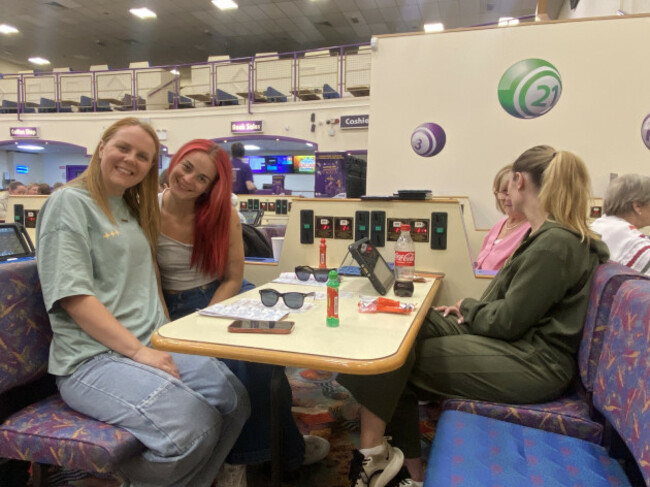
Despite being new to the game, the women were using blotters and paper books instead of the bees, and had no winners on the night.
Closer to the centre of the room, Catherine O’Connor and Kathleen Byrne said they have been coming to Whitehall together for years.
“We’re coming for entertainment. You couldn’t come here to win because you probably won’t,” Catherine said.
“It’s kind of a bit of community, they all know each other, they all keep the seats for each other and they all have their own special machine with the number on the side. They have their machine and it’s a community of people.”
We’re not too sad if we don’t win, but if we do win – happy days.
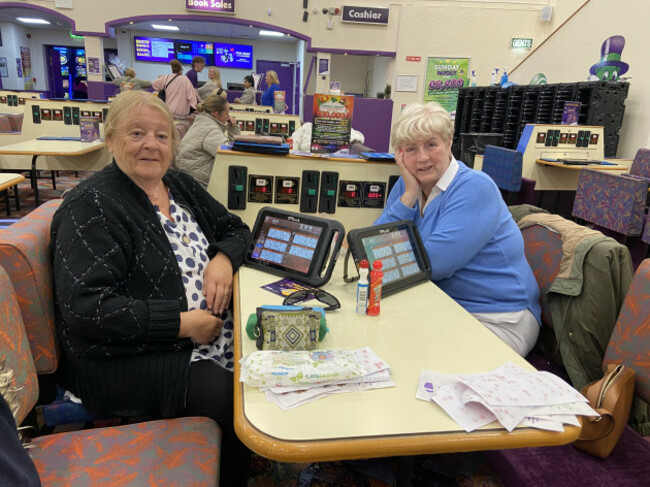
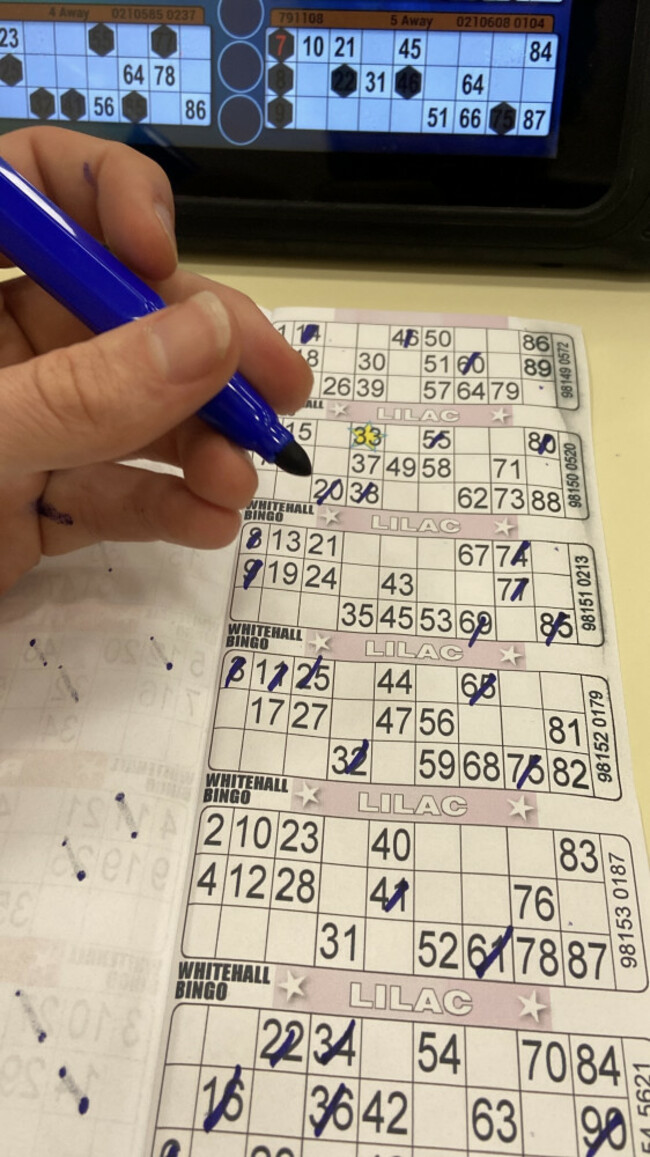
For the second half, I decided to buy a paper book and I had a lot more fun. The physical act of marking the numbers made the evening go by faster. At the break, my companions went out and bought chips in the nearby chipper which they shared with me, and the smell of salt and vinegar wafted through the hall.
This seems like the proper, old school way to play bingo: low stakes, blotter in hand, and full concentration.
But at Jack Pott’s it’s only one of many ways to gamble money, and it’s easy to see how people might drop a lot of cash every night. From the main games, to pongo, to the additional games, to the slot machines, the temptation to spend more is always there.
The women I spoke to all wanted to win money, for sure, but they were also there for something to do on a Friday night that was different from the pub or staying in. A chance to spend some time, catch up with friends and, who knows, maybe hit a big winner.
I think I’ll go back and play again with some friends. It’s a fun, different way to spend a Friday night. But if I come it will be to play the old fashioned way, for a bit of craic and to soak up the atmosphere. And if I win (again) – happy days!
The main games ended at about 10pm, and people started to file out. I said goodbye to my companions and the women I spoke to and headed back through the foyer and onto Collins Avenue.
People were already sitting alone in front of the big slot machines as I passed them by, sinking coins into the slots, their faces lit up by the blue neon glow of the huge digital screens.
Cormac will be back next Tuesday evening with another exploration of how Ireland spends its spare time (in ways that might surprise you).

To embed this post, copy the code below on your site















have your say