Sign in. It’s quick, free and it’s up to you.
An account is an optional way to support the work we do. Find out more.
Sign in. It’s quick, free and it’s up to you.
An account is an optional way to support the work we do. Find out more.
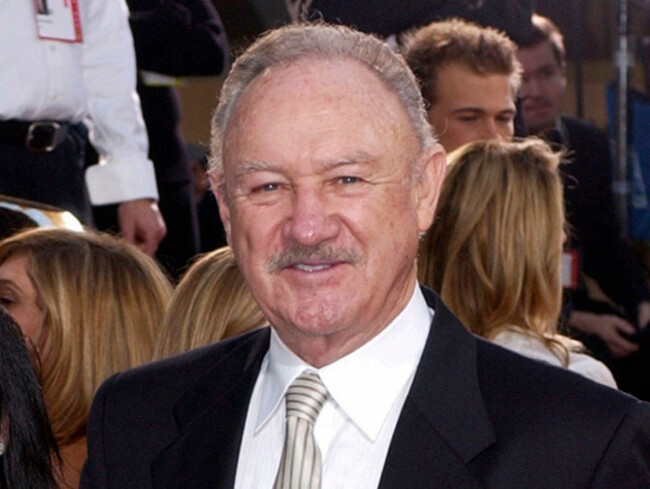
GENE HACKMAN, WHO has been found dead in his home in New Mexico at the age of 95, was once voted as likely to flop in showbiz but instead went on to enjoy a storied, Oscar-winning career as an everyman actor who mined personal pain to give intense, edgy performances.
Hackman is perhaps best known for his portrayal of the tough and vulgar New York cop Jimmy ‘Popeye’ Doyle in the 1971 crime thriller The French Connection.
Its five-and-a-half-minute car chase scene — in which Doyle crashes his way through bustling city streets, grunting, grimacing and honking as he pursues a bad guy who has commandeered an elevated train — is the stuff of Tinseltown legend.
Hackman won the best actor Oscar for that film, with the film taking five Oscars in total including Best Picture.
Hackman won another golden statuette two decades later for Best Supporting Actor for his portrayal of the brutal small-town sheriff ‘Little Bill’ Daggett in Clint Eastwood’s 1992 western Unforgiven.
The film itself won four Oscars including Best Film and Best Director for Eastwood.
He earned three more Oscar nominations during a five-decade career in which he appeared in more than 80 films.
“He’s incapable of bad work,” Alan Parker, who directed Hackman in the 1988 civil rights drama Mississippi Burning, told Film Comment magazine that year.
“Every director has a short list of actors he’d die to work with, and I’ll bet Gene’s on every one.”
Midwestern roots
Hackman was a native Midwesterner, born in 1930 during the Great Depression in Illinois.
His father left the family when he was 13, waving enigmatically as he drove away one day. Hackman said he knew right then that the man was never coming back.
Hackman’s mother died in a fire before he had established himself as an actor.
He also served an unpleasant stint in the US Marines, which he joined at 16 by lying about his age.
He used his personal turmoil as fuel to flesh out his characters.
“Dysfunctional families have sired a number of pretty good actors,” Hackman told The Guardian in 2002.
‘An actor, not a star’
Hackman was an unlikely star — he came to acting relatively late after dabbling in a series of jobs, and only attracted attention in his 30s.
In fact after his enrollment at the Pasadena Playhouse in California in the late 1950s, Hollywood legend tells that he and a fellow student, one Dustin Hoffman, were voted the “least likely to succeed.”
Later, they would pal around with Robert Duvall in New York when all three were struggling actors.
Not blessed with leading man good looks, Hackman instead drew on his talents and versatility, taking on gritty roles and delivering thoughtful, intelligent performances.
“I wanted to act, but I’d always been convinced that actors had to be handsome. That came from the days when Errol Flynn was my idol. I’d come out of a theater and be startled when I looked in a mirror because I didn’t look like Flynn. I felt like him,” Hackman once said.
After studying journalism at the University of Illinois, he first tried television production, before going to acting school in Pasadena.
Upon graduation, Hackman moved back to New York, where he worked off-Broadway and began to turn heads.
In 1964, he was cast on Broadway in the play Any Wednesday, which led to a small role in the film Lilith starring Warren Beatty.
A few years later, Beatty was casting for Bonnie and Clyde and chose Hackman as Clyde’s brother Buck Barrow.
That landmark 1967 film won Hackman his first Oscar nomination for best supporting actor, and put him firmly on track for stardom.
A second Academy Award nomination came for I Never Sang For My Father (1970), in which he played a professor who feels he has never won his father’s approval.
“I was trained to be an actor, not a star. I was trained to play roles, not to deal with fame and agents and lawyers and the press,” Hackman said.
In 1988 he starred in Mississippi Burning alongside Willem Dafoe.
Drawn from the real-life FBI investigation into the disappearance of three civil rights activists in the Deep South in 1964, Hackman plays a former sheriff who uses his southern wiles to smoke out the Ku Klux Klan members responsible for their murders.
Hackman notched up dozens of film credits in his career, working well into his 60s and 70s although he stayed out of the limelight, living with his second wife in Santa Fe, writing and painting.
Into the 21st century, he starred in The Heist and The Royal Tenenbaums in 2001.
In The Royal Tenenbaums he played the patriarch of an eccentric over-achieving New York family, who has to explain to his grown-up children why he and his wife (Anjelica Huston) are separating. It won him his third competitive Golden Globe.
He made his final film in 2004 before officially retiring from acting in 2008.
“It really costs me a lot emotionally to watch myself on screen,” Hackman once said.
“I think of myself, and feel like I’m quite young, and then I look at this old man with the baggy chins and the tired eyes and the receding hairline and all that.”

To embed this post, copy the code below on your site












have your say