Sign in. It’s quick, free and it’s up to you.
An account is an optional way to support the work we do. Find out more.
Sign in. It’s quick, free and it’s up to you.
An account is an optional way to support the work we do. Find out more.
LAST UPDATE | 11 Feb
(This article is produced by our Gaeltacht team. You can read an Irish version of this piece here)
SAINT BRIDGET WAS the cause of much celebration last week, not least for giving us a bank holiday, but this week allow us to introduce you to Gobnait, a woman who, according to folklore, lived over 1,000 years ago in a Gaeltacht community in west Cork.
Without taking anything away from the reputation of Ireland’s female patron and a woman who is, in recent times, being referred to as a ‘Celtic goddess’, it is worth listening to the story of ‘Gobnait múinte Baile Mhúirne’/Courteous Gobnait from Ballyvourney, a story that you wouldn’t be faulted for thinking was the bones of a screenplay for a Hollywood film, with Jessie Buckley, perhaps, a candidate to play the lead role.
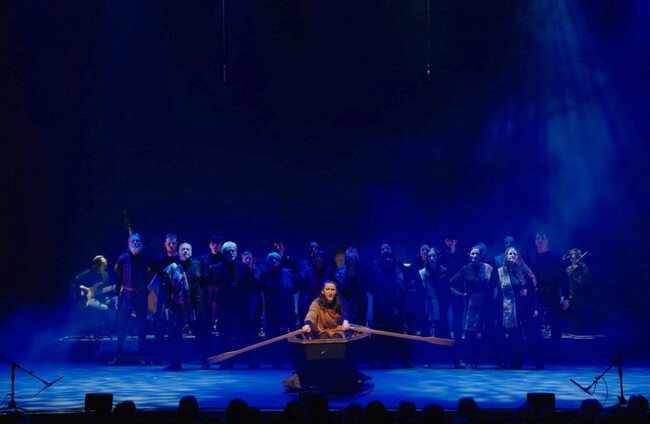
She has inspired a musical that has had crowds filling theatres, a ship in the Irish Naval Service is dedicated to her and she has inspired an annual festival that attracts women with ‘Gobnait’ in their name to come to Baile Mhúirne to celebrate her.
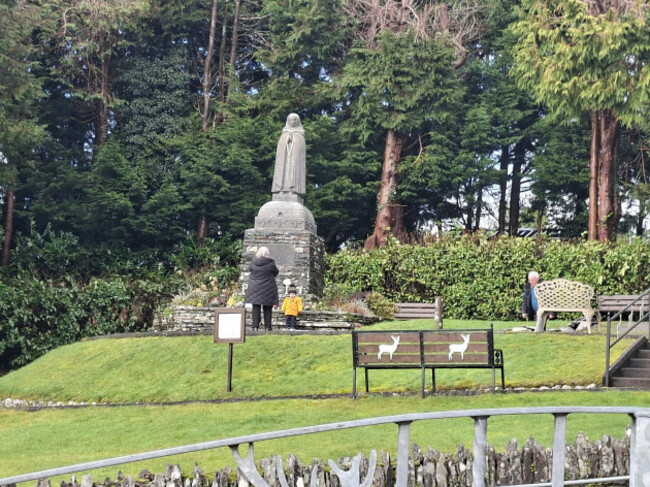
Every year on 11 February, this celebration is held in memory of Gobnait of whom it is said that she came from the west of Ireland, Inis Oírr, and that an angel inspired her in a vision to wander until she came to a place where there were nine white deer and that she should establish a monastery there.
Not only is Gobnait commemorated in Baile Mhúirne but, since folklore tells us that she stopped in Dún Chaoin, in north Cork and in Waterford on her way to Muskerry, she is also celebrated in those places. She is unique in that her reputation is venerated in Gaeltacht communities in the Aran Islands, Kerry, Cork and in Waterford.
More than 1,000 years after her death, stories of the influence of this miraculous woman still live on in folklore – and there is physical evidence to back up some of the stories associated with her in folklore.
In St Gobnait’s Cemetery/Shrine in Baile Mhúirne, there is an old ruined church and high on an inner wall, there is an engraved stone head. It is said that this is the head of the black, vicious thief who robbed the church but when Gobnait realised what had happened, she caused a fog to fall on the area and the thief spent the night wandering in the mist. When the next day dawned, he found himself where he had begun his escape, back just outside the church. He was hanged and we can still see a grim reminder of what happened to him, an effigy of his head high on the inner wall of the ruined church.
Gobnait was also famous for her beekeeping and it is said that she sent a swarm of bees to repel warriors from a neighboring tribe who threatened the community
She used a bowl, the type used in the sport of road bowling today, to knock down a building that a local lord was building. According to legend, she knocked down the building three times before the builder received the message that his efforts would not be successful.
This morning, the parish church in Baile Mhúirne was packed to the brim with locals and pilgrims who had come from all over the country to pay their respects to the holy woman.
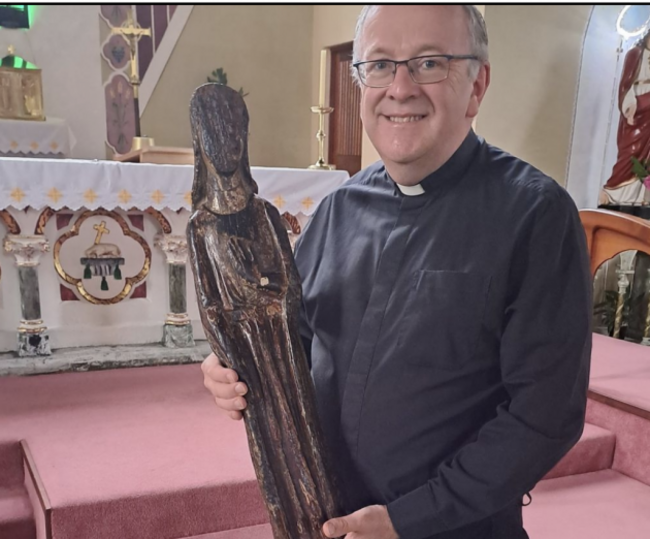
After Mass, the pilgrims went up to the altar where a wooden statue of the saint, from the 13th century, lay on a table and the tradition is that the statue is measured with a thin colored ribbon.
The pilgrim takes the ribbon with them and rubs it on whatever part of the body is bothering them. Hymns were sung to her that recalled her miraculous powers and the connection that people feel with her to this day.
God bless you, holy Gobnait, Mary bless you and I bless you, To you I have come to complain of my case, Asking for my healing for God’s sake.
Up at her shrine in Reilig Ghobnatan , people regularly do the ’round’. Tis is a walk around a number of sites associated with Gobnait, her grave, her kitchen, the statue made by Cork artist Séamus Murphy in the 1960s, the well from which she got her water and the old ruins of the church she built. You say prayers at each site and ask Gobnait to intercede on your behalf/.
Many sick people have found some relief because of prayers said on their behalf by a parent or other relative or friend at the shrine. They may not have been completely cured but they have received confidence or courage to help them on the way to recovery or acceptance. These traditions continue to this day.
If you look up Gobnait’s name on the official list of Saints at the Vatican, you are unlikely to find it there. But she is considered a saint, a hero, or a goddess by many here in Ireland, and particularly in the parish of Baile Mhuirne.
The Journal’s Gaeltacht initiative is supported by the Local Democracy Reporting Scheme

To embed this post, copy the code below on your site












have your say