Sign in. It’s quick, free and it’s up to you.
An account is an optional way to support the work we do. Find out more.
Sign in. It’s quick, free and it’s up to you.
An account is an optional way to support the work we do. Find out more.
LAST UPDATE | 21 Apr
GERMANY AND ITALY have rejected calls for the European Union to suspend its trade agreement with Israel at a meeting of EU foreign ministers in Luxembourg.
Foreign Affairs Minister Helen McEntee and her colleagues from Spain and Slovenia had asked that today’s meeting include a discussion of the EU-Israel Association Agreement.
The agreement, which came into force in 2000, provides the legal and institutional framework for political dialogue and economic cooperation between the EU and Israel.
Article 2 of the agreement states that it “shall be based on respect for human rights and democratic principles”, but there have been violations of this on behalf of Israel.
The most recent example of an Article 2 violation was last month, when Israeli MPs approved a bill that would allow the execution of Palestinians convicted on terror charges for deadly attacks in the West Bank.
Foreign Ministers of Ireland, Slovenia and Spain, have written to HRVP @kajakallas on the urgent situation in the Middle East.
— Irish Foreign Ministry (@dfatirl) April 18, 2026
Read full letter here: https://t.co/w7KYUVdVG1 pic.twitter.com/UlEXV7q5CJ
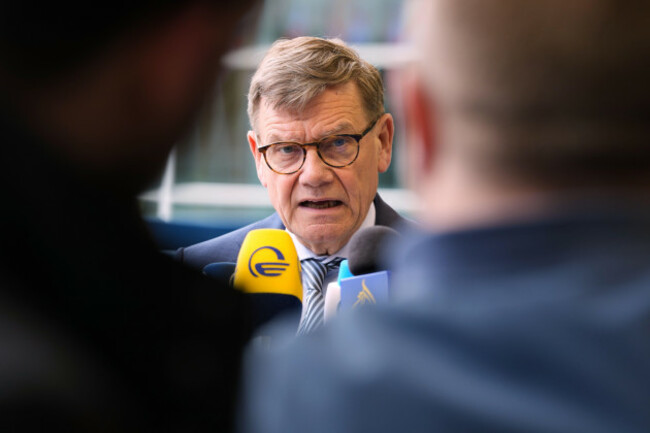
Speaking today, German foreign minister Johann Wadephul called the proposal to suspend the agreement “inappropriate”.
“We have to talk with Israel about the critical issues,” he said at the start of the meeting, adding: “That has to be done in a critical, constructive dialogue with Israel.”
Italian counterpart Antonio Tajani pushed back as well, saying that “no decision will be taken today”.
Suspending the entirety of the EU’s cooperation agreement requires unanimity among the bloc’s 27 countries and would almost certainly be blocked by allies of Israel.
More feasible could be suspending the part of the deal facilitating closer trade ties, a move that only requires support from a weighted majority of EU countries.
But that would require a shift in position from EU heavyweights Germany or Italy.
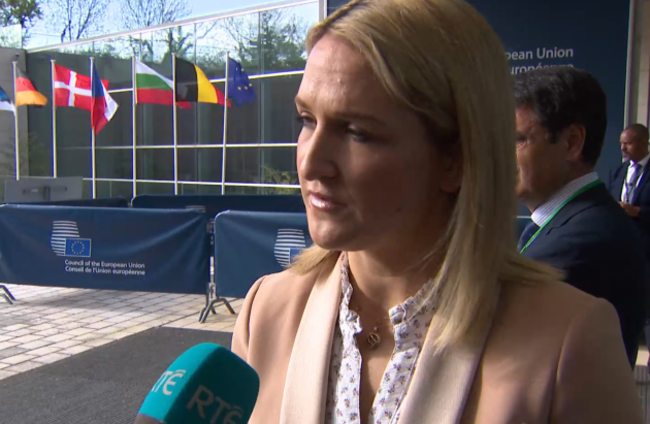
Speaking on her way into the meeting today, Helen McEntee said the EU needs to ensure that countries it has agreements with are “upholding fundamental values”.
She pointed to the recent introduction of the death penalty by Israeli MPs and said this is “completely unacceptable”.
McEntee said the EU “needs to move in unison” and has called on her EU colleagues to support a suspension of the agreement.
“At the very least, if we can’t reach that full agreement, that we would have suspension of the overall trade elements of it,” added McEntee.
She remarked that there is an “unprecedented and unacceptable escalation of violence in the West Bank”.
McEntee meanwhile said it’s “very clear” that there has been a “shift” in support for Israel within the EU.
“I think we’ve heard from EU leaders in recent weeks a very clear dissatisfaction and annoyance at the actions that Israel have taken,” she said.
She pointed to recent elections in Hungary which saw an end to the 16-year rule of Viktor Orban and the election of Péter Magyar.
“The communication from the incoming government has been very clear,” said McEntee. “They want to work with the EU.”
McEntee said that while a decision is unlikely to be taken today, she expressed hope that “we can make sure that at the next agenda, there are some clear actionable items”.
These actions could include the suspension of the trade agreement with Israel or banning goods in the West Bank.
France and Sweden re-upped an earlier call from some other EU countries for the bloc to consider halting the import of goods from Israeli settlements in the occupied West Bank, which are considered illegal under international law.
A separate proposal for sanctions on “extremist” Israeli settlers in the West Bank had been vetoed by Hungary for months.
The European Commission proposed suspending the trade agreement last September, and the UN yesterday said that the EU faces a “clear moral test” at the Foreign Ministers’ meeting today.
“The EU cannot credibly claim to uphold human rights while sustaining preferential trade with a State whose conduct has been found by multiple international bodies as amounting to genocide, crimes against humanity, and war crimes,” said the UN experts.
Meanwhile, the Lebanon prime minister Nawaf Salam is attending today’s meeting and McEntee remarked that “Irish people will be well aware of the importance that Ireland places on the need for a sustainable peace in Lebanon”.
“It’s really important that we as an EU express our solidarity and our support with the Lebanese government and for their right to their sovereignty and to protect their country and their civilians, many of whom have been unfairly targeted, killed in recent weeks and displaced in the millions.”
Elsewhere, a petition to suspend the EU trade agreement with Israel has hit over one million signatures.
Once a European citizens’ initiative, like the current petition, obtains at least one million valid signatures in at least seven EU countries, it can be submitted to the European Commission for examination.
The current petition, organised by Justice for Palestine, has over 1.4 million signatures.
It proposes suspending the Association Agreement on the basis Israel has violated human rights in Palestine.
With reporting from © AFP 2026

To embed this post, copy the code below on your site














have your say