Sign in. It’s quick, free and it’s up to you.
An account is an optional way to support the work we do. Find out more.
Sign in. It’s quick, free and it’s up to you.
An account is an optional way to support the work we do. Find out more.

THIS SUMMER WAS the warmest on record for Ireland, according to Met Éireann.
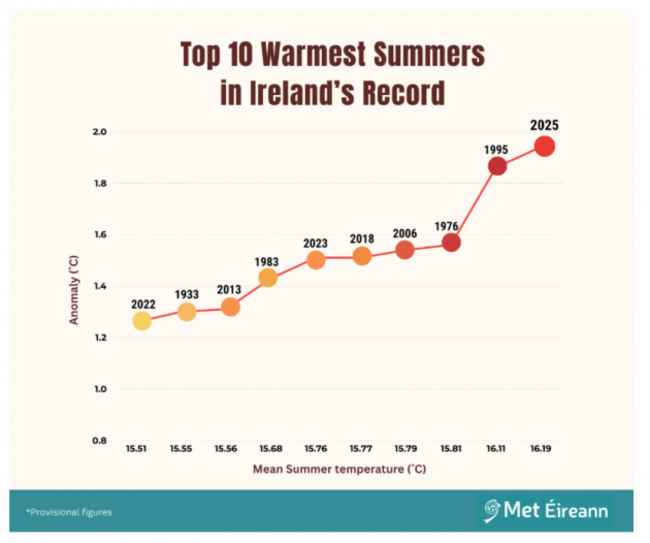
Provisional data from the national forecaster shows the average temperature for summer 2025 narrowly surpassed summer 1995, the previous hottest summer, by 0.08 degrees Celsius.
The three-month season averaged 16.19 degrees, 1.94 degrees above the long-term average.
“Provisional Met Éireann data shows that summer 2025 is the warmest on record since 1900, when this temperature dataset began,” said Met Éireann climatologist Paul Moore.
“It hasn’t been particularly sunny during summer, but the dry soils from a warm and sunny spring, the heat domes over mainland Europe, periods of high-pressure dominance and the high sea surface temperatures around Ireland, have kept temperatures over the last three months consistently above average, especially at nighttime,” Moore added.
“The added heat in the system and the continuous background warming due to climate change can transform an unexceptional season into a record-breaking one.
“Ireland is experiencing the effects of climate change, and our climate projections show that our climate is going to become warmer.”
2025 has already seen the warmest spring on record, and now summer 2025 is another example of the warming trend according to Met Éireann, making it the first year since 1933 with consecutive spring and summer records.
Six of the ten warmest Irish summers have occurred since 2000. Notably, 1995 and 2025 are the only summers to surpass an average temperature of 16 degrees.
Summer 2025 was warm overall, with occasional hot spells caused by heat domes over Europe.
Dry soils, elevated sea surface temperatures, and warm nights all helped keep temperatures high.
The persistent warmth we saw in June, July and August was driven by a combination of factors, with climate change being an underlying reason for these, Met Éireann said.
Dry soils allowed heat to build, heat domes brought short hot spells, marine heatwaves kept air masses warm, and warm nights pushed the overall average higher.
Ireland’s climate has warmed about 1.1 degrees since 1900, with minimum summer temperatures rising faster than maximums.
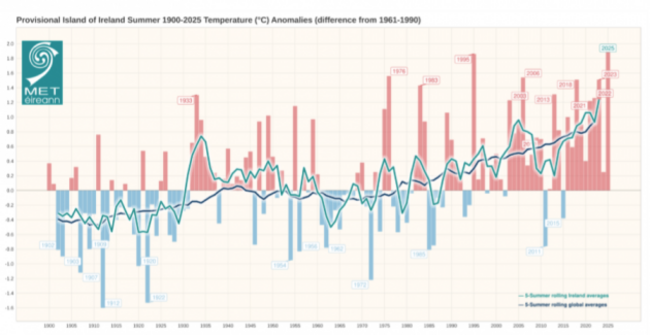
Future projections show that summer temperatures are expected to continue increasing under moderate and high emission scenarios.
Although 2025 has recorded the warmest spring and summer on record, it is too early to say if it will become Ireland’s warmest year overall, as autumn and winter temperatures could influence the annual average.
“Temperatures are still expected to be above average for much of world, including the Northern Hemisphere,” Moore added.
Unsure of what exactly is happening with the earth’s climate? Check out our FactCheck Knowledge Bank for essential reads and guides to finding good information online.

To embed this post, copy the code below on your site















have your say