Sign in. It’s quick, free and it’s up to you.
An account is an optional way to support the work we do. Find out more.
Sign in. It’s quick, free and it’s up to you.
An account is an optional way to support the work we do. Find out more.
LAST UPDATE | 19 May 2025
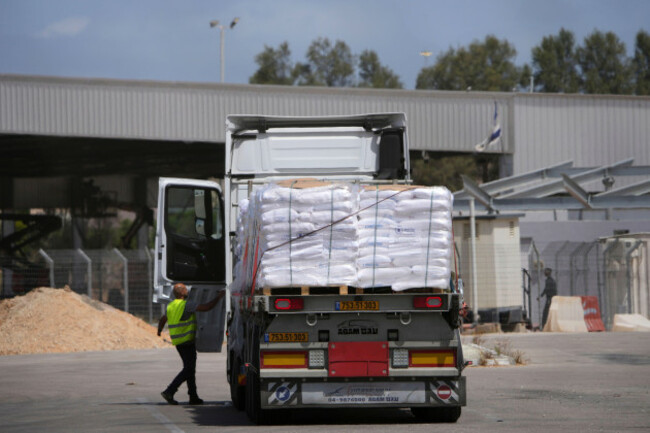
THE UNITED NATIONS has confirmed that nine aid trucks have been “cleared to enter” Gaza, the first humanitarian aid to be admitted since Prime Minister Benjamin Netanyahu’s government enforced a total blockade in the region over 11 weeks ago.
However, the UN said that ”none of the aid has been picked up” for distribution.
It comes as Netanyahu said the country will “take control” of the whole of Gaza, where rescuers reported more than 50 killed in Israeli strikes as the military pressed a newly intensified campaign.
Israel has enforced a total blockade on Gaza since 2 March, blocking food, fuel and water. It has faced mounting pressure, including from key backer the United States, to end the blockade.
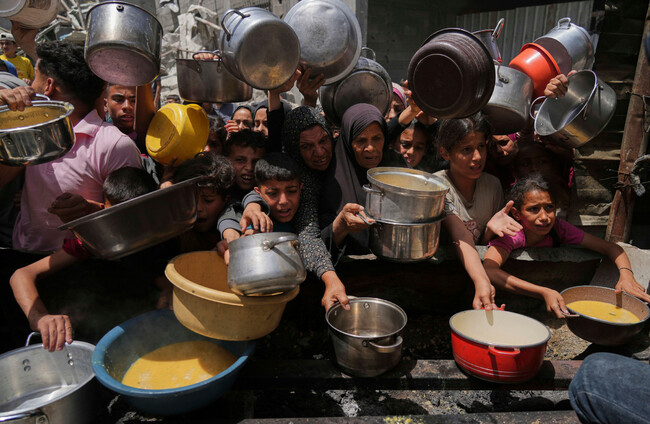
Last week, a UN-backed report warned that one in five people in Gaza now face starvation, while doctors in Gaza said they are witnessing and recording the highest levels ever of malnutrition there, with families resorting to boiling grass and eating animal feed.
The country has said its blockade was aimed at forcing concessions from Hamas.
Speaking to reporters today, Israel’s foreign ministry director general Eden Bar Tal said: “Today, Israel is facilitating the entry of trucks with baby food into Gaza,” adding that “in the coming days, Israel will facilitate the entry of dozens of aid trucks.”
In a statement this evening, UN humanitarian chief Tom Fletcher confirmed that nine trucks had been “cleared to enter” Gaza.
“But it is a drop in the ocean of what is urgently needed, and significantly more aid must be allowed into Gaza, starting tomorrow morning.”
UN spokesman Stephane Dujarric, who was unable to confirm the exact number of trucks inside Gaza, said that “none of the aid has been picked up” at a designated zone as it was “already dark” and due to “security concerns, we cannot operate in those conditions”.
Israeli authorities have temporarily allowed us to deliver limited aid to Gaza after 11 weeks of blockade.
— Tom Fletcher (@UNReliefChief) May 19, 2025
A drop in the ocean. It must reach the civilians who need it so urgently, and we must be allowed to scale up.
We are determined to save as many lives as we can. pic.twitter.com/Ai5m9cawqt
UN agencies have warned of critical shortages of food, clean water, fuel and medicines in the besieged territory.
World Health Organisation chief Tedros Adhanom Ghebreyesus said that two million people in Gaza “are starving” while “tonnes of food is blocked at the border, just minutes away”.
The risk of famine in Gaza is increasing with the deliberate withholding of humanitarian aid.
The UN humanitarian agency OCHA said it had been approached by Israeli authorities about the resumption of aid.
Netanyahu cited “practical and diplomatic reasons” for the resumption. He said that Israel “will not give up. But in order to succeed, we must act in a way that cannot be stopped”, justifying to his hardline supporters the decision to resume aid.
“We must not let the population (of Gaza) sink into famine, both for practical and diplomatic reasons,” he said, adding that even supporters of Israel would not tolerate “images of mass starvation”.
The leaders of Britain, France and Canada issued a harsh condemnation of Israel’s conduct of the war this evening, slamming its “egregious actions” in Gaza, particularly the expanded offensive and the “wholly inadequate” limited resumption of aid.
“If Israel does not cease the renewed military offensive and lift its restrictions on humanitarian aid, we will take further concrete actions in response,” the leaders said in a joint statement.
They did not say what action could be taken, but added: “We are committed to recognising a Palestinian state as a contribution to achieving a two-state solution and are prepared to work with others to this end.”
The statement coincided with a joint demand by 22 countries – including Ireland – for Israel to immediately “allow a full resumption of aid into Gaza”, noting that the territory’s population “faces starvation”.
In response, Netanyahu said that by asking Israel to end “a defensive war for our survival before Hamas terrorists on our border are destroyed and by demanding a Palestinian state, the leaders in London, Ottawa and Paris are offering a huge prize” to Hamas.
Last week US President Donald Trump acknowledged that “a lot of people are starving”, adding “we’re going to get that taken care of”.
Israel’s far-right National Security Minister Itamar Ben Gvir argued against any resumption of aid, saying on X that “our hostages receive no humanitarian aid”.
Finance Minister Bezalel Smotrich, also of the far right, defended the decision, stressing no supplies would be allowed to reach Hamas.
“This will allow civilians to eat and our friends in the world to keep giving us diplomatic protection,” he said.
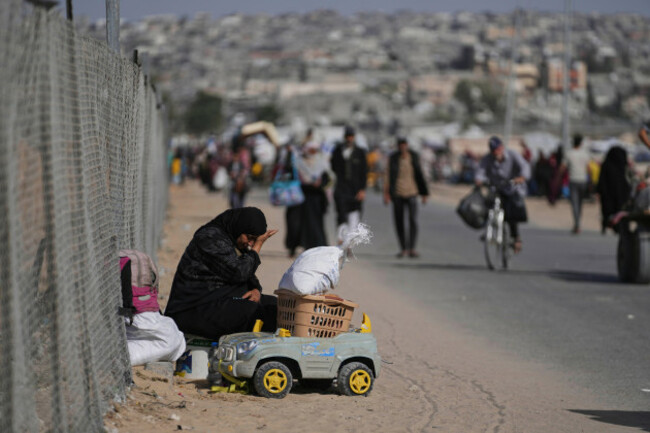
Meanwhile, in southern Gaza, the Israeli military issued an evacuation call to Palestinians in and around Khan Younis city ahead of what it described as an “unprecedented attack”.
The call came after the military announced it had begun “extensive ground operations” in an expanded offensive against Hamas militants.
Gaza’s civil defence agency said 52 people had been killed in Israeli attacks across the territory today.
In a video posted on Telegram, Netanyahu said that “the fighting is intense and we are making progress.”
“We will take control of all the territory of the strip,” the Israeli leader added.
The UN’s OHCHR rights office decried actions that are “in defiance of international law and tantamount to ethnic cleansing”, citing the latest attacks, displacement, the “methodical destruction of entire neighbourhoods” and denial of humanitarian aid.
Today, Israel’s military said it had struck “160 terror targets” in Gaza over the past day.
Military spokesman Lieutenant Colonel Nadav Shoshani said troops aim to “encircle” some areas, “get the civilian population out of the way, and then fight Hamas”.
Khan Younis resident Mohammed Sarhan told AFP that Gaza’s main southern city “felt like the apocalypse”.
“There was gunfire coming from every apartment, fire belts, F-16 warplanes and helicopters firing,” he said.
Israeli military spokesman Avichay Adraee earlier called on Gazans in the city and nearby areas to “evacuate immediately”.
“From this moment, Khan Younis will be considered a dangerous combat zone,” he said on social media.
AFPTV footage showed a helicopter over the city, while at Nasser Hospital, a young boy in a tracksuit was being treated as two other boys, both barefoot and bleeding, sat on the floor.
Further north in Deir el-Balah, Ayman Badwan mourned the loss of his brother in an attack.
“We are exhausted and drained – we can’t take it anymore,” he told AFP.
Hamas’s 7 October 2023 attack resulted in the deaths of 1,218 people on the Israeli side, mostly civilians, according to an AFP tally based on official figures.
Militants also took 251 hostages, 57 of whom remain in Gaza, including 34 the military says are dead.
Today, Gaza’s health ministry said at least 3,340 people have been killed since Israel resumed strikes on 18 March, taking the war’s overall toll to 53,486.
With reporting from © AFP 2025
Need more information on what is happening in Israel and Palestine? Check out our FactCheck Knowledge Bank for essential reads and guides to navigating the news online.

To embed this post, copy the code below on your site












have your say