Sign in. It’s quick, free and it’s up to you.
An account is an optional way to support the work we do. Find out more.
Sign in. It’s quick, free and it’s up to you.
An account is an optional way to support the work we do. Find out more.
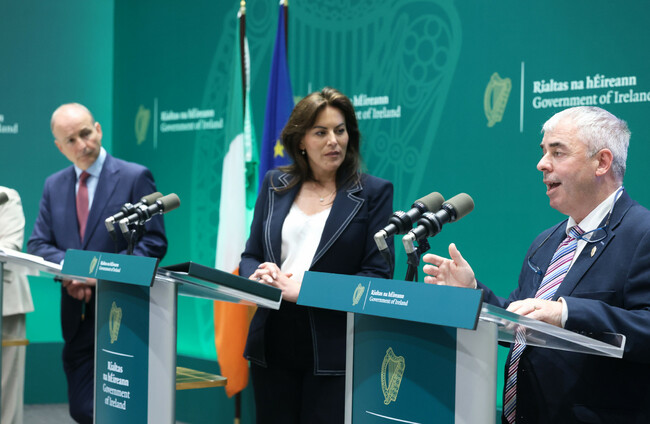
MINISTER OF STATE Kevin “Boxer” Moran opened up about his own mental health struggles, including a suicide attempt, at the launch of the government’s new strategy to reduce suicide and self-harm.
He told reporters a “number of things caught up with” him several years ago, and said: “I did try to commit suicide.”
He added: “I bottled it within myself for years and years, and the only people that knew were my wife, my parents, my mother-in-law, my father and my best friend.
“I carried that right through my career as I entered national politics.”
Moran had previously disclosed his suicide attempt in a difficult period in his life following his brother’s death and financial pressures, as well as being associated with his anxieties around difficulties in reading and writing.
He said the most daunting part of revealing the information in a 2017 Late Late Show host interview was telling his two teenage sons beforehand.
“I had to tell them that their father nearly committed (suicide) and I had to explain to them on the way to Dublin what had happened, and what I had learned going forward.”
Moran also told him then-minister Paschal Donohoe had rung him before the interview and told him: “Be yourself, say it as it is.”
The minister of state said he had used the experience to reach out and help others.
The new government strategy launched today seeks to prioritise “compassionate, person-centred care”, which will include strengthened crisis supports in hospitals and communities and expanded community-based services.
Improved access to supports for those experiencing self-harm will also be prioritised.
It also promotes open conversation and stigma reduction to encourage help-seeking.
The new report also sets out that the government should consider changing the legal burden of proof of suicide to a “balance of probabilities”.
The current standard of proof to return a verdict of suicide by a coroner is “beyond a reasonable doubt”, which campaigners have said means it is being underreported.
An analysis of coroners’ reporters under a burden of balance of probabilities suggests the recorded suicide rate could be up to 30% higher under such a threshold, a senior source in the Department of Health said.
In official figures from the Central Statistics Office, the standardised rate of suicide in Ireland has declined from 12.9 per 100,000 in 2000 to 8.6 in 2022.
The aim of the new strategy is to reduce that rate to seven by 2035.
Due to an increasing population, the overall number of people dying by suicide has consistently remained at about 500 per year, as recorded under the current standard of proof.
Making changes around the burden of proof would require legislative changes.
Mary Butler, Minister of State for Mental Health, said she had been working on achieving “more accurate” reporting.
In Ireland and internationally, men are significantly more likely to die by suicide than women.
However, women have consistently higher rates of self-harm and non-fatal suicide attempts.
The decision whether someone has died by suicide is a legal determination made by coroners.
Consultation before the publication of the strategy identified the need for “significant” reform in the Coroner Service, with reports that the coroner’s court process itself was often described as “distressing”.
Taoiseach Micheal Martin said: “Every death by suicide is a tragedy that leaves a deep and lasting impact on families, communities and our society as a whole. While we have made important progress, even one death is one too many.
“This new strategy represents our collective commitment to build on that progress and to address the root causes of suicide and self-harm.
“It will require a whole-of-government and whole-of-society response, and I am confident that, working together, we can create a future where more people feel supported, valued and hopeful.”
Asked if he would accept there was a link between young people’s use of social media and suicide, Martin said more detailed peer-reviewed research would be needed to make a determination but added it was his personal view that social media represents “one of the major public health challenges of our time”.
He told reporters at the strategy launch that there was now “unthinkable access” to harmful material, such as sexual-based violence online, as he criticised “algorithm frameworks” that keep people “hooked and addicted to social media”.
On the Taoiseach’s Instagram account, Martin thanked Moran for sharing his “deeply moving” personal experience, stating “it shows why we are so determined to get this strategy right”.
If you have been affected by any of the issues mentioned in this article, you can reach out for support through the following helplines. These organisations also put people in touch with long-term supports:

To embed this post, copy the code below on your site













have your say