Sign in. It’s quick, free and it’s up to you.
An account is an optional way to support the work we do. Find out more.
Sign in. It’s quick, free and it’s up to you.
An account is an optional way to support the work we do. Find out more.
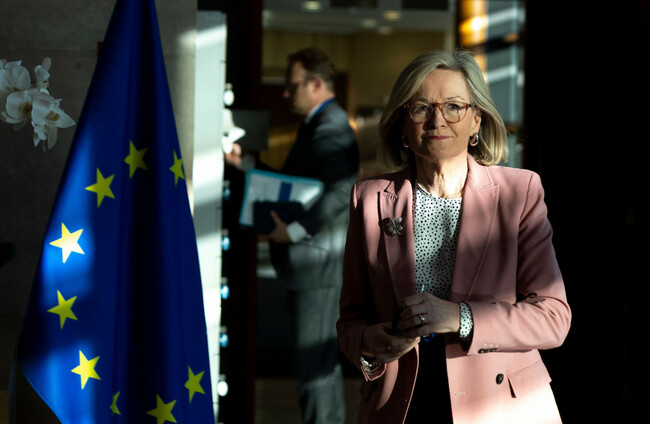

A PRESIDENTIAL RACE always brings up political choices from candidates’ pasts, and Fine Gael’s Mairead McGuinness, who announced her candidacy this week, is no exception.
McGuinness’ 2019 vote against an EU Parliament resolution to resume search and rescue efforts for shipwrecked refugees trying to cross the Mediterranean Sea is one of the choices that’s likely to come up during the campaign.
It was a non-binding motion, with no costs or legislation attached to it, but its proponents had hoped it would put pressure on the European Commission and member states to do more to save people trying to cross the Mediterranean.
Its rejection was met with outrage among the public, civil society organisations and those MEPs who had voted for it.
In October 2019, MEPs narrowly voted down the proposal to provide vessels for more search and rescue operations in the Mediterranean.
At the time, Europe had been grappling with a political crisis over how to handle large numbers of people fleeing the Middle East and the African continent.
There were 1,885 people reported dead or missing in the Mediterranean in 2019, according to the Missing Migrants Project run by the UN’s International Organisation for Migration.
The EU had until then carried out a number of different operations that aimed to prevent people seeking refuge in Europe from drowning, including operations Sophia and Triton.
But a new conservative government in Italy and mounting anti-immigrant sentiment in Europe meant the issue became one of political, rather than purely humanitarian, concern. Italy and Greece had been receiving the majority of refugees, which led to friction among the member states over how those people would be housed and where.
That was the political context in which Fine Gael’s four MEPs, including McGuinness, voted against the resolution alongside their European People’s Party (EPP) colleagues in the parliament.
The vote came after an EU-wide search, rescue and anti-human-trafficking operation had come to an end.
It also took place on the same day that 39 Vietnamese people were found dead in the back of a lorry in Essex, southeast England – something that MEPs later suggested emotionally charged the debate on Europe’s search and rescue missions.
The failed resolution had called on EU member states to “enhance proactive search and rescue operations by providing sufficient vessels and equipment specifically dedicated to search and rescue operations and personnel, along the routes where they can make an effective contribution to the preservation of lives”.
It also called for member states “to step up their efforts in support of search and rescue operations in the Mediterranean”.
McGuinness and her fellow Fine Gael MEPs – Maria Walsh, Sean Kelly and Frances Fitzgerald – faced heavy criticism from opposition politicians after the resolution fell just two votes short of being passed.
Fellow Irish MEPs – Green Party members Ciaran Cuffe and Grace O Sullivan, Sinn Féin’s Martina Anderson and Matt Carthy, and Independents Luke ‘Ming’ Flanagan and Mick Wallace – all voted in favour of the resolution.
No votes were recorded for Independent Clare Daly, DUP MEP Dianne Dodds, the Alliance Party’s Naomi Long, or Fianna Fáil’s Billy Kelleher.
The vote marked a shift in EU policy towards asylum seekers.
The bloc has since moved away from search and rescue operations and has increasingly treated irregular immigration as a security issue, striking controversial deals with third countries to prevent people from making the crossing from the Middle East and North Africa.
The move to halt search and rescue options was widely condemned by NGOs, as well as opposition politicians.
“Rescuing people from drowning is just that: rescuing people from drowning. There is no nuance to it or for and against,” the Irish Refugee Council said following the vote.
At the time, Sinn Féin’s Marina Anderson said it was “a matter of deep shame that four Fine Gael MEPs actively voted to maintain a ‘fortress Europe’ status quo that has seen thousands of men, women and children drown simply for seeking sanctuary.
“While Fine Gael wax lyrical about the ‘four freedoms’ of the EU, including the freedom of movement, they are ready to side with their right-wing EU colleagues to ensure these values don’t extend to those fleeing destitution, war and persecution.”
Labour MEP Aodhán Ó Ríordáin, who was a senator at the time, said:
“Reports that far right and ultra conservative politicians in Europe were applauding the result in the European parliament just says it all.
“During the European Elections the Taoiseach called on voters to ‘send our best team’ to the European Parliament. This is what they have decided to do.”
He also said that it was “particularly dispiriting when candidates from centre right parties pretend to have progressive politics at election time, but revert to type when lives are at stake”.
Speaking to RTÉ News at the time, McGuinness defended her vote and said the provision would have required Frontex, the EU border agency, “to share information with all ships in the region, including traffickers”.
McGuinness said that would not have been acceptable and that if the resolution had passed, it would have “made the situation worse”.
“We had concerns about the actual content of it, not about the objective,” she said.
“A lot of people are just reading what is on social media without looking at the facts of the situation. I will not allow anyone challenge my ethics or morality around saving lives. It is for political gain,” she said.
In an interview on RTÉ’s Morning Ireland at the time, Maria Walsh also pointed to the Frontex part of the resolution and said sharing information about “our most vulnerable when they are most at risk is not the way to do it”.
The Journal’s FactCheck is a signatory to the International Fact-Checking Network’s Code of Principles. You can read it here. For information on how FactCheck works, what the verdicts mean, and how you can take part, check out our Reader’s Guide here. You can read about the team of editors and reporters who work on the factchecks here.

To embed this post, copy the code below on your site











have your say