Sign in. It’s quick, free and it’s up to you.
An account is an optional way to support the work we do. Find out more.
Sign in. It’s quick, free and it’s up to you.
An account is an optional way to support the work we do. Find out more.
LAST UPDATE | 14 Jul 2025
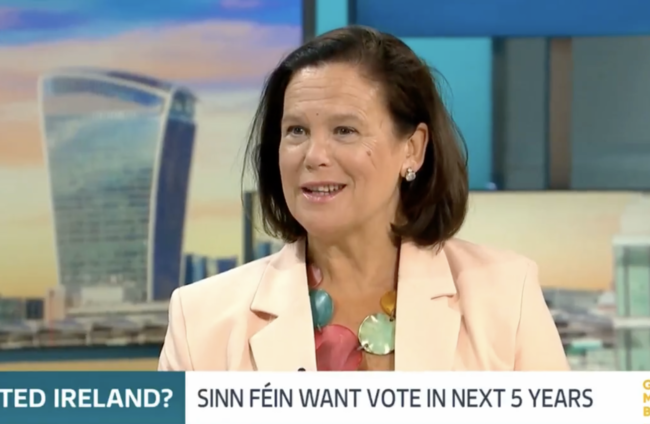
SINN FÉIN LEADER Mary Lou McDonald appeared on ITV’s Good Morning Britain this morning to call for a border poll and stress her party’s commitment to Irish reunification.
McDonald made her case for the reunification of the island of Ireland and fielded questions regarding Northern Ireland’s economic state on the programme.
“We are now 27 years on from since the Good Friday Agreement, as we all know, a historic moment where we settle on the institutional arrangements to end what was a conflict that ran for centuries,” she said.
“And at the heart of that agreement is a commitment to referendums to make the decision on partition. Just remember, more than a century ago Ireland was partitioned down the barrel of a British gun. There was no democracy involved, it was imposed on the island.”
She said that partition has been “deeply damaging” for Ireland and has damaged the relationship between Britain and Ireland.
Given Ireland’s economic position, McDonald said, “Irish unity makes sense.”
When it was put to her that Northern Ireland is economically effectively “running at a loss”, McDonald said that the six-county region is not economically viable as it is “cut off from its natural political, social, and economic engine”.
She said that “it makes no sense to partition” the country given its small size.
Sinn Féin have long stressed that they want a border poll to happen within the decade.
A report released earlier this month stated that a united Ireland would cost €3bn in the first year, but any financial burdens would disappear within a decade.
The report, the first peer-reviewed study on the cost of a united Ireland, says an initial investment of €1bn in public expenditure would reduce the cost of a 32-county Ireland gradually.
Author professor John Doyle critiques other projections that say the level of subsidies from the UK government to Northern Ireland, quoted as up to £14bn per year, makes unity not economically feasible.
Doyle says the figure “grossly exaggerates the probable real cost of unity”.
The initial public spending deficit, inherited by the south from the north, would be roughly €1.75bn, he estimates. A gradual implementation of a 48% increase in public pay, over 15 years, would bring wages in line with the Republic’s.
It would cost €152m per year, for 15 years.
People across the political spectrum have begun to warm to the idea of Irish unity in recent years. Former Taoiseach and leader of Fine Gael Leo Varadkar said that he would sacrifice two years of economic growth for a united Ireland.

To embed this post, copy the code below on your site












have your say